
Imagine you just installed a brand new pool.
Waterfall feature.
A slide for your kid.
The crew finished last Tuesday, and your backyard finally looks like the one you promised your wife when you bought the house…
One day, the doorbell rings.
A guy in a blue polo is standing there, and he launches into his pitch…
Financing options.
Free consultation.
Summer’s coming… “Would you like a new pool?” — No matter what this guy does, no matter how smooth the pitch, no matter what discount he pulls out.. you are not buying a pool.
You HAVE the pool.
The conversation was dead before the doorbell rang.
Now imagine paying someone $5,000 a month to have that exact conversation, 200 times a day, on your behalf.
That’s what most outsourced SDR arrangements actually are.
TLDR
- Most outsourced SDR arrangements fail due to misaligned incentives and lack of proper infrastructure.
- Only 7% of businesses report success with outsourced SDRs, indicating systemic issues with the model.
- Outsourced SDRs often lack specific knowledge about your market, making it challenging to generate quality leads.
- Hiring a dedicated sales rep offers better alignment with your sales goals and more effective prospecting.
- To succeed, companies need to build the outbound machine first before considering outsourcing.
Table of contents
- Nobody Can Tell You What You’re Actually Buying
- The 7% Number
- Why the Math Falls Apart
- Nobody Buys Snowmobiles in Phoenix
- The 8 Things Outbound Actually Requires
- The Ugly Truth
- The Outsourced SDR Model That Actually Works
- How To Interview An SDR (Or Other Sales Roles)
- What It Costs
- What Happens on the First Call
- FAQ
- Hire an SDR Who’s Actually Yours
Nobody Can Tell You What You’re Actually Buying
I’ve placed over 1,100 people across 35 countries.
Sales reps, Appointment Setters, SDRs, Closers — I’ve seen every version of this hire.
And I’ll admit something: when someone says “outsourced SDR agency,” even I don’t know exactly what they’re selling.
- Are they writing your script?
- Or are you handing them one?
- Are they bringing the lead list?
- Or dialing whatever you give them?
- Are they building your email sequences?
- Managing your domains?
- Working in your CRM — or dragging you into theirs?
Ask 5 agencies and you’ll get 5 different answers.
Because “outsourced SDR” is an attempt to productive an offer, but what it includes varies wildly from company to company. At the end of the day though…what do you want?
Revenue.
Hence, “outsourced SDR” ends up a label slapped on everything from a fractional sales team with a CSO to a boiler room who places an SDR who is working for 3 other clients.
Here’s the thing: If the guy (me) who does this for a living can’t tell you what the product is, the founder about to wire them $8,000 a month definitely can’t.
And that confusion isn’t a side issue…
It’s the whole problem.
The 7% Number
Jason Lemkin at SaaStr surveyed his audience about outsourced SDRs.
Roughly 1,200 responses… Only 7% said it really worked.
7 percent.
That’s not a “results may vary” number…
That’s a “the model itself is broken” number.
Meanwhile, any outsourced SDR agency you stumble on is going to tell you a different story.
“Yes, yes, yes. You need an outsourced SDR. Here’s the contract. How many seats? Annual subscription? What else can we upsell you?”
I’m not selling that model.
So I can tell you why it fails.
Why the Math Falls Apart
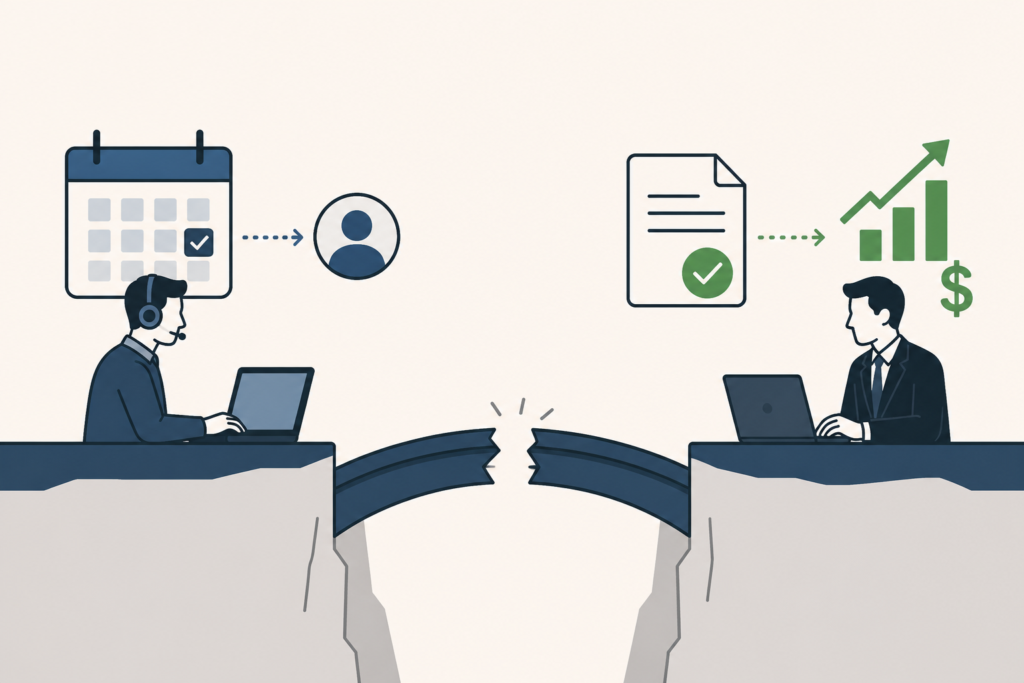
Most outsourced SDR agencies get paid 1 of 2 ways — per meeting booked, or a monthly retainer justified by meetings booked.
Notice what’s missing from both…
Revenue.
The agency gets paid when someone agrees to a calendar invite.
You get paid when someone signs a contract.
Those are not the same event…they’re not even close to the same event.
And ask yourself this: How many SDR agencies are willing to get paid off revenue instead of booked calls?
Almost none.
Because they know exactly how that bet would go.
Look — I get the tension.
I’m hesitant even with my own Appointment Setters when bonuses are tied purely to booked calls instead of revenue.
— You want them booking lots of calls.
— You also want them booking QUALITY calls.
Those 2 things pull against each other, and getting the balance right is hard even when the person works for you directly.
Now hand that same incentive problem to an outside agency whose entire revenue depends on the meeting count.
The agency optimizes for what they’re paid for…anything with a pulse that agrees to a meeting counts.
The bar to book is “didn’t hang up.”
Then the meetings hit your calendar…half don’t show.
Of the ones that do, half were never qualified.
Your Closer or Account Executive burns a month taking calls with people who thought they were talking to a different company.
By week 6, your sales team resents the pipeline you’re paying thousands a month to fill.
You wanted closed deals.
They wanted booked meetings.
You both got what they wanted.
Nobody Buys Snowmobiles in Phoenix
There’s a second failure underneath the incentive problem, and it’s worse.
Even if the agency wanted to book quality meetings — most of them can’t.
Because they don’t know who to call.
You could be the best snowmobile salesman in America — killer pitch, decades of experience, closes everyone he talks to.
Put him in Phoenix, Arizona and he sells zero snowmobiles.
Not because he got worse…because nobody there has snow!
You’re not one objection-handle away from a deal.
You’re in the wrong city.
Every business has its own Phoenix, and it’s more specific than any agency will ever learn.
Take my business.
Before my team makes a single dial, we need to know:
1. Is this company actively hiring? — Because pitching remote staffing to a company that just made its hire is the pool guy staring at the tractor.
2. Are they hiring remote already, or are they open to doing so? — We place remote talent. If someone needs a butt in a seat in St. Louis, we can’t help them — and no amount of follow-up changes that.
3. Is it a role we can actually fill? Or is it some funky hybrid “growth marketing guru manager” title that doesn’t map to a real hire?
That’s my filter… 3 questions, and they took years of placements to sharpen.
Now here’s the question that matters:
What’s YOUR version of that filter?
You have one.
Every business does.
Maybe it’s companies that just ripped out a competitor’s tool…
Maybe it’s a headcount trigger, a funding announcement, a specific tech stack, a regulatory deadline.
That filter is 80% of whether outbound works.
And the rep at the agency — the one splitting attention across four accounts, who learned your ICP from a one-page onboarding doc three weeks ago? — they will never know it.
They’ll know “VP of Sales at a SaaS company.”
They will not know which VPs just lost their best AE, which ones just got budget, and which ones just bought a snowmobile.
The 8 Things Outbound Actually Requires
This is the section I wish someone had shown me years ago.
And fair warning — you might wonder how a staffing guy knows this much about dialers and domains and sequence design.
The answer is pain.
I didn’t learn this from a course…
I built outbound for my own company, got most of it wrong the first time, and paid for every lesson on this list in real money and wasted months.
Nobody hands you this.
You earn it or you hire someone who already did.
Here’s the thing: Outbound isn’t a person.
It’s a machine with 8 parts.
A rep — any rep, yours or an agency’s — is the operator of that machine.
Not the machine.
Go through this list and ask 2 questions at every step.
- Does this exist in my business today?
- And is the agency going to build it?
1. The List
- Where are the leads coming from?
- Has the data been vetted?
- Are you getting direct mobile numbers or dialing front desks?
- Have you tested the bounce rate before burning a domain on it?
- Will the agency build this?
Some will sell you access to their database…most are dialing whatever you hand them.
Very few are building a targeted, verified, trigger-based list around YOUR Phoenix filter — because they don’t know your filter exists.
2. The Script and the 15-Second Pitch
Not a novel…
15 seconds.
What’s the pain, what’s the promise, why should this stranger not hang up?
Will the agency write this?
Maybe…
This is the one thing some of them will actually take a swing at. But they’re writing it from that same one-page onboarding doc.
The pitch that works gets sharpened by hundreds of real conversations with your actual market — and the person doing that sharpening needs to care whether it converts, not whether it books.
3. Multi-Touch Sequences
Real outbound in 2026 isn’t a phone…
It’s phone plus email plus LinkedIn, sequenced.
Touch 3 is a call referencing the email from touch one.
Touch 5 is a LinkedIn message that doesn’t read like a bot wrote it.
Will the agency build this?
Almost never.
And ask the awkward follow-up: Whose LinkedIn accounts would those messages even come from?
The rep is likely working 3 or 4 other companies at the same time — they can’t run YOUR outreach from THEIR personal profile.
So you get a burner account created last month with 40 connections.
That’s not outreach…that’s spam with your company’s name on it.
4. The Email Infrastructure
You cannot blast cold email from your main domain. That’s how you end up in spam folders for your CUSTOMERS, not just your prospects.
You need secondary domains, warmed up properly, with sending limits, connected to your systems.
Will the agency build this?
No.
This is tech work, and they don’t do tech work.
If they’re sending from your subdomains without this setup, they’re not generating pipeline — they’re torching your domain reputation while you pay them for the privilege.
5. The CRM and Dialer
The dialer should live inside the CRM.
- Calls logged automatically.
- Transcripts captured.
- Sequences triggered without manual typing — there is no reason a human should be hand-typing the same follow-up email 40 times a day.
Will the agency set this up?
No.
Worse, many want you working out of THEIR CRM.
Which means the day you part ways, your data, your call history, and every lesson learned walks out the door with them.
6. The KPIs and the Scorecard
- How many dials a day?
- How many emails?
- What counts as a conversation?
- Where is it tracked, and who reviews it weekly?
A rep without a scorecard isn’t underperforming — they’re unmeasured, which is worse.
Will the agency provide this?
They’ll send you a report.
A report of the metrics THEY chose, measuring the things THEY get paid on.
Meetings booked will be on it.
Show rate might not be.
7. The Conversion Math and Sales Cycle
Even with a small sample size, you need a working expectation.
Dials to conversations — conversations to meetings — meetings to closed deals
And how long the whole cycle runs — because if your sales cycle is 90 days, judging outbound at day 30 is like complaining your article doesn’t rank #1 on Google two days after you published it.
Will the agency know yours?
They can’t.
It’s your product, your price point, your market.
They can quote you industry benchmarks…
Benchmarks are what people cite when they don’t have your data.
8. The Comp Structure
The rep’s pay has to point at the same target you’re aiming at.
Pay per meeting, and you get meetings.
Pay pure salary, and you get comfort.
The structure IS the strategy.
Will the agency align comp with your revenue?
This is the one they structurally cannot do.
Their entire business model is the misalignment…
Asking an agency to fix the incentive problem is asking the casino to help you beat the house.
Now step back and look at the list.
The agency reliably covers part of one item. Maybe two on a good day.
The other 6?
Either they already exist in your business…or nobody is doing them.
And here’s the kicker: If all 8 already exist in your business — if the list is built, the sequences run, the CRM hums, the scorecard is live — then what exactly are you paying an agency $6,000 to $10,000 a month for?
At that point you hire your own dedicated rep, keep the knowledge in-house, and pocket the difference.
The machine is the hard part.
And the agency was never going to build the machine.
The Ugly Truth
Here’s what most founders searching for this actually want: they want out of sales… Not out of the dialing.
Out of sales.
The whole thing.
They want to sign a contract, forward a login, and have revenue appear while they get back to product.
I understand the wish… I run a company too.
But I’ll tell you this: You can get out of the dialing.
You cannot get out of the owning.
- Somebody has to decide who gets called.
- Somebody has to notice the script stopped landing in week three and rewrite it.
- Somebody has to look at the scorecard Friday afternoon and ask why conversations are up but meetings are down.
- Somebody has to hold the rep accountable — and know enough to tell the difference between a rep problem and a list problem.
If you have a Head of Sales, that’s their job.
If you don’t — and most companies typing this search don’t — that somebody is you.
The agency pitch is seductive precisely because it promises to delete that list of hard work from your life.
It can’t.
Nobody can.
The founders in that 7% who made outsourcing work?
Every one of them stayed the owner…they wrote the scripts, reviewed the calls, ran the rep like a member of their own team.
Which raises an obvious question.
If the only version of outsourcing that works is the version where the rep functions like your own dedicated hire… why not just make them your own dedicated hire?
The Outsourced SDR Model That Actually Works
This is what we do at HireUA, so factor that in.
But the logic stands on its own.
Instead of renting a slice of a pooled rep, you hire one full-time person.
Yours.
They work your accounts, and nobody else’s.
They learn your Phoenix filter, your objections, your sales cycle — and that knowledge compounds instead of walking out the door when the agency reshuffles accounts.
We recruit from Latin America, Eastern Europe, and the Philippines for this role — and we like presenting candidates from a variety of regions so you can pick the best PERSON, not the best flag.
That said, for phone-based sales into the US market, Latin America is especially strong right now.
- Timezone overlap with US hours
- Smooth, Americanized English
- The cultural fluency to banter with a prospect from Dallas without missing a beat
- The vetting is where most of the difference lives
- Every sales candidate we put in front of a client goes through a mock call
But not the way most companies run them…
How To Interview An SDR (Or Other Sales Roles)
- We don’t warn them
- We don’t hand them a script
- We don’t ask them to sell OUR service — that would just test how well they memorized our website
We ask them one question: “What’s your favorite thing you’ve ever sold?”
Then we say, “Sell it to me. Right now.”
No prep.
No script.
Just them, a product they know, and a live prospect asking real questions.
A natural seller lights up.
- They ask what I care about
- They adapt on the fly
- They handle the curveball and ask for the close
A script-reader freezes.
That’s the difference between a salesperson and a call center worker, and no resume tells you which one you’re looking at.
The mock call does.
Every time.
What It Costs
An SDR or outbound sales rep through us typically runs $1,000 to $2,000 a month all-in, plus performance bonuses.
And I’ll be straight with you about that range, because normally I hate ranges like that.
When a client tells me their budget for a role is “$1,000 to $3,500,” I push back.
A 3x spread usually means they haven’t defined the role — but sales is the one function where a wide spread is real.
Experience varies wildly.
Prior comp varies wildly.
A rep who’s closed $2M in a similar market costs more than a hungry rookie with great instincts — and depending on your machine, either one might be the right call.
The part that matters more than the base number: The comp structure.
We generally build sales comp around a 70/30 split of base to commission — and we help you structure it, because after placing sales talent across 35 countries, we know what motivates an overseas rep and what quietly kills their drive.
Get the structure wrong: And the best rep in the world underperforms.
Get it right: And the incentive problem that sinks the agencies never exists in the first place.
Your rep gets paid more when you close more.
Same target.
Same scoreboard.
What Happens on the First Call
One warning before you book anything with us: we’re going to ask you uncomfortable questions.
These ones:
- Where’s your list coming from?
- Has the data been vetted?
- Are you getting direct mobile numbers?
- What’s the script?
- What’s the 15-second pitch?
- Is there a multi-touch sequence — email, LinkedIn, phone — or just a phone?
- What stage does the call happen at?
- Is your CRM connected to your dialer and your sequences, or is everything manual?
- How many dials a day?
- How many emails?
- A dial is a dial — but how many CONNECTS?
- What counts as a call?
- What counts as a QUALIFIED call?
- How do you define a quality conversation?
- What’s the scorecard, and who reviews it weekly?
- What’s your expected conversion rate — even a rough one?
- How long is your sales cycle?
- What’s the bonus structure, and what exactly triggers a bonus?
Read that list again.
If it made you slightly uncomfortable, good.
That’s the point.
If you have answers, great.
We’ll find you a killer and plug them into your machine.
If you don’t have answers, we’ll tell you — before you spend a dollar on a hire that’s set up to fail.
Because a great rep dropped into no machine produces the same result as a bad rep — it just costs more and takes longer to figure out why.
That conversation is free.
It’s also the conversation the pay-per-meeting agencies will never have with you, because their business depends on you not asking these questions.
FAQ
What is an outsourced SDR?
An outsourced SDR is a Sales Development Representative employed by a third-party agency who does outbound prospecting on your behalf — cold calls, cold email, LinkedIn outreach.
Their job is usually to book meetings for your closers.
In practice the term covers everything from dedicated fractional reps to pooled call-center seats shared across multiple clients.
That’s why buyers should always ask exactly what model an agency is selling.
How much do outsourced SDR services cost?
Traditional outsourced SDR agencies charge roughly $3,000 to $7,000 per month per seat.
Pay-per-meeting lead gen shops typically run $300 to $500 per booked call.
A dedicated full-time SDR hired through a placement agency like HireUA runs $1,000 to $2,000 per month all-in, plus performance bonuses.
The rep works only your accounts.
Why do most outsourced SDR arrangements fail?
Two reasons.
Incentive misalignment — agencies get paid for meetings booked, not revenue closed, so quality collapses.
And missing infrastructure — outbound requires a targeted list, tested scripts, multi-touch sequences, email infrastructure, an integrated CRM, and a scorecard.
Agencies operate the machine but almost never build it, and most buyers don’t have it built either.
Outsourced SDR vs. in-house SDR — which is better?
An in-house or dedicated SDR wins on everything except speed to start.
They learn your ICP deeply, their knowledge compounds, and their incentives can be aligned to revenue.
An agency starts faster but plateaus quickly and takes its learnings with it when you leave.
The middle path — a dedicated overseas rep placed on your team at $1,000 to $2,000 per month — gets you in-house economics without US in-house salaries.
What are the best outsourced SDR companies?
Any list you find ranking “best outsourced SDR companies” was written by one of the companies on the list.
The honest answer: The best option depends on whether your outbound machine already exists.
If it does, a dedicated rep beats an agency on cost and quality.
If it doesn’t, no vendor on any list will save you — build the machine first, or find a partner who will tell you it’s missing.
How quickly can an outsourced SDR start generating meetings?
Agencies advertise pipeline within weeks, and pooled reps can start dialing fast — but fast dials into a bad list produce fast garbage.
A dedicated rep typically ramps in 4 to 8 weeks if your infrastructure exists.
If it doesn’t exist, no rep of any kind generates real pipeline until it does.
Hire an SDR Who’s Actually Yours
Here’s the deal.
The outsourced SDR agency model fails 93% of the time, and it fails for structural reasons — misaligned incentives and a machine nobody built.
The 7% who succeed all did the same thing: they treated the rep like their own hire.
So skip the middle step.
We’ll find you a dedicated sales rep with real instincts — vetted through live mock calls, not resumes.
You show up to the interviews and pick.
One monthly bill, a replacement guarantee, and comp structured so your rep wins when you win.
And on the first call, we’ll ask the questions the agencies won’t.
Click here to get started: