
“We loved their work, but it didn’t align with our brand tone.”
I always ask the same follow-up.
Me: “OK — what’s your brand tone?”
Client: “Well…we kinda like red and blue. We’re kind of fun. We just kind of expected them to get it.”
Me: “You sell accounting services. You want to project “fun”? Most people consider you the equivalent of a colonoscopy.”
Now look — I’m exaggerating for humor. But only slightly.
This conversation happens all the time. The details change, but the pattern is identical. A company hires a Graphic Designer, rejects their work, and when you ask them to articulate what they actually wanted…they can’t. “Fun” but they can’t describe what that looks like. “Modern” but they can’t point to a single example. “Bold” but they also want “clean” and “minimal.”
If YOU can’t describe your brand clearly, in plain English, to another human being — how do you expect a total stranger to figure it out for you?
And the real kicker?
Most of the time, this critique happens after a 15-minute interview and a project file dump. No revision. No chance to iterate on the feedback. The candidate gets tossed into the Hiring Dumpster Pile while you go dig through more CVs and portfolios.
This article exists because I’ve watched this cycle destroy hundreds of Graphic Designer searches. Companies spend months interviewing candidates, rejecting trial tasks, and complaining that “nobody gets it” — when the truth is, they never defined what “it” was in the first place.
If you’re about to hire a Graphic Designer, this is the most honest guide you’ll find. Real pricing from actual placements. Real screening methodology. And real stories about what goes wrong when you skip the hard work of figuring out what you actually need before you start looking.
Let’s get into it.
Last Updated: February 2026
Table of Contents
- Figure Out What Kind of Designer You Actually Need
- Why Portfolios Are Lying to You
- Stop Expecting Strategists at Executor Prices
- The Brand Guidelines Minimum (Your Homework Before You Hire)
- How to Actually Screen a Graphic Designer
- What It Actually Costs (Real Numbers)
- Why Most Creative Searches Take Too Long (And Cost More Than They Should)
- Case Studies — What Happens When You Get It Right
- Set Your Designer Up to Win
- FAQ
- The Bottom Line
Figure Out What Kind of Designer You Actually Need
“Graphic Designer” in 2026 is about as specific as saying “athlete.”
Cool. What sport?
Because a Social Media Content Designer, a Performance Ad Creative, an Email Designer, a UI/UX Designer, a Brand Identity Specialist, and a Web Designer are all “Graphic Designers.” They all use Figma. They all know color theory. They all have Behance portfolios.
But they are completely different hires with completely different skill sets, completely different day-to-day work, and completely different price points.
Here’s the breakdown:
The Content Poster — Makes social media graphics, Instagram carousels, simple banners, basic marketing collateral. Follows existing brand guidelines. Doesn’t set strategy, doesn’t run ads, doesn’t touch conversion data. This is the most common need and the most affordable hire.
The Performance Ad Creative — Designs ads for Meta, Google, TikTok that are measured by CTR, ROAS, and thumb-stop rates. Understands direct response principles. Iterates based on performance data. This is the toughest design role to fill and the most expensive. By far.
The Email Designer — Lives in Klaviyo or Figma, designs emails that drive clicks and conversions for e-commerce brands. Knows what works on mobile, understands flow design, can match existing client brand styles without hand-holding. (We wrote a full case study on hiring a Klaviyo Email Designer here.)
The UI/UX Designer — Product and interface design. Wireframes, user flows, prototyping. A completely different animal from marketing design. If someone tells you they do “graphic design and UI/UX” for $1,500/month, one of those skills is probably surface-level.
The Brand Identity Specialist — Logos, style guides, brand books, color systems. You hire this person once (or for a season), not ongoing. They SET the visual direction that every other designer on this list will follow.
The Web Designer — Figma-to-Webflow/WordPress, landing pages, site redesigns. Often overlaps with front-end development. Needs to understand responsive design, load times, and UX — not just aesthetics.
Most people who come to us saying “I need a Graphic Designer” need the Content Poster. Some need the Email Designer. A few need the Performance Ad Creative.
Almost none of them need all six.
But get this:
Their job description asks for all six.
The Kitchen Remodel Problem
My house burned down when I was 17. True story.
When my parents rebuilt, the plan was simple. Expand the kitchen. Make it a little bigger than before.
Then it became new counters here. Open concept there. A nice fridge with the special doors. Custom pantry shelves. Better lighting. Heated floors in the bathroom while we’re at it.
Next thing you know, it was another 7% of the entire home price tacked on to what was supposed to be a simple kitchen.
Bless my Mom, RIP.
But this is exactly what happens with Graphic Designer searches.
It starts with: “We need someone to make social media graphics.”
Then it becomes: “Well, they should probably know email design too.”
Then: “And if they could do some light web design…”
Then: “Actually, we also need performance ad creatives for Meta.”
Then: “Can they also create our brand guidelines from scratch?”
Each add-on is reasonable on its own. But stack them all together and you’re no longer looking for a Graphic Designer. You’re looking for a Creative Director. And Creative Directors don’t cost $1,500/month.
The more specific things you want, the longer it will take, and the more it will cost.
Industry-specific experience? Add time and cost. Super niche tool requirements? Add more. A rare combination of skills that barely exists in one person? Now you’re in unicorn territory.
This isn’t a bad thing. It just needs to be honest.
If you want the base model — a solid Graphic Designer who can execute your brand consistently across social, email, and basic marketing materials — that’s findable, affordable, and fast.
If you want the fully loaded version — performance ads, brand strategy, motion graphics, Webflow development, and the ability to read your mind — expect to pay accordingly. Or better yet, hire two people.
Why Portfolios Are Lying to You
This might be the most important section in this article.
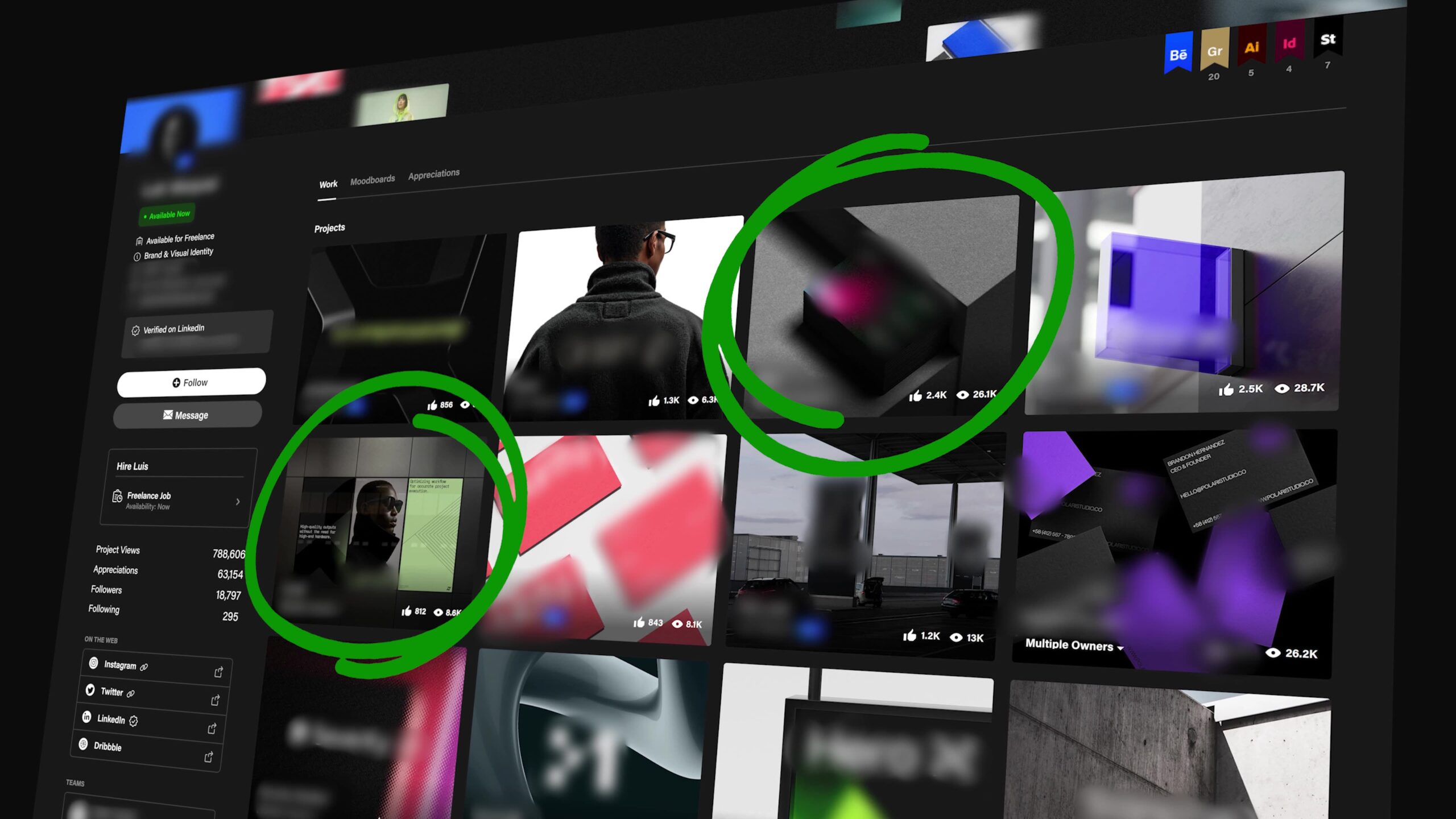
A portfolio shows you what a designer was ASKED to create. It does not show you what they’re CAPABLE of creating.
Read that again.
If a designer spent three years making corporate SaaS landing pages, their portfolio is full of corporate SaaS landing pages. That doesn’t mean they can’t design stunning e-commerce emails or bold social media graphics. It means nobody has ever asked them to.
And here’s the kicker:
The best person for your role might have literally never had the chance to create what you need. Their portfolio might look nothing like your brand. But give them a clear brief, solid references, and 90 minutes — and they’ll surprise the hell out of you.
I’ve seen it happen dozens of times. A candidate gets rejected at the portfolio stage because their past work doesn’t “match the vibe.” Meanwhile, the person doing the rejecting can’t even describe what “the vibe” is in a way that another human could understand — let alone a designer seeing your brand for the first time.
If you can’t clearly articulate what your brand looks and feels like, you have no business rejecting someone for not matching it.
On the other hand, I’ve seen designers with gorgeous, Instagram-worthy portfolios completely bomb a trial task because they’ve only ever worked on their own passion projects. Their portfolio was a highlight reel of their own taste — not proof they can execute someone else’s vision.
The Portfolio Test
Here’s what we do instead of judging portfolios at face value.
We go to candidates and say, “Here are 3 examples of what the client needs. Find 3-5 pieces in your portfolio that best showcase similar work, and explain in 1 sentence why each one is relevant.”
That’s it.
If they can look at their own work and identify the pieces that match your style, your audience, and your goals — they pass. If they send you their “best work” without any connection to what you actually need, they don’t.
You’re not testing design skill yet. You’re testing whether this person can read a room. And reading the room is what separates a designer who nails it in two rounds from one who needs 73 revisions and still misses.
We also tell candidates: “If you don’t have these pieces in your portfolio, there’s a high chance you’ll be disqualified. But — perhaps you can whip up a quick example showing you have the chops?”
This does two things. It gives talented designers without the “right” portfolio a fair shot. And it instantly filters out anyone who can’t connect dots between what they’ve done and what you need.
What Bad Taste Looks Like (A Real Example)
I’ll give you a story from our own hiring at HireUA.
We ran a trial task for a Social Media Manager role — our brand at the time was blue and yellow. Bold, clean, professional. If you look at our Instagram or our website, the aesthetic is pretty clear.
One candidate came back with a carousel in purely pastel colors. Soft pinks. Muted greens. The whole thing looked like a baby’s nursery. And I have no idea why there’s a random swimming pool as a background.
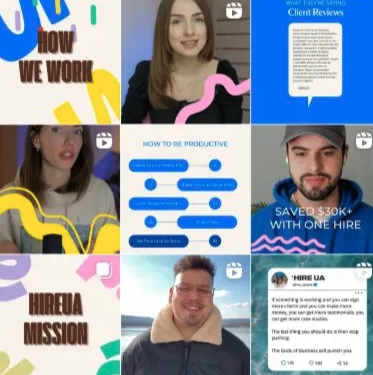
Even the yellow — which is literally one of our two brand colors — was so washed out it barely registered.
That was the sign. This isn’t the right fit.
Not because she was a bad designer. The technical execution was fine. But she had zero instinct for matching the brand’s existing aesthetic. She looked at our feed, our site, our content — and still came back with pastels.
That’s what I mean by taste. It’s not something you can teach in a week. Someone either looks at your brand and gets it, or they don’t. The trial task reveals this in 90 minutes.
Stop Expecting Strategists at Executor Prices
Would you expect a line cook to put together a 12-course Michelin meal on his first day?
No.
You’d train him. Show him the menu. Walk him through the kitchen. Let him shadow someone for a few shifts. Then — and only then — you’d let him work the line on his own.
But when companies hire a Graphic Designer for $1,500/month, they dump a Slack channel full of “content ideas” and a Dropbox folder of “brand assets” (half of which are low-res PNGs from 2019) and say, “Go.”
No brand guidelines. No color palette PDF. No reference examples. No Loom walkthrough. No defined tone of voice. Nothing.
Then they’re shocked — SHOCKED — when the first round of designs doesn’t “feel right.”
Here’s what I don’t get:
How is someone supposed to nail your exact brand tone, visual style, and strategic direction…on a trial project…before they’ve even been hired…without any real briefing?
They can’t.
And the companies that keep churning through designers every 6-8 weeks? They all have the same thing in common. It’s not that the designers are bad. It’s that the company never did the work to define what “good” looks like.
The same principle applies to every creative role.
“Ugly Designer” and Other Nonsense Job Titles
While we’re here — stop making up job titles.
I’ve literally had clients tell me, “We want to hire a hideous Graphic Designer.” What they mean is someone who can make static images that convert — not stuff that wins design awards.
But guess what?
No designer on earth wants to apply for a job that says, “Design hideous and vomit-inducing images.”
It’s demoralizing. It’s confusing. And it’s killing your applicant pool.
“Performance Brand Strategist.” What does that even mean?
“Conversion Ad Performance Specialist.” Same thing.
“Creative Expressive Designer.” Dear God.
“Designer of Awesomeness.” I wish I was kidding.
Just call it what it is. Graphic Designer. Then in the job description, say exactly what they’ll be designing. Social media graphics for Instagram and LinkedIn. Email templates in Klaviyo. Banner ads for Meta campaigns. Static product images for your Shopify store.
Clear title. Clear responsibilities. Better applicants.
The moment you try to get cute with the title, you lose half your candidate pool. Good designers scroll past weird titles because they don’t know what the job actually is. And the ones who DO apply to “Designer of Awesomeness” are probably not the ones you want.
The Brand Guidelines Minimum (Your Homework Before You Hire)
Before you interview a single candidate, you need to have this ready. Not after the hire. Not “we’ll figure it out together.” Before.
If you can’t produce this list, you’re not ready to hire a Graphic Designer. You’re asking someone to read your mind. And your mind hasn’t made itself up yet.
Your color palette — Hex codes. Not “we like blue.” Which blue? Navy (#001f3f)? Royal (#4169e1)? Baby blue (#89CFF0)? There are a thousand blues. Pick yours and write it down. Primary colors, secondary colors, accent colors.
Your fonts — Which typeface for headers? Which for body text? Do you have a brand font or are you using whatever came with the Squarespace template? Serif or sans-serif? Bold or light weight? If you don’t know, that’s OK — pick one and commit. But don’t ask your new designer to guess.
3-5 examples of designs you love — From anyone, anywhere. Other companies, competitors, random Instagram accounts. The point is to show, not tell. “We like this because it’s clean and bold” is 10x more useful than “we want something modern.”
3-5 examples of designs you HATE — Just as important. Knowing what you don’t want eliminates entire categories of output before the designer even opens Figma.
Your logo files — In multiple formats. SVG, PNG with transparent background, dark version, light version. If you only have a JPEG your cousin made in 2018, fix that first.
A real tone description — And I mean real. If ChatGPT spit out something like “friendly and engaging” — that’s garbage. You need to define what that actually MEANS for your brand. Here’s what real tone descriptions look like:
“We use blue and white to project calmness. We’re a yoga company. Nothing should feel aggressive, loud, or cluttered.”
“We use red and black because we’re a performance car brand. Bold fonts. Everything should feel fast and unapologetic.”
“We use neon green and hand-drawn elements because our marketing agency is chaotic on purpose. We throw shit at the wall until it sticks, and our visuals should feel exactly like that.”
“We use earth tones and serif fonts because we’re a heritage coffee roaster. Think 1920s general store, not Silicon Valley startup.”
See the difference? Each of those tells a designer something they can actually design to. “Friendly and engaging” tells them nothing. A designer reading “we throw shit at the wall” knows EXACTLY what to make. A designer reading “friendly and engaging” is guessing.
One Loom video of you walking through your brand — Spend 5 minutes showing your website, your social media, your competitors’ stuff, and just talk. Say what you like, what you don’t, what you’d change. A designer can learn more from a 5-minute Loom than from a 20-page brand book.
If all of this sounds like a lot of work…it is. But it’s YOUR work, not theirs. Get your shit together before you start interviewing. Your designer will thank you, and you’ll actually get designs you like on the first try.
How to Actually Screen a Graphic Designer
The Interview Comes First
I see this mistake constantly. Someone posts a job, gets 50 applications, and says, “Do this test project, and then maybe we’ll talk.”
Then they wonder why all the trial work looks lazy or off-brand.
Here’s why:
Designers know the drill. The good ones — the ones we place — they know they’re going to be judged off the trial task. They get it. They’ve been through this before.
But think about it from their side for a second.
Do you give away your product or services for totally free? If you can’t volunteer 15 minutes to get on a call, why would you expect someone to take 90 minutes of unpaid time to impress you?
Do the interview first — even if it’s short. Explain the role. Explain the trial. Give them context about your brand, your audience, and what you’re trying to accomplish.
And — here’s the part most people skip — let THEM ask questions.
Because the questions a designer asks tell you everything.
A good one will ask, “How do you want the person to feel when they see this?” or “What’s the primary action you want someone to take?” or “Can you show me 2-3 examples of what you consider on-brand?”
A bad one will ask, “Do you prefer this shade or that shade?” or “How many pixels wide should it be?”
The first designer is thinking about outcomes. The second is thinking about specifications. You want the first one.
Then send them the trial.
You’ll get 10x better results. They’ll actually understand what you’re looking for. They’ll feel respected. And you’ll have a real conversation to compare candidates against — not just a stack of anonymous design files.
The Trial Task
90 minutes. That’s it.
Give them a clear brief: “Here are examples of what we need. Here’s our brand guide. Design [specific deliverable].”
A good trial says, “Here’s what the client expects. Execute it.” A bad trial says, “Come up with our whole strategy.” That’s not a trial. That’s free consulting. And you’ll get free consulting-level results.
The trial should be the same type of work they’ll do on day one. If they’re making social media graphics, the trial is a social media graphic. If they’re designing email templates, the trial is an email template. Don’t give a Social Media Designer a logo project and wonder why it doesn’t feel right.
The “Unlimited Revisions” Red Flag
You see this everywhere on freelance platforms. “Unlimited revisions! We’ll keep working until you’re happy!”
Sounds great, right?
Wrong.
If a designer needs 73 tries to get something right, they didn’t understand the assignment in the first place.
You don’t want unlimited revisions. You want someone who nails it in 2-3.
Unlimited revisions is a red flag — not a selling point.
What It Actually Costs (Real Numbers)
Here’s what we charge based on actual placements. Not salary aggregator data. Not “it depends.” Real numbers.
Graphic Designer (Content / Social / General)
| 10h/week | 20h/week | 40h/week | |
|---|---|---|---|
| Eastern Europe | $500 – $700 | $1,100 – $1,400 | $1,700 – $2,100 |
| Latin America | $400 – $600 | $900 – $1,200 | $1,500 – $2,000 |
Creative Strategist / Performance Ad Designer
| 10h/week | 20h/week | 40h/week | |
|---|---|---|---|
| Eastern Europe | $1,000 – $1,400 | $2,000 – $2,500 | $3,500 – $4,000 |
| Latin America | $800 – $1,200 | $1,700 – $2,200 | $3,200 – $3,600 |
Look at that gap.
A general Graphic Designer at 40 hours per week from Eastern Europe: $1,700 – $2,100.
A Creative Strategist / Performance Ad Designer at 40 hours: $3,500 – $4,000.
Almost double.
That’s the price of the add-ons. And this is exactly why the “figure out what you actually need” section matters. If you need a content poster but you’re interviewing candidates at the Creative Strategist level, you’re either going to overpay for skills you don’t use — or you’re going to underpay and get frustrated when they can’t do the strategist work you secretly expected.
The pricing gap between executor and strategist is consistent across every creative discipline.
The AI Question
“Do I even need a designer anymore? Can’t Canva and Midjourney do this?”
Here’s the deal:
AI tools have changed the baseline. A non-designer can now produce decent social graphics in Canva using templates and prompts. Midjourney can generate concept art. ChatGPT can write ad copy.
But here’s what AI can’t do:
Give you a layered PSD or Figma file you can tweak. Make a small adjustment to one element without regenerating the entire image. Understand your brand context after three months of working together and start anticipating what you need. Maintain visual consistency across 50 pieces of content over 6 months.
You can prompt Canva a zillion times, but at the end of the day, you still don’t have a source file you can make a surgical edit to. Every revision is starting from scratch. And that adds up fast.
AI tools are best used BY a designer, not instead of one. A good designer who knows Midjourney, Canva, and Figma is 3x faster than the same designer five years ago. That’s the real win — not replacing the person, but making the person exponentially more productive.
Why Most Creative Searches Take Too Long (And Cost More Than They Should)
We’ve worked with organizations that spent 4-6 months trying to fill a single Graphic Designer role. Interviewed 15+ candidates. Gave trial tasks to a dozen of them. Rejected every single one.
And here’s the kicker:
The issue was never the candidates.
The issue was fear. Fear of making the wrong choice. Fear that there’s someone better in the next batch. Fear that the portfolio doesn’t perfectly match the exact thing they need.
At some point, you have to take a leap of faith.
Creative roles are, by their literal title, creative. You cannot expect someone to have exactly what you need sitting there in their portfolio ready to go. You might — you know — have to give some feedback. Let them make some iterations in their first few weeks. Actually invest in the relationship.
The Math on Churning
Here’s what most people don’t think about:
A failed hire typically costs 30% of their annual salary when you factor in the time spent recruiting, onboarding, training, and then doing it all over again. For a $2,000/month Graphic Designer, that’s roughly $7,000 in wasted cost per failed hire.
Churn through three designers in six months? That’s $21,000 in lost time and productivity. You could have hired a $3,500/month Creative Strategist who would have gotten it right from day one — and still come out ahead.
The companies that churn through designers every 8 weeks all have the same pattern. They hire, dump tasks with no direction, get frustrated when the output doesn’t match the picture in their head, and fire. Rinse. Repeat. And every cycle, they burn another $7,000.
The companies that keep designers for years? They gave clear briefs. They gave feedback fast. They let the designer learn. And within a few weeks, the designer started anticipating what they needed before they even asked.
That’s when you know you’ve hired right.
The Multi-Stakeholder Problem
Creative roles have a unique curse. They touch revenue.
Marketing needs to approve the designs. Sales has opinions about what converts. The CEO has “a vision.” Maybe there’s an HR manager involved for some reason. And if someone new joins the team midway through the search — a new CTO, a new Creative Director, a new head of marketing — everything gets reshuffled.
Now every stakeholder has a different definition of “good design.” And the poor designer (or recruiter) is trying to hit a target that keeps moving.
If you’re hiring for a design role, decide who the decision-maker is BEFORE you start.
One person.
Not a committee.
Committees kill creative hires.
Case Studies — What Happens When You Get It Right
GoSproost — Three Roles, One Designer
Brandon at GoSproost came to us looking for three separate hires: a Graphic Designer, a 3D Renderer, and someone to rebuild his website. He’d previously tried hiring from the Philippines — unreliable internet, 12-hour time zone gap, and two months of searching just to find one person who could do basic renderings.
We lined up 10 interviews in a week. He hired Tiana at $1,500/month.
She didn’t just do 3D renderings. She redesigned his logo. She revamped his entire website (moving it from Wix to WordPress). She handled all the graphic design for his investor presentations and marketing materials.
Three roles. One person. $1,500/month.
In Brandon’s words: “I would definitely look like a huge eight-figure construction company when it’s really just me and her.”
In the US, he estimated that skillset would have been 2-3 separate roles between $60K-$85K each. He got it for a fraction of that — and she started within two weeks.
Support Pets — Design That Energizes the Whole Team
Support Pets, an e-commerce pet services company, hired a Graphic Designer through us in 2023. He’s still there.
Their words: “Our Designer has been integral to our team — his creativity and passion are contagious, and he not only produces outstanding work but also energizes the entire team.”
Between their Designer, Executive Assistant, and QA Analyst (all hired through HireUA), they’re saving over $150,000/year in payroll. That’s not counting the time and productivity they’ve gained back.
Read the full Support Pets case study here →
Real Way Marketing — The Niche Design Hire
John Prince runs an email marketing agency for e-commerce brands. He’s not a designer — but he was doing all the Klaviyo email design himself. Every email, 45 minutes minimum. 45 hours a month on work that wasn’t the best use of his time.
He’d tried hiring designers before. The designs would look fine, but the details were always wrong. Typos, wrong links, broken elements. He was spending as much time reviewing and fixing their work as he would have spent doing it himself.
We placed Yulia, a Klaviyo Email Designer from Eastern Europe. She matched existing client brand styles without hand-holding. The output was clean from day one.
John got 45 hours a month back. $24,000 in annual savings. And he stopped being the bottleneck in his own agency.
This is what happens when you hire the RIGHT kind of designer — not a generalist, but someone whose niche matches exactly what you need.
Read the full Real Way Marketing case study here →
Set Your Designer Up to Win
The best designer-client relationships follow a simple pattern.
Step 1: Visual references, not vague instructions. Don’t say “make it pop.” Show 3-5 examples of what you’re going for. Screenshots, links, competitor examples — anything visual. The more specific, the better.
Step 2: Explain the WHY behind every project. Who’s the audience? What’s the goal? What feeling should this design create? A designer working on a Facebook ad for a yoga studio makes completely different choices than one working on a Facebook ad for a car dealership. Context turns decent designers into great ones.
Step 3: Fast feedback. Don’t let confusion sit for three days. If something’s off, tell them immediately. The faster the feedback loop, the faster they learn your style.
Step 4: Definition of Done. How many graphics per week? What format? What’s the approval process? Who gives final sign-off? If it’s not defined, it doesn’t exist. (We use this framework across every role we place — it’s the single biggest unlock for remote team productivity.)
Within a few weeks, a good designer starts anticipating what you need before you even ask. They’ll match your colors instinctively. They’ll choose the right photos without being told. They’ll adjust layouts to fit your style without a reference.
That’s when the hire pays for itself.
FAQ
Do I need a freelance or full-time Graphic Designer?
If you have consistent, ongoing design work — social media graphics, email templates, marketing materials every week — hire someone full-time (or at least 20 hours). If you need a one-off project like a logo, brand identity package, or website redesign, a freelancer or project-based engagement makes more sense. Most businesses that come to us need the full-time Content Poster, not the occasional freelancer.
What tools should a Graphic Designer know in 2026?
Adobe Creative Suite (Photoshop, Illustrator, InDesign) is still the standard for print and detailed design work. Figma is nearly a must-have — it’s become the industry default for collaborative design, especially for web and UI. Canva Pro for quick social content. And increasingly, AI tools like Midjourney and other generative platforms are becoming part of the toolkit. A designer who can use AI to accelerate their workflow is significantly more productive than one who can’t.
What’s the difference between a Graphic Designer and a Creative Director?
A Graphic Designer executes. You give them a brief, references, and brand guidelines — they produce the design. A Creative Director sets the strategy. They define the brand, decide the visual direction, and manage other creatives. If you’re paying $1,500-$2,000/month for a Graphic Designer and expecting creative direction, strategy, and brand development — you’re expecting a Creative Director at a Graphic Designer’s price. That gap is where most frustration lives.
Can AI replace a Graphic Designer?
Not yet. AI tools like Midjourney and Canva’s AI features have lowered the bar for producing decent-looking graphics. But they can’t maintain brand consistency across dozens of assets, can’t give you editable source files for surgical tweaks, and can’t build the contextual understanding that comes from working with your brand for months. AI makes designers faster. It doesn’t replace them.
How do I hire a Graphic Designer on a tight budget?
Start with 10 hours per week. In Latin America, that’s $400-$600/month for a solid general Graphic Designer. Give them your most repetitive design tasks — social media graphics, basic marketing materials, email assets. As they learn your brand and prove themselves, increase hours. This is better than hiring a full-time person on day one and discovering the fit is wrong after you’ve committed to 40 hours.
Should I hire a local or offshore Graphic Designer?
Design is one of the most location-independent roles that exist. The deliverable is a file. It doesn’t matter where the designer lives — it matters whether they can match your brand, communicate clearly, and deliver on time. We’ve placed hundreds of designers from Eastern Europe and Latin America with US companies, and the quality is consistently on par with domestic hires at 40-70% lower cost. The biggest factor isn’t location — it’s the screening and briefing process.
The Bottom Line
Every company that struggles to hire a Graphic Designer has the same problem. It’s not that good designers don’t exist. It’s that the company never defined what they needed, never prepared proper brand guidelines, and expected a $1,500/month executor to function as a $5,000/month Creative Director.
Do the homework. Define the role. Prepare the brief. Screen for judgment, not just portfolio prettiness. And once you hire — give feedback fast, set clear expectations, and let them learn.
If you’d like help finding a Graphic Designer who’s been vetted using the exact process described in this article — book a call with HireUA. We’ll help you figure out what you actually need, find the right person, and set you both up to succeed. And if it doesn’t work out, we replace them.
That’s the deal.
Helpful videos about hiring creative talent:
How to Hire a Graphic Designer (The Right Way)