

I’m going to tell you something that might surprise you. Of all the roles we place at HireUA — SDRs, account managers, operations people, developers — the Executive Assistant is the one that changes the most lives. So what does an Executive Assistant do to make the lives of their principal easier?
A good EA gives you back the one thing you can’t manufacture — time.
But here’s the problem. Most business owners have no idea what an EA actually does. They think it’s calendar management and booking flights. That’s like saying a surgeon just “cuts people open.” Technically true. Completely misses the point.
I’ve had several EAs over the years. I’ve had great ones, good ones, and ones I’ve had to let go. I’ve placed hundreds more with clients. Here’s everything I actually know about this role — the good, the bad, and the stuff nobody tells you.
Last Updated: February 16th, 2026
Table of Contents
- What an EA Actually Does (The Interceptor Model)
- The Real Job Description For An EA
- The Invisible Vacation Test
- Virtual Assistant vs Executive Assistant
- What Founders THINK They Need vs. What They Actually Need
- What Makes a Great EA (Not Just a Good One)
- What Kills EA Relationships (I’ve Learned This the Hard Way)
- How to Screen for an EA (It’s Different From a VA)
- How to Manage Your EA (The L10 Meeting Format)
- Executive Assistant Salary Bands
- Success Stories: What’s Possible When You Hire The Right EA
- When You Need an EA (and When You Don’t)
- The 3 Ways to Hire an EA
- The Growth Path: EA → Operations Manager → Chief of Staff
- The Bottom Line on Hiring an Executive Assistant
- Executive Assistant FAQ
What an EA Actually Does (The Interceptor Model)
Let me tell you exactly how my EA operated, because I think this is the best way to understand the role.
When she was in Poland and I was in California, she worked while I slept. By the time I woke up every morning, there was a full report waiting for me. Everything that happened overnight — every Slack message, every channel, every email — she had intercepted it all and decided if it was worth my time.
That’s the word I always come back to: Interceptor.
About 80% of the communications that came into my business, she responded to as me or for me. Clients, team members, vendors — she handled it. The remaining 20% where she was genuinely blocked, she didn’t just forward them to me with “what do you want to do?” She’d lay out the situation, give me the options she saw, and ask me to pick. Here’s the problem. Here are three possible solutions. I recommend option two because of this reason. What do you want to do?
So instead of wading through 100 messages every morning, I’d review 5-10 decisions she’d pre-packaged for me. That’s the difference between an EA and a VA. A VA forwards your messages. An EA processes them, handles what they can, and serves you the rest on a silver platter.
That’s what the role is at its core: Making every decision in your day either disappear entirely or arrive pre-digested so you can decide in 30 seconds instead of 30 minutes.
The first line of my EA SOP says it all: “The real title of this job is problem solver. The words “It can’t be done” — should never be said.”
The Real Job Description For An EA
An Executive Assistant’s job is to remove friction from your day and make your life easier. Everything else is a tactic in service of that one goal.
Calendar and Schedule Management
This is the obvious one, but it goes way beyond “add this meeting to my calendar.”
A great EA owns your calendar. They know which meetings you actually need to attend and which ones can be delegated. They build in buffer time because they know you need 15 minutes between calls to reset. They protect your deep work blocks like a bouncer at a club.
Bad EAs are order-takers. “Someone wants to meet at 3pm.”
Good EAs are gatekeepers. “Someone wants to meet at 3pm, but you have a deep work block. I suggested Thursday morning instead and they confirmed.”
That difference is massive.
Email and Communication Management
Your inbox is probably a disaster. Hundreds of emails a day, most of which don’t need your personal attention. Inbox zero? Let me laugh out loud.
Here’s exactly how I set up inbox management with my EA: Every email gets labeled into one of seven priority categories. The top label is “Kyle” — things that need my brain. Underneath that is “EA” — things she handles autonomously. Then Sales, Company, Finance, Newsletters, Personal.
It looks something like this:
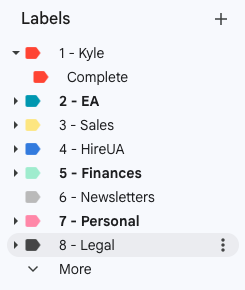
Within my label, she drafts responses for almost everything. I review, tweak if needed, and hit send. The goal is that I never have to craft an email from scratch. Within her label, she handles it completely — chasing vendors, booking appointments, coordinating logistics — and I never see it unless something goes sideways.
She responds from my email account but signs her name.
“Kind regards, [Name], EA to Kyle Mau.”
Why?
Because people take “the CEO” more seriously than “the assistant.” It’s unfortunate, but sending from my account gives her the power of the title. People respond faster. Things get done.
The goal isn’t inbox zero. The goal is that nothing important falls through the cracks while you focus on the stuff that only you can do.
Travel and Logistics
Flights, hotels, ground transport, restaurant reservations, conference registrations — all the stuff that takes you 45 minutes to research and book. An EA does it in 15 because they know your preferences.
- Window seat.
- Aisle if it’s under 3 hours.
- Hotel close to the venue, not the cheapest one 20 minutes away.
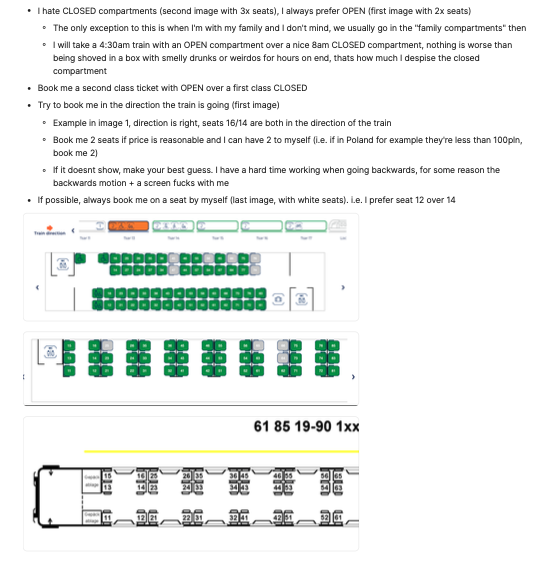
The level of detail matters. My SOP has my airline preferences ranked (KLM, Swiss, Lufthansa within Europe for example), my hotel chain preferences ranked (Hilton, Marriott, IHG), my layover city preferences ranked (Amsterdam, Warsaw, Zurich), my train seat preferences (open compartment, facing the direction of travel, solo seat if available, book two seats if cheap enough).
Below is the sort of detail I give my EA. I travel often on regional trains in Eastern Europe. I am very specific. If I’m on the train, it’s either hours cramped next to a stranger who hasn’t showered in a week or hours of productivity. Given the value of my time these days, that’s potentially thousands I can generate for our company if the SOP is followed.
You might look at this and say I’m crazy, but this is what an EA can do for you. Make sure you’re comfortable and taken care of. Every. Single. Time.
Even my barber’s name, location, and the fact that I tip well and can call in favors.
The best EAs internalize all of this. You tell them once. Maybe twice. After that, they just know. You wake up in a new city and there’s a document in your inbox with your full schedule, addresses, contact info, and a restaurant recommendation for dinner.
I had an EA who literally saved a business retreat. We had a house booked in the forest for my EO Forum — private chef, the whole deal. The house flooded.
She handled everything:
Found a new house, rebooked the chef, coordinated with the entire team. The retreat went off flawlessly. I didn’t have to make a single call. That’s what this role looks like when it’s working.
Task and Project Management
This is where EAs really earn their keep. You say “I need to get this proposal out by Friday.” A good EA turns that into a project: Who needs to contribute, what’s the timeline, when does the draft need to be reviewed, who’s formatting the final version.
They track your commitments so you don’t. When you tell someone “I’ll get back to you next week,” your EA puts it in the system and makes sure it actually happens.
The Daily Report
Every day at a set time, my EA sends me a structured report of everything happening in the business and my personal life. It’s organized into four sections:
#1: Business Action Items
Things that need my decision or response. Each one comes with context, a link to the email or Slack message, and her recommended solution. Not just “this happened.” Instead: “This happened. Here are three options. I recommend option two because of this reason.”
#2: Business Non-Urgent Items
Things I should be aware of but don’t need to act on right now. She knows I don’t want fluff. I don’t need to know if we’re “searching” for a candidate — I need to know if we’re searching and it’s been four days with nothing. I don’t need to know we’re “doing interviews” — I need to know if a client has had three interviews and doesn’t like what they see.
#3: Personal Action Items
Tasks that need my involvement. The lawyer responded about the visa — here’s what you need to do. I’ve researched rental cars for your trip — here are two options with prices, features, and pickup locations.
#4: Personal Non-Urgent Items
Reminders and updates. You have dinner with a friend at 5pm. I’m researching office spaces and will bring options to our meeting tomorrow.
This daily report is the backbone of the entire EA relationship. It turns chaos into a structured decision-making dashboard. I open it, make decisions, move on with my day.
The Gatekeeper Role
Not everyone who wants your time deserves your time. An EA screens calls, filters meeting requests, and protects you from the endless stream of people who want “just five minutes.”
This is uncomfortable for a lot of business owners. You feel guilty saying no. You feel like you should be accessible. But the math is brutal — if you say yes to every “five minute” request, you lose your entire day in meetings you didn’t need to take.
A good EA takes that guilt off your plate. They say no (politely) so you don’t have to.
The Part Nobody Talks About: Your Whole Life
A great EA doesn’t just manage your business. They manage the personal-professional blend because for founders, there is no line between the two.
My EA SOP has my wife’s birthday, my daughter’s birthday, my parents’ birthdays, my in-laws’ birthdays, even the date my mom passed away.
It says:
“A present for my wife should be in my hands one week before the following dates: Her birthday, International Women’s Day, Mother’s Day, Christmas, New Years. You are not responsible for picking the gift, you are responsible for making sure I remember. You are to hound me until I get it done — by the deadlines.”
Your EA should know your stress levels. They should know when you’re running hot and need a lighter calendar day. They should know when something heavy is happening at home and that this isn’t the week to stack five client calls in a row.
This isn’t overstepping. It’s the job. An EA who only manages your work calendar but ignores that your wife is stressed because you just booked another last-minute trip — that’s an incomplete EA. The role is the whole person, not just the CEO.
The Invisible Vacation Test

Here’s how you know your EA relationship is working: You go on vacation and nobody knows you’re gone.
I went to Dubai for two weeks. Uninstalled Slack from my phone. Uninstalled email. Completely off the grid. We had one five-minute check-in halfway through. That’s it.
When I came back, everything was running. Nothing had fallen apart. Nobody on the team had been left hanging. Clients were handled. Decisions were made. The business didn’t skip a beat.
That’s the invisible vacation. And it’s only possible when your EA truly understands you, your business, and your decision-making patterns well enough to operate as you in your absence.
If you can’t take a two-week vacation without your business falling apart, you either don’t have an EA or you haven’t invested enough in the relationship yet.
That should be the goal from day one: Build toward the point where your absence is invisible.
Virtual Assistant vs Executive Assistant
This is where a lot of business owners get confused, and I see it every week on sales calls.
“I need a Virtual Assistant” and “I need an Executive Assistant” are not the same sentence.
A Virtual Assistant is a generalist. They can do a little bit of everything — data entry, light research, social media posting, basic admin. They execute within systems you build.
An Executive Assistant is embedded in your workflow. They understand your business. They anticipate what you need before you ask for it. They make decisions on your behalf.
The VA does what you tell them. The EA figures out what needs to be done and tells you what they did.
Here’s the practical test: If the role requires judgment, anticipation, and independent decision-making, it’s an EA. If it’s primarily execution of clearly defined tasks, it’s a VA.
And here’s the uncomfortable truth…
Most founders who come to me asking for an EA actually need a VA. Their expectations are out of whack. They want someone to “manage their chaos” — but they haven’t defined what the chaos is, they don’t have systems, and they change priorities every day.
That’s not an EA problem. That’s a founder problem.
An EA can’t organize chaos that the founder keeps creating. You need basic systems first. Then the EA amplifies them.
What Founders THINK They Need vs. What They Actually Need
I need to go on a rant here because this is one of the most frustrating things we deal with at HireUA.
I recently had a client come to us looking for — and I quote — an “Executive Partner / Chief of Staff” who operates at a “Self-Authoring to Self-Transforming developmental stage,” demonstrates “co-regulation capacity,” and can serve as the CEO’s “continuous cognitive-emotional environment.”
The job description included a “Post-Interaction Body Check” to evaluate whether the candidate creates “emotional spaciousness.
I’m going to say this as directly as I can:
If you need your EA to be your therapist, your co-regulator, and your “cognitive-emotional environment” — you don’t need an EA. You need an actual therapist. And then you need an EA.
What founders actually need is someone to intercept his communications, follow up on his ideas, manage his calendar, and occasionally say, “You started six projects this month and finished zero. Which three are we killing?”
That’s it. No developmental psychology framework required. No archetype mapping. No neurophysiology checks. Just a sharp, organized person who can manage founder-brain and isn’t afraid to push back.
Stop looking for a unicorn. Hire a competent EA. Give them clear systems. Let them grow into the role.
What Makes a Great EA (Not Just a Good One)

We’ve placed a lot of EAs. The good ones check the boxes — organized, responsive, detail-oriented. The great ones do something different.
Anticipation
The best EAs don’t wait for you to ask. They see the board meeting on the calendar next week and have the prep materials ready by Wednesday. They notice you’re flying to a client and have the account summary in your inbox before you board.
You can’t really teach this. Some people are wired to think “what’s coming next?” and some people are wired to think “what was I just told to do?” You want the first type.
Discretion
EAs see everything.
Financials, personal stuff, sensitive conversations, internal politics. My EA has access to my email, calendar, credit cards, contact lists, banking info, and personal documents. If you can’t trust them completely, the role doesn’t work. Period.
Communication That Matches Your Voice
They’re representing you. Every email they send on your behalf, every call they take, every meeting they schedule — it reflects on you. They need to match your tone, your professionalism, and your standards.
I had a client tell me his EA started pushing back on low-quality prospects in exactly the same way he would. That’s when you know you’ve got the right person.
Ownership
Great EAs don’t say “you forgot to tell me about that.”
They say “I saw it coming and handled it.”
They own their domain completely. Your calendar, your email, your logistics — that’s their territory, and they take pride in running it flawlessly.
Understanding That the Principal IS the Job
Here’s a red flag that immediately tells me someone won’t cut it as an EA: They talk about the job as a set of tasks.
A great EA understands that the principal — the person they support — is the actual job. Not the calendar. Not the inbox. Not the travel bookings. You.
In some ways, a great EA is part performance manager for the executive. They’re reading your energy, adjusting the day when you’re running low, creating space when you need it, and keeping the pressure on when you’re in a groove. It’s a person who pays attention and gives a damn.
The EAs who get this — who understand that their job is a person, not a task list — are the ones who last years and become indispensable. The ones who see it as “I manage calendars and book flights” burn out or get replaced within six months.
What Kills EA Relationships (I’ve Learned This the Hard Way)
A candidate I once interviewed — someone who’d been an EA for eight years — described it as a “professional friendship.”
I really agreed with that framing, and I think it’s the best way to understand why EA relationships are so fragile.
It IS like a professional friendship. There’s trust, there’s rhythm, there’s shorthand that builds over time. Your EA knows you’re going to be cranky after the 4pm call. They know not to schedule anything heavy on Monday mornings. They know which clients you actually like talking to and which ones you tolerate.
That trust takes months to build. And it can break in a day.
The #1 Killer: Waiting Instead of Driving
I’ve been through more EAs than I’d like to admit. And the pattern that kills the relationship most often isn’t incompetence. It’s passivity.
The EA who sits around for instruction instead of going and figuring it out. An EA who says, “What should I do next?” every morning is a VA with a fancy title.
A real EA wakes up, looks at the calendar, looks at the inbox, looks at the task board, and starts moving. If they’re waiting for you to tell them what to do, they’ve missed the entire point of the role.
Let me give you a real example. I once gave my EA a simple task: Make sure we have food and coffee for a meeting at 9am. I gave her the name of a preferred bakery. I said to try to order jugs of coffee — the kind you see at events.
This should have been a straightforward, one-and-done task. Instead, it turned into a saga that spanned three weeks and four sync meetings.
- First she asked savory or sweet — a week after the task was assigned.
- Then she reported that coffee places in Poland don’t sell jugs for small events.
- This became an update for the next two weeks: “No places offer this.”
- Then she asked what kind of coffee.
- Then she proposed ordering a bunch of individual Americanos and carrying them to the office.
- Then she realized that would be hard to carry and asked me for help.
- Then she asked if we needed water.
- Then she asked me to buy and carry the water upstairs.
- Then she proposed bringing her home coffee machine with capsules.
- Then I had to answer questions about what capsule flavors to buy and what kind of cups.
A simple “have food and coffee ready at 9am” became a three-week project that was constantly boomeranged back to me for decisions. Every problem was narrated to me instead of solved.
The right EA would have handled this in 24 hours. Order pastries from the bakery. Buy a box of decent coffee and some cups. Done. If the jug thing didn’t work out, figure out an alternative and tell me what you did — not ask me what to do instead.
The Follow-Instructions Problem
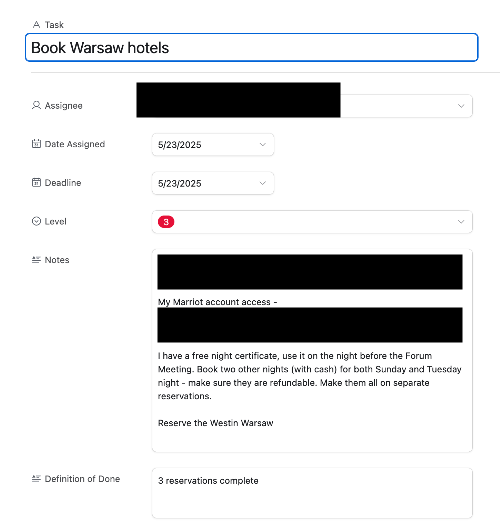
Another real example: I assigned a hotel booking task with crystal clear instructions. Exact hotel (the Westin Warsaw), exact dates, exactly which nights to use a free certificate and which to pay cash, even logged into the rewards account to confirm availability.
Instead of just executing, I got questions back about a completely different hotel I never mentioned. Then she suggested yet another hotel. Then booked the one I asked for — but the back-and-forth took three hours of messages across three days. A task that should have taken 20 minutes.
When I pointed out the issue, the explanation was that she’d never heard of the Westin and thought I meant “the west side of the hotel.” But “Westin Warsaw” is one Google search away. And the instructions literally said “Reserve the Westin Warsaw.”
The lesson: If something is unclear, ask a precise clarifying question. Don’t guess.
Do your own research first.
The goal is to delegate, not to circle back, clarify, and re-explain myself when you’ve written crystal clear instructions. It doesn’t matter that it got done eventually. What matters is the wasted time and energy dragging it there.
What I’ve Learned From My Own EA Churn
It’s OK to be wrong. An EA who makes a judgment call and gets it wrong is infinitely better than an EA who freezes and doesn’t make the call at all.
It’s OK to ask. A question isn’t a sign of weakness. It’s a sign they want to get it right. But ask a precise question, ask it early, and ask it once.
It’s NOT OK to drop a ball silently. If something slipped, tell me immediately. Don’t pray I won’t notice. I will notice. And the cover-up is always worse than the mistake.
It’s NOT OK to narrate every problem. Solve it. Then tell me what you did. If you truly can’t solve it, bring me the problem with your recommended solution — not just the problem.
The relationship is the product. An EA isn’t a tool. They’re a person you work with intimately every day. If the dynamic doesn’t feel right — if it’s tense, if it’s awkward, if there’s no shorthand developing — it’s probably not going to get better.
Cut it early and find the right fit.
How to Screen for an EA (It’s Different From a VA)
Screening an EA is fundamentally different from screening a VA because the role is fundamentally different.
With a VA, you’re testing: Can they follow instructions? Can they execute accurately? Can they use the tools?
With an EA, you’re testing: Can they think? Can they anticipate? Can they represent me? Do I trust them with my world?

Match the EA to the Executive (Not the Company)
This is the single most important screening criterion that almost everyone misses.
An EA who spent eight years supporting the CEO of a 1,000-person financial services big corporation is a completely different animal than an EA who supported a startup founder getting an AI startup off the ground with 10 people.
Both are experienced.
Both are competent.
They are not the same, though.
The financial services EA is used to structure, hierarchy, formal communication, and process. Things probably move slow and there’s likely bureaucracy.
The startup EA is used to chaos, ambiguity, wearing twelve hats, and figuring things out with no playbook.
If you’re a founder who changes priorities every 48 hours, the corporate EA will be miserable — and most importantly, you won’t get what you need.
If you’re a structured executive who runs on process, the startup EA will feel sloppy.
Ask about the personality of the executive they supported.
- How did that person work?
- What was the communication style?
- What drove them crazy?
- You’re hiring for the match between the EA and YOU, not the EA and your company.
The Trial Task: 90 Minutes That Tell You Everything
Here’s the actual trial task I give EA candidates in second-round interviews. 90 minutes total. No AI allowed.
—
The setup:
It’s Monday, 8:00 AM. You’re my EA. I’m at home. I usually arrive at the office at 10:00. I’m in back-to-back meetings from 8:00 to 16:00. You have access to my email, calendar, credit cards, and contact lists.
Here’s what just happened:
I received a letter from the IRS. The previous accountant left a mess — the IRS says it’s missing my signature and my wife’s social security number. It needs to be addressed immediately.
I just found out I have to be in Warsaw tomorrow for an emergency meeting. I was supposed to attend remotely, but now I need to be there in person. The meeting starts at 11:00 and ends at 14:30.
Wednesday is my wife’s birthday. I’ve planned nothing. I have no gift. She’s at home with our 3-year-old, already stressed, and this surprise trip is going to make it worse. $200 budget.
I have no hotel or train booked. I need a haircut before I go — my barber is notoriously hard to reach, but she loves me and I tip well. You may need to call in a favor.
The lawyer from Poland called — the government office lost my daughter’s passport documentation again. They need a fresh copy delivered by tomorrow or the case gets thrown out.
You have 5 minutes right now to read this, ask clarifying questions, then 30 minutes to triage, diagnose, and plan the entire week. I’ll have 15 minutes to debrief before my next call.
—
This trial task tests everything at once:
Prioritization. The IRS issue is urgent-legal. The passport is urgent-deadline. Warsaw is urgent-logistics. The birthday is urgent-emotional. The haircut is nice-to-have. Can they sort these correctly?
Judgment. What do they handle autonomously vs. what do they escalate? Do they just list the problems back at you, or do they come back with solutions?
Resourcefulness. The barber is hard to reach. The wife’s birthday has a $200 budget and a toddler in the picture. The passport docs need to be physically delivered. These all require creative problem-solving, not just task execution.
Emotional Intelligence. The wife is already stressed. This trip makes it worse. Does the candidate even acknowledge that? Do they think about how to soften the impact — maybe arrange the birthday gift to arrive before you leave, or plan something special for when you get back?
Speed Under Pressure. They have 5 minutes to clarify and 30 minutes to plan. Can they operate under a real-world time crunch?
A VA would read that scenario and freeze. An EA reads it and starts triaging. The ones who pass this test are the ones who thrive in the role.
The Questions You Should Ask Yourself (Not the Candidate)
Before I make any hire — EA or otherwise — I run through these questions honestly:
Would I be disappointed if a competitor snatched this person? Name a competitor you hate and imagine them working there. If you feel nothing, that’s your answer.
Do I trust this person to solve problems without me? Or will I be secretly checking everything they touch?
If this hire failed, would I say “I should’ve known”? If there are red flags now, they don’t get smaller after you hire them.
Do they show hunger without entitlement? There’s a massive difference between “I want to grow” and “I deserve more.”
Do they make me sharper, or do I feel like I have to dumb things down?
Do they energize me or drain me after a 30-minute conversation?
Am I genuinely thrilled to hire this person? Not “they’re fine.” Not “they check the boxes.” Thrilled. If the answer isn’t yes, the answer is no.
Can they get to the point? Do they narrate too much? If someone takes 5 minutes to answer a simple question in an interview, imagine what Slack will look like every day.
How to Manage Your EA (The L10 Meeting Format)
Once you’ve hired the right person, the management structure matters just as much as the hire itself. I use a modified version of the EOS L10 meeting format for my weekly EA sync. Here’s the structure in a quick screenshot:
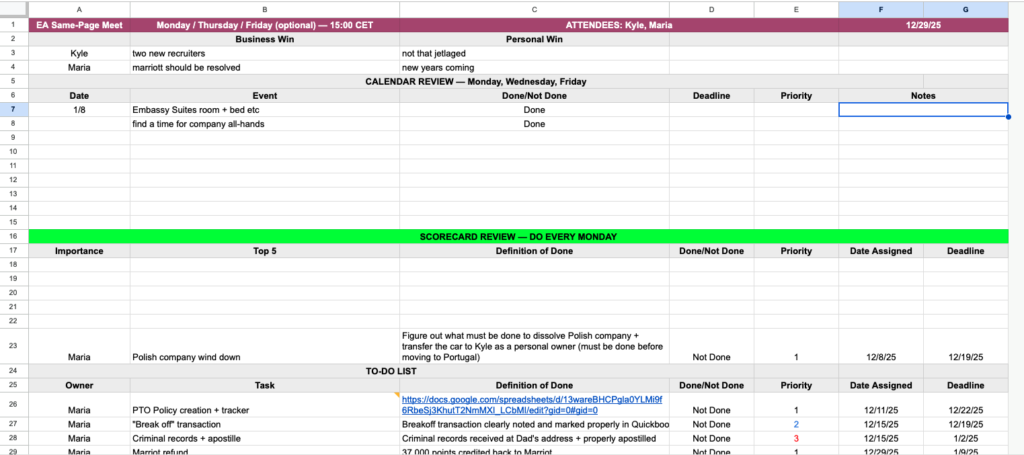
This structure is very deliberate – it forces left to right, then down reading — just like you’d read a paper or a book. It forces you to go through the entire structure, and by the end, all bases should be covered.
Business Win / Personal Win
Start every meeting by sharing one business win and one personal win each. It might sound cheesy, but there’s something about starting everything off with some positive notes that sets the tone. Mindset matters.
It builds the “professional friendship” dynamic that makes the EA relationship work. If you only ever talk about tasks, you lose the human element that makes a great EA great.
Calendar Review
Walk through the coming week: Monday, Wednesday, Friday at minimum. I like to look at least 2 weeks ahead on a weekly basis, and review a month ahead every 2 weeks.
What’s on the calendar?
Does everything make sense?
Are there conflicts?
Anything that needs to be moved?
Scorecard Review (Top 5 Priorities)
Every Monday, review the top five monthly priorities with clear “Definition of Done” for each. This is the most important section. Every priority has: What the task is, what “done” looks like (specifically), whether it’s done or not done, the priority level, date assigned, and deadline.
No ambiguity. No “I’ll know when I see it.” The Definition of Done is written down in advance so both you and your EA are calibrated on exactly what success looks like.
(In the above example, it was the end of the year and December’s projects had been completed)
To-Do List
Active tasks beyond the top 5, also with Definition of Done and deadlines. These roll over week to week until completed.
IDS: Identify, Discuss, Solve
Any issues that came up get discussed here. Not vented about. Discussed. Identify the problem. Discuss the options. Solve it. Move on.
Rate and Reset
End each meeting by rating it on a scale of 1-10. Both of you. This forces honest feedback about whether the meetings are working and whether the relationship is on track.
This format forces a direction. It prevents meetings from becoming aimless status updates. And the scorecard with Definition of Done eliminates the #1 problem in EA relationships: Ambiguous expectations.
Executive Assistant Salary Bands
In the US, a solid EA runs $70k-$85k per year. In major metro areas, closer to $90k-$120k. Add benefits, taxes, and overhead, and you’re looking at $80k-$130k all-in.
Overseas — specifically in Eastern Europe and Latin America — you can find EAs with the same skill set, fluent English, and professional experience for $2,000-$4,000 per month. That’s $24k-$48k per year.
The good EAs really know what they’re worth. And they should.
This is one of those roles where the savings aren’t just in salary — they’re in the hours of your life you get back. If you value your time at $200/hour (which is conservative for most founders), and an EA saves you 15 hours a week, that’s $3,000 a week in recaptured productivity. Even at the top of overseas pricing, the ROI is absurd.
Don’t lowball this hire.
The difference between a $1,000/month, penny-pinching EA and a $3,000/month EA is the difference between someone who manages your calendar and someone who manages your world.
The Timezone Question
Eastern Europe overlaps well with US East Coast hours — you get a solid 4-5 hours of overlap with 6-8 hours of difference. Latin America is even better: Most of LatAm is within 1-3 hours of US time zones, which means near-complete overlap with your working day.
But here’s what most people miss: An EA who works while you sleep is actually an advantage. My EA in Poland would process everything overnight. By the time I woke up in California, the world was organized. That asynchronous model works incredibly well if you set it up right.
Success Stories: What’s Possible When You Hire The Right EA
Marcos Ruiz — Solopreneur to $1M+ Agency
Marcos came to us as a one-man show running a Twitter marketing agency, barely cracking six figures. He didn’t know what position he needed — just knew he was drowning. We helped him figure out he needed an EA.
We placed Sophia with him.
Within a year and a half, she’d been promoted to operations manager. She now runs client success, onboarding, content organization — the operational backbone of the company. Marcos flew from the US to Poland to meet her in person. They sat down and planned a multi-year company vision together. He calls her a partner in his business.
When he signed with us, The Birdhouse was doing barely six figures. Today they’ve crossed a million dollars in sales. The EA was the first domino.
Kanon Clark — 15-20 Hours a Week Reclaimed
Kanon runs a lead generation company for home service contractors. Before HireUA, he was sifting through hundreds of candidates on OnlineJobs.ph and burning time on unqualified interviews. We placed someone who functions as both a data specialist and an EA — she handles research, client communication, and operational tasks.
He was working weekends just to keep up with the admin backlog. Now he’s saving 15-20 hours a week. And the thing he emphasized: He specifically wanted someone who could think outside the box, not just follow instructions. That’s the EA difference.
Both of these clients came back to hire additional people. That’s the real testimonial.
When You Need an EA (and When You Don’t)
You Need an EA If:
You’re spending more than 2 hours a day on admin, scheduling, email triage, and logistics. That’s 10+ hours a week of your time that’s worth way more than what you’d pay someone to handle it.
You’re dropping balls — missing follow-ups, forgetting commitments, running late to meetings because nobody’s managing your schedule.
You’re turning down meetings or opportunities because you literally don’t have the bandwidth to coordinate them. You’re leaving money on the table.
Your business depends on your relationships and your time — and right now both are being eaten alive by admin.
You Don’t Need an EA If:
You actually just need a VA. If your primary pain is “I need someone to post on social media, update my CRM, and do some data entry” — that’s a Virtual Assistant. An EA is overkill and you’ll be overpaying.
You don’t have any systems yet. An EA amplifies existing systems. They don’t create them from scratch. If you have no processes, no tools, no structure — hire a VA first, build the foundation, then upgrade to an EA once the systems exist.
You’re not ready to let someone in. An EA needs access to everything. If you’re the type who can’t delegate, can’t give up control, and will secretly check behind every decision they make — save your money until you’re actually ready to trust someone.
The 3 Ways to Hire an EA
DIY (Freelance Platforms)
Post on LinkedIn, Upwork, or similar platforms and hire someone yourself. You handle everything: Recruiting, vetting, interviewing, onboarding, training, and management.
This can work for EAs, but the risk is higher than with VAs because the stakes are higher.
A bad VA costs you some wasted tasks.
A bad EA costs you months of building trust and sharing access, only to start over. And…potentially, major mistakes or issues that they made. Screwing up a basic task is one thing, screwing up your tax return is another (EA terrirotyr).
“Managed” EA Companies (The Plug-and-Play Model)
Companies that hire EAs as their employees and assign them to you. Typically $25-30/hour. Many offer a “replacement” if your person goes on vacation or leaves.
Here’s my honest take: The plug-and-play model is fundamentally flawed for EAs. The entire point of a great EA is someone who KNOWS you. Your preferences, your thinking, your communication style. You build that over months. You can’t plug someone in and replicate it.
If a person is truly “plug-and-playable,” they’re not doing EA work — they’re doing admin. Which is fine. But you’re paying EA prices for admin capability.
Take that $3,000+ a month and hire the best person you can afford directly. Pay them what they’re worth. The best EAs are not interchangeable. That’s the whole point.
Recruitment / Placement Agency
A company like HireUA finds, vets, and places an EA who works directly for you. The person is yours — embedded in your business, dedicated to you, growing with you.
This is the Marcos and Sophia model. She wasn’t assigned from a pool. She was selected, vetted, and placed specifically for his business. That’s why she flew so far and so fast — that’s why he flew to Poland. You don’t build that kind of partnership with a rotating pool of temps.
If it doesn’t work out, we replace them at no cost. But unlike the managed model, the goal is to find the right person once — not to create a revolving door.
The Growth Path: EA → Operations Manager → Chief of Staff
This is the trajectory nobody talks about, and it’s one of the most valuable things I’ve learned from placing hundreds of people.
Sophia started as a basic EA. Now she runs operations at a million-dollar agency. Dozens of our placements have followed the same trajectory.
The pattern is the same:
- Hire someone competent for where you are today.
- Give them clear systems and room to grow.
- Let them evolve with the business.
The person you hire as an EA at $2,000/month might be running your operations at $4,000/month two years from now — and they’ll be worth every penny because they know your business inside out.
The Bottom Line on Hiring an Executive Assistant
An Executive Assistant isn’t an expense. It’s infrastructure.
The right EA gives you 15-25 hours a week of your life back.
They catch the balls you’d drop. They handle the communications you’d forget. They protect your time so you can spend it on the things that actually grow your business. And when the relationship is right, they become a true partner — someone who knows your business as well as you do.
The wrong EA — or the wrong expectations about the role — is worse than no EA at all. You end up with more work, not less, because now you’re managing someone who can’t manage your world.
Get clear on what you actually need. Screen for the match with YOU, not just the resume. Define what “done” looks like. Build the trust through the Triple S method (Show, Supervise, Shut Up). Run weekly L10s to stay calibrated. And if it doesn’t work out, cut it quickly and try again.
If you’re ready to hire an Executive Assistant who can actually run your world — not just book meetings — book a call with HireUA. We’ll find you someone who fits your workflow, your communication style, and your standards. And if they don’t work out, we replace them. Lifetime guarantee. That’s the deal.
Executive Assistant FAQ
How long does it take to find a good EA?
At HireUA, we have you interviewing within a week. The whole process — from initial call to placed candidate — usually takes 2-4 weeks. EAs are harder to place than VAs because the match has to be tighter, so we present fewer candidates but they’re more carefully vetted.
Should I hire an EA part-time or full-time?
If you’ve never had an EA, start part-time (20 hours/week). That’s enough to cover email management, calendar, and the core interceptor function. Once they prove themselves and you start handing off more, you’ll likely go full-time within 2-3 months. Most of our EA clients end up at 40 hours within the first quarter.
How much access does an EA need?
All of it. Email, calendar, Slack, CRM, financial dashboards, credit cards, contact lists — whatever is relevant to your workflow. An EA with limited access is like a chef with one burner. You either trust them with your systems or you don’t need an EA. If you’re not ready for that level of access, start with a VA until you are.
Do I need SOPs before hiring an EA?
It helps, but it’s not required. What IS required is that you can articulate your preferences. How do you like emails handled? What’s your travel style? What are your priorities? If you can explain it verbally, your EA can document it. Some of my best SOPs were created BY my EA after she learned my preferences. But you need to invest the time upfront to teach.
What if my EA goes on vacation?
A great EA makes their vacation nearly invisible. They plan meticulously before they leave, pre-handle everything they can, and leave clear notes for anything urgent. They don’t need a “plug-in replacement.” The best EAs make sure the business runs smooth even in their absence. That’s the mark of the role done right.
Can an EA grow into a bigger role?
Absolutely. This is one of the highest-ROI paths in hiring. Sophia went from EA to operations manager running a million-dollar company. Dozens of our placements have followed the same trajectory. If you hire well and invest in the person, your EA becomes your most trusted operator — someone who knows your business as well as you do and can eventually run entire departments.
What’s the difference between an EA and a Chief of Staff?
A Chief of Staff typically manages a team, drives strategic initiatives, and operates more as a deputy leader. An EA manages YOU — your time, your communications, your logistics. There’s overlap, but the core difference is: An EA’s job is the executive. A CoS’s job is the organization. Many EAs grow into Chief of Staff roles over time.