

I posted a job description on LinkedIn for an Executive Assistant.
Within 48 hours, it ended up on the front page of the Executive Assistants subreddit.
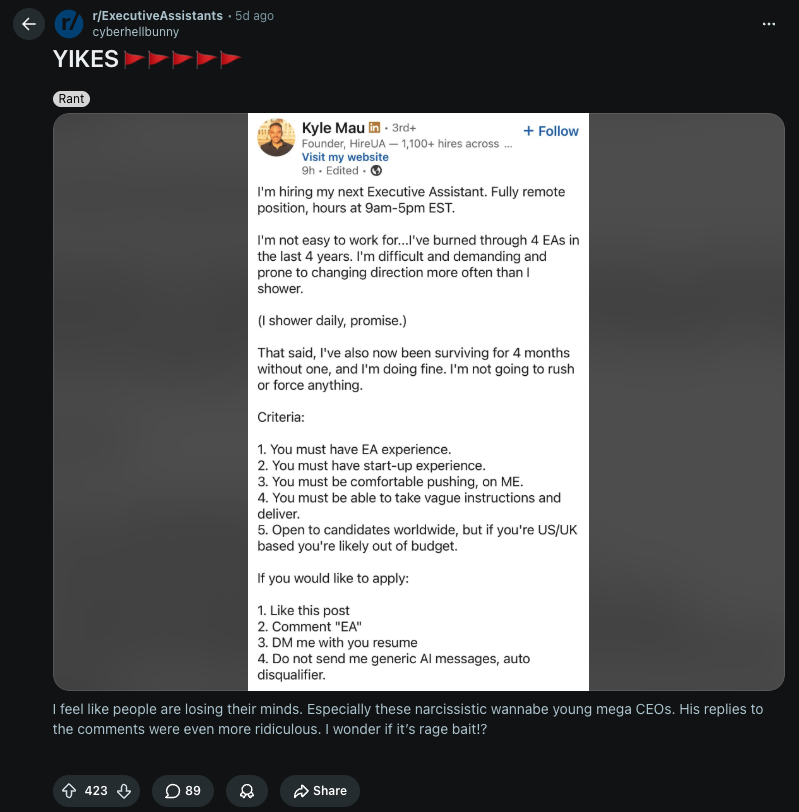
344 upvotes. 58 comments.
“Narcissistic wannabe mega CEO.”
“I would love to accept this job only to drive him nuts.”
One person called me delusional.
Another said I should just hire ChatGPT.
That same day, a candidate DM’d me on LinkedIn and said, “I appreciate the directness. When can we talk?”
She understood the role. She understood me. She understood that the job description wasn’t written for the 344 people who hated it.
It was written for her type of person.
I’m the founder of HireUA, a staffing agency that’s placed over 1,100 people into businesses across 35 countries. I’ve reviewed thousands of job descriptions from clients. Most of them are terrible. Not because the people writing them are dumb — because nobody ever taught them that a job description is a sales document, not a wish list.
This is the article that teaches you how to write one that works.
TLDR — How To Write A Job Description
- A job description is a sales document, not a wish list; keep it one page
- Strong job descriptions attract fewer but better candidates — be specific about requirements
- Post a salary range to save time and establish credibility with candidates
- Use clear, simple titles and concise language
- Commit to your approach — either attract many applicants or a few qualified ones, but don’t do it halfway
Table of Contents
- How To Write A Job Description: 1-2 Pages MAX
- Your Job Description Is a Resume for Your Company
- The Porsche Dealership
- The Framework: How to Write a Job Description That Works
- The Salary Range Is a Screening Tool
- The Stupid-Simple Filter Nobody Uses
- How NOT To Write A Job Description
- The JD Was the Easy Part
- How To Write A Job Description: FAQs
- Here’s What It All Comes Down To
How To Write A Job Description: 1-2 Pages MAX
I’m going to give you the single most useful piece of advice in this entire article before we get into anything else.
One page.
Two max.
That’s it.
If your job description is six pages, nobody is reading it. Nobody.
The best candidates — the ones with three other offers — scan it in 10 seconds. If they can’t figure out what the job is, what it pays, and where it is in those 10 seconds, they’re gone. You lost them before they read a single bullet point.
Think about it like a resume.
You tell candidates to keep it to one page. You throw out the three-page resumes that ramble about “leveraging synergies” and “driving cross-functional alignment.” You want tight, clear, relevant.
Your job description should follow the same rule.
Here’s the thing:
It’s like basketball. The worst shot you can take is a long two-pointer. You don’t get the benefit of the three. Either pull up from behind the arc or drive to the rim.
Same thing when it comes to how to write a job description.
Either commit to one page — tight, clean, everything the candidate needs and nothing they don’t. Or commit to two pages and USE all of it. Fill that second page with your interview process, your timeline, and your “nice to haves.”
The worst thing you can do is write a page and a third. That’s the long two. You didn’t commit to being concise and you didn’t commit to being thorough. You just wrote until you ran out of things to say and hit publish.
One or two. Commit.

Your Job Description Is a Resume for Your Company
Every hiring manager has sat at their desk reading a stack of resumes and thought…
“These all say the same thing.”
Examples:
“Results-oriented professional with a proven track record of excellence.”
“Detail-oriented self-starter with strong communication skills.”
“Dynamic individual who thrives in fast-paced environments.”
You hate these resumes. You can’t tell one candidate from the next. They all blur together into one giant blob of meaningless corporate language.
Nothing specific.
Nothing real.
Nothing that tells you who this person actually is or what they’ve actually done.
Now read your job description.
“We’re a dynamic, fast-paced company looking for a motivated self-starter who thrives in an ever-changing environment.”
Sound familiar?
Your job description is doing the exact same thing you hate candidates for doing on their resumes. Vague language. Generic requirements. No clear picture of what success actually looks like.
And here’s the real problem:
A bad resume gets rejected. A bad job description gets applicants — just the wrong ones.
The vague candidate who reads a vague description and thinks, “Yeah, I could probably do this” — that’s exactly the person you don’t want. They can’t tell what the job is, but it sounds easy enough. So they apply.
Meanwhile, the A-player reads your description, sees no clear expectations, no defined interview process, no indication that you actually know what you want — and closes the tab. They don’t have time for companies that can’t articulate what they need. They have three other offers from companies that can.
Bad job descriptions are a filter. They just filter in the wrong direction.
And if you wrote yours with ChatGPT — every candidate knows.
The emojis, the spacing, the bullet formatting, the “we value innovation and collaboration” line that shows up in every AI-generated JD on the internet. You can spot a ChatGPT job description from across the room the same way you can spot a ChatGPT resume.
You can’t complain about candidates using AI to write their applications when you used AI to write the thing they’re applying to.
They could marry each other. They kind of deserve each other.
The Porsche Dealership

Most articles about job descriptions will tell you how to get MORE applicants.
More reach. More visibility. More applications in the pipeline.
That’s terrible advice.
You don’t walk into a Porsche dealership and see 400 people milling around. You see maybe 12. Every single one of them can afford what’s on the floor. Every conversation the salesperson has is with a qualified buyer.
Walk into a Toyota dealership and there are 200 people. Half of them are browsing. A quarter won’t get approved for the financing. The salespeople are spending 80% of their time on people who will never buy.
Your job description works the same way.
A generic JD is a Toyota dealership. You get 500 applications and spend the next three weeks buried in resumes from people who aren’t remotely qualified. Maybe 10% are worth a phone screen. Maybe 2% get an interview. You just spent 60 hours to find 10 people.
A specific, honest, slightly polarizing JD is the Porsche dealership. You get 50 applications. 40 of them are qualified. 15 get interviews. You find your person in a week.
Fewer applicants. Better applicants. Faster hire.
Every other article on this page is teaching you how to fill the Toyota lot. I’m telling you to build the Porsche dealership.
But here’s what most people miss:
The Toyota approach can work.
There’s nothing wrong with casting a wide net — if you commit to actually sorting through everything that comes back. Some companies find incredible hires buried at application #347 out of 500. Diamonds in the rough exist. But you have to do the work to find them. You have to read every resume, screen every promising candidate, and accept that 80% of your time will be spent on people who aren’t the right fit.
What you don’t get to do is run the Toyota dealership and then act like Porsche at the last second.
You don’t get to write a generic JD, attract 500 random applicants, and then complain that nobody’s qualified. You don’t get to skip the screening because “there are too many resumes.” You chose volume. Volume costs time. That’s the deal.
So pick your lane.
Porsche or Toyota.
Specific or broad.
50 qualified applicants or 500 random ones.
Both can work.
But you have to commit.
And if that scares you — good. The best candidates are looking for companies brave enough to say what they actually want. Not companies hiding behind “competitive salary” and “exciting opportunity.” Real expectations. Real language. Real information.
The 344 people on Reddit who hated my EA job description? They self-selected out of my hiring pool. They did me a favor. The one person who DM’d me saying “I appreciate the directness” — she’s the Porsche buyer. She walked into the dealership because the sign on the door told her exactly what was inside.
The Framework: How to Write a Job Description That Works
Here’s the structure. It’s stupidly simple. That’s the point.
The Title
Three words. Maybe four. No slashes. No made-up roles.
Not “Growth Happiness Ninja.”
Not “Analytics Manager / Senior Analytics Lead.”
Not “Digital Synergy Orchestrator.”
The slash is the tell. If your title has a slash in it, you’re hiring for two roles on one salary. Pick one. And if someone has to Google your job title to understand what it means, you’ve already lost them.
Think about the show Shark Tank.
Are you trying to create a new category? Because then you have to educate people on what it is.
That’s expensive. Apple can call their retail employees “Geniuses” because they’re Apple. You’re not Apple. Call the role what it is.

For every one company that successfully invents a job title, there are a thousand that just confused everybody and got zero applicants. You have absolutely nothing to gain.
Quick-Scan Bullets at the Top
Before your first paragraph. Before your company description. Before anything.
- Position: Account Manager
- Hours: Full-time, Monday–Friday
- Salary: $80,000–$100,000
- Location: Remote (US time zones)
Four bullets. The candidate knows in 3 seconds whether to keep reading.
Every other article on this topic says lead with your company description. “We’re a leading provider of innovative solutions founded in 2012 with a mission to empower…” Nobody cares. Not yet. They care about the role, the hours, the money, and the location. Give them that first.
The Company — One Sentence
“SaaS company founded in 2012 with over 1 million users, looking for our next Account Manager.”
That’s it. Fifteen words. The candidate knows the industry, the scale, and the maturity of the business. If they need more, they’ll Google you. And if they don’t Google you before the interview — that’s a filter too. You just learned they don’t prepare.
Don’t waste three paragraphs explaining your mission statement and core values. Link to your core values page and say, “Here’s what we stand for. If these resonate with you, keep reading.” The candidate who clicks that link is self-selecting. The candidate who skips it just told you they don’t care.
The Summary Paragraph
Three to four sentences. What the role is. What success looks like. What you value.
“We’re looking for an experienced Account Manager to manage our enterprise SaaS clients. The right person reduces churn, builds long-term relationships, and becomes the client’s first call when something goes wrong — or right. We value people who take ownership and communicate directly. If you need to be told what to do every morning, this isn’t the role.”
That last sentence is a filter.
And it’s honest.
The right person reads it and thinks, “Good. I hate being micromanaged.” The wrong person reads it and feels uncomfortable. That’s the point.
How To Write A Job Description In Prose
One to two paragraphs. Not bullets. Describe the actual job like you’re telling a friend about it over coffee.
What does this person do on a Monday? Who do they talk to? What decisions do they make on their own? What does a good week look like vs. a bad one?
This is where you stop sounding like every other job listing on the internet. Templates can’t help you here. Only you know what this role actually looks like in your company.
Key Responsibilities — 5 to 10 Bullets
Now the bullets. Keep them tight. Action verbs. Specific outcomes.
- Manage a portfolio of 15–20 enterprise accounts
- Reduce quarterly churn below 5%
- Conduct weekly check-ins with each account
- Maintain clean CRM records in HubSpot
- Escalate technical issues to the engineering team within 2 hours
Not “assist with various client-related activities.” Not “support the team in achieving company goals.” Those mean nothing. If you can’t describe the responsibility in one specific sentence, you don’t actually know what the job is. And if you don’t know, the candidate sure as hell doesn’t.

Hard Requirements
The non-negotiables. Keep it to 5, maybe 7.
These are the things where if the candidate doesn’t have them, the conversation is over. C1 English. 3+ years in SaaS account management. Experience with CRM systems. Whatever the actual requirements are — not the wish list, the real requirements.
Nice-to-Haves
This section exists to STOP people from disqualifying themselves over something learnable.
“Experience with HubSpot or similar CRM.”
That “or similar” does all the work. The candidate who’s spent three years in Salesforce doesn’t see “HubSpot” and close the tab. They see “or similar” and think, “I can learn that in a week.”
Same principle everywhere. “Experience with Monday.com or similar project management tools (Asana, Notion, ClickUp).” Now you’ve told the candidate that you’re flexible on tools, you care about the skill not the specific software, and you understand that smart people learn new tools quickly.
The biggest hiring mistake I see from clients is treating nice-to-haves as hard requirements. You’re making a two-hour Loom video to save yourself from hiring the right person who uses a different project management tool. That’s insane.
The Interview Process (If You’re Using Page Two)
Commit to the second page? Use it. Lay out the process in numbered steps. Five max.
- Submit your resume and portfolio at [link]
- 15-minute screening call with our recruiter
- 45-minute interview with the hiring manager
- 1-hour trial task (paid)
- Final decision within one week
Five steps. The candidate knows exactly what they’re signing up for.
And here’s what you DON’T do — twelve rounds. A 45-day process. Four panel interviews with different stakeholders who all ask the same questions.
Long hiring processes don’t filter for the best candidates. They filter for the most desperate ones.
The A-player with three offers isn’t waiting 45 days. They took the job at the company that made a decision in two weeks. The only person left at step 9 of your 12-step process is the person nobody else wanted.
Keep it tight. Five steps. Two weeks. Make a decision.
Want help designing your job description? We take care of this for all of our clients. Click below to start hiring today.
The Salary Range Is a Screening Tool
Post the range.
Not because some state requires it. Because it’s a power move.
When you post the salary range, you earn the right to ask, “OK, we showed ours. What are you making right now?” The company that hides the salary has zero leverage to ask that question. The one that posts it has every right.
Here’s why it matters:
Both sides are playing coy. Candidates won’t say what they want. Companies won’t say what they’ll pay. Both sides are dancing around the one number that determines whether this conversation is worth having.
Put the range in the JD. Save everyone 45 minutes.
And here’s the thing nobody tells you:
The salary range is a character test.
Your range is $80K–$100K. The candidate says their expectation is $100K. You ask what they’re currently making. Two things happen:
If they say $95K — makes total sense. They want the top of the range. Reasonable.
If they play games, dodge, and eventually admit they’re making $60K — they’re trying to hustle you. They saw the top of your range and figured they’d shoot for it. A $60K-to-$100K jump is a red flag, not an ambition. It tells you they’re optimizing for the paycheck, not the role.
But the candidate who says, “I’m at $60K now. Your bottom is $80K. That’s already a big jump, and I’d be happy there” — that’s someone with integrity. That’s someone who read your JD, understood the range, and is being honest about where they stand.
The salary range didn’t just save you time. It told you who you’re dealing with.
The Stupid-Simple Filter Nobody Uses
We’ve placed over 1,100 people. Every single one of them went through a job description we wrote.
And we built a system where candidates physically cannot apply without reading every requirement first. Zero unqualified applicants.
It’s not an ATS. It’s not a $500/month software. It costs nothing. Takes 10 minutes to set up.
It is so stupidly simple that I almost don’t want to tell you, because you’ll think I’m joking. But it’s by far the most effective filter we’ve ever used.
If you want to see how it works — book a call.
How NOT To Write A Job Description
“We’re a family.”
You’re not. You’re a business.
Everybody is looking out for themselves and trying to make the most out of their life. The right candidate knows this. The right candidate wants to know what the exchange is — their skills for your compensation. Not a fake emotional bond that dissolves the first time there’s a bad quarter.
You want to describe culture? Link to your core values. One line. “Here’s what we stand for. If these resonate, keep reading.” The candidate who doesn’t click isn’t your person anyway.
Made-up titles.
“Growth Happiness Ninja” tells me you’re more interested in sounding clever than finding someone qualified. Clever titles don’t attract better candidates. They attract confused candidates. Or nobody, because no one is searching LinkedIn for “Digital Synergy Orchestrator.”
ChatGPT paste jobs.
If you copy-pasted from ChatGPT and didn’t even bother to remove the emojis or change the default formatting — every candidate sees it.
And the good ones assume you spent 30 seconds on the role they’re supposed to spend the next two years in. At least change the margins. At least take out the emojis. At least make it look like you gave it five minutes of thought.
Six-page wish lists.
The longer your requirements section, the fewer qualified people apply. Research consistently shows that candidates — especially strong ones — will skip a job posting where they don’t meet 100% of the listed qualifications. Your 30-bullet wish list isn’t thorough. It’s a repellent.
Twelve-step interview processes.
Every additional round loses you candidates. The best people are in demand. They’re not waiting 45 days for your committee to make a decision.
The JD Was the Easy Part
Congratulations. You wrote a job description that fits on one to two pages, leads with real information, describes the role like a human being, and doesn’t sound like every other posting on the internet.
That took you 30 minutes.
Now you’re about to get 300 applications.
Do you know how to tell a ChatGPT-written resume from a real one?
Do you know what a fabricated answer sounds like on a screening call?
Do you know how to spot the candidate who interviews like a 9 and performs like a 4?
The job description is step one. The screening, the interviews, the trial task, the reference checks, the onboarding — that’s where hires succeed or fail. And that’s the part most companies get wrong because they’ve never done it 1,100 times.
Writing the JD was the appetizer. Reading 500 resumes is the meal.
If you want to do it yourself — go. You have everything you need. The framework above works.
If you want someone who’s placed over 1,100 people across 35 countries, who reviews your JD, screens every candidate, runs every interview, and guarantees the hire for a full year — that’s what we do.
How To Write A Job Description: FAQs
How long should a job description be?
One page.
Two if you need the space for interview process details and nice-to-haves. A page and a third is the worst — you didn’t commit to being concise and you didn’t commit to being thorough. Pick your shot.
Should I post the salary range?
Yes.
It saves you time, earns you the right to ask what the candidate is making, and acts as a character test. The candidate who sees $80K–$100K and demands $100K while making $60K just told you something important about how they negotiate.
Can I use ChatGPT to write my job description?
You can. And every candidate will know you did.
If you’re going to use it as a starting point, at minimum remove the emojis, change the formatting, and replace the generic language with specifics about your actual role. But the best JDs can’t be written by AI because they require you to know what the job actually is — and that takes thinking, not prompting.
How many requirements should I list?
Five to seven hard requirements. Five to seven nice-to-haves.
If your list is longer than that, you’re writing a wish list, not a job description. And your wish list is actively scaring away qualified people.
Should I include “additional duties as assigned”?
No.
It’s lazy and it tells the candidate nothing. Ask about flexibility in the interview instead. “How do you feel about tasks outside your core scope?” The answer tells you everything the boilerplate line doesn’t.
What if I don’t know exactly what I need?
Then you’re not ready to write the JD yet.
And if you’re not ready to write the JD, you’re definitely not ready to sort through 300 applications. Figure out what success in this role looks like first. If you can’t describe it in one sentence, keep thinking.
Should I include the company description?
One sentence. “SaaS company founded in 2012, 1M+ users, looking for an Account Manager.”
They’ll Google you if they’re interested. And if they don’t research your company before the interview — you just learned something important about how they prepare.
How do I handle job descriptions for international or remote hires?
State the time zones, the language requirements, and the communication expectations.
A Developer who needs B2 English for Jira tickets and one weekly standup is a different hire than an Executive Assistant who’s on the phone with your clients every day and needs C1 minimum. Know which roles need conversational English and which just need technical English. That distinction comes from experience — not a template.
What’s the right number of interview rounds?
Five steps max.
Submit, screening call, hiring manager interview, trial task, decision. If you can condense two steps into one line — “45-minute interview + 1-hour paid trial task” — do it. Every additional round loses you candidates. The best people have other offers. They’re not waiting 45 days.
Should I put “we’re a family” in the JD?
No. It’s a red flag to every experienced candidate.
It signals that boundaries don’t exist, that you’ll expect unpaid overtime disguised as “commitment,” and that you’ll guilt people who leave. Say what you actually offer. Health insurance, PTO, growth opportunities, clear expectations. Business, not family.
What if my role is niche and I need specific tools?
Separate hard requirements from nice-to-haves and always add “or similar.”
If you need someone who knows HubSpot, write “Experience with HubSpot or similar CRM (Salesforce, Pipedrive, Zoho).” The person who’s mastered Salesforce can learn HubSpot in a week. You’d rather have the right person learning a new tool than the wrong person who already knows it.
My last three hires didn’t work out. Is the JD the problem?
Maybe. A vague JD attracts vague candidates.
If you’re consistently getting people who don’t match expectations, look at your job description first. Does it describe what success looks like? Does it list real responsibilities or generic ones? Does it filter for the right qualities? The JD is always step one of the diagnosis.
How do I write a JD for a role I’ve never hired for?
Talk to someone who does that job.
Or talk to someone who’s hired for that role before. Don’t Google a template and copy-paste — you’ll end up with a job description for a role that doesn’t match what you actually need. If you can’t find anyone to help you define the role, that’s a sign you might need a staffing partner, not a job board.
Should the title be creative or simple?
Simple. Always.
“Finance Assistant” gets found on LinkedIn and job boards.
“Brand Storytelling Evangelist” doesn’t. For every one company that successfully invents a job title, there are a thousand that confused everybody and got zero applicants.
Does the job description really matter that much?
It’s where everything starts.
A great JD attracts fewer, better candidates. A bad one attracts more, worse candidates. Hiring is already hard enough without starting from a broken foundation. Simplify it and you’ll get better results. And that starts with the job description.
Here’s What It All Comes Down To
Hiring is a drag. It’s administrative, it’s time-consuming, and most of the process feels like manual work that goes nowhere.
And that’s exactly why most people cut corners on the job description. It’s the first step, so it feels like the least important one. Knock it out in 10 minutes, paste it on a job board, and start praying.
But everything downstream flows from this document. The quality of your applicants. The speed of your hire. Whether the person you bring on actually understands what they signed up for — or quietly realizes on day 14 that this isn’t what they expected.
Every single thing I’ve told you in this article comes back to one word.
Commit.
Commit to one page or two.
Commit to Porsche or Toyota.
Commit to posting the salary or keeping it private.
Commit to five interview steps or three.
Commit to being specific about what you want, even if it scares away 80% of applicants — because the 20% who stay are the ones you actually want.
The companies that struggle with hiring aren’t the ones doing it wrong. They’re the ones doing it halfway. Half-specific titles. Half-honest salary ranges. Half-thought-out requirements lists. A page and a third.
Standing out takes courage.
Not much.
Not “bet the company” courage.
Just the courage to write a job description that sounds like a human being wrote it instead of a committee. The courage to say what you actually want.
The courage to post it knowing that some people will hate it — and understanding that those people were never going to be your next great hire anyway.
If you want help with how to write a job description and attract the top A-Players worldwide, click the button below: