

Should You Hire Latin American Talent? The Honest Guide:
Every company selling Latin American talent has the same homepage.
A smiling stock photo.
The word “nearshore” in the headline.
A promise that you’ll save 70% on salaries.
Two of those three things are misleading.
We’ll get to which ones…
I run HireUA, a remote placement agency with 1,100+ placements across 35 countries.
We started in Eastern Europe.
We expanded into Latin America because clients kept asking for it, and because the talent is real.
But we’re not a Latin America shop.
We place wherever the best person for your role actually lives.
That changes how I can write this article.
A company that only recruits in Latin America has to tell you Latin America is the answer.
I don’t.
Sometimes it is.
Sometimes I’ll tell a client to hire their Developer in Eastern Europe and their Appointment Setter in Colombia, and both of those calls come from the same place: We’ve placed people in both, and we know what each region is actually good at.
So here’s the full picture.
The pluses.
The cons nobody puts on a homepage.
The best positions.
The countries we love, the countries we skip, and why.
TLDR — Hire Latin American Talent
- Hiring Latin American talent can offer significant benefits but comes with caveats, including cultural differences and language proficiency.
- The ‘nearshore’ label often misleads companies into thinking Latin America offers cultural alignment similar to the US.
- You’re not just buying cheaper labor; you’re gaining access to high-quality talent that offers an unfair advantage.
- Effective vetting is essential, as the hiring process in Latin America reveals challenges such as flakiness and varying English proficiency.
- Companies should consider the specific roles best suited for Latin American talent, particularly in sales, customer service, and creative positions.
Table of contents
- TLDR — Hire Latin American Talent
- “Nearshore” Is a Sales Word
- The Cost Truth: You’re Not Buying Cheap. You’re Buying Unfair.
- Hire Latin American Talent: What Latin America Is Actually Good At
- The Cons of Hiring Latin American Talent No Homepage Admits
- The Best Positions to Hire Latin American Talent
- The Country-by-Country Breakdown for Hiring Latin American Talent
- The Real Problem Isn’t Finding People. It’s Vetting Them.
- Sometimes Hiring Latin American Talent Isn’t the Right Answer. We’ll Tell You.
“Nearshore” Is a Sales Word
Let’s start with the word you’ll see on almost every website that promises to help you hire Latin American talent.
Nearshore.
Here’s what it’s supposed to mean: They’re close, so it’s basically like hiring an American.
Here’s what it actually means: The time zones line up.
The time zone part is true, and it matters.
When your team is in Latin America, you’re mostly working the same day.
Bogotá is on Eastern time.
Mexico City runs an hour or two behind Dallas.
Even Buenos Aires, at the bottom of the continent, is only an hour or two ahead of New York.
Compare that to a Developer in Manila who is 12 hours away from your standup, and yes, the overlap is a real advantage.
But “nearshore” smuggles in a second claim, and this one is a stretch: That because the map looks close, the culture comes along with it.
It doesn’t.
If you’re in San Diego hiring in Tijuana, sure, there’s real overlap.
But someone in Paraguay has about as much in common with your Ohio office as someone in the Philippines does.
- Different work culture
- Different communication norms
- Different assumptions about deadlines and feedback and what “urgent” means.
Nearshore sells you a time zone and lets you assume a culture.
The time zone is real.
The culture is something you screen for, one person at a time.
That’s true whether you’re trying to hire Latin American talent or anywhere else in the world.
Anyone who tells you otherwise is reading you their homepage.
And one more thing, while we’re here: Argentina is a 10-hour flight from Dallas.
That’s about the same flight time as to Germany.
“Near” is doing a lot of work in that word.
The only country in Latin America that’s actually near, in the get-on-a-plane-and-go-meet-your-team sense, is Mexico.
More on that below.
The Cost Truth: You’re Not Buying Cheap. You’re Buying Unfair.
Now the second homepage promise.
The 70% savings.
If you want to hire Latin American talent, here’s the first thing to understand: Latin America has talent at every price point, and the quality tracks the price.
Rock-bottom rates buy rock-bottom results.
The good ones cost.
Here’s why that’s the best news in this article.
A strong offshore Developer out of Latin America, Eastern Europe, or the Philippines runs $5,000 to $7,000 a month.
That’s roughly what a mediocre mid-level Developer costs in the US.
A good US Developer is running $12,000 to $15,000 a month once you’re done with salary, benefits, and payroll taxes.
Read that again.
For the price of a mediocre American hire, you get a top-tier one.
That’s not a discount.
That’s an unfair advantage.
You’re not cutting corners on talent; you’re getting better talent than your competitor down the street who’s paying double for it and feeling responsible about it.
For non-technical roles, here’s the ladder we see across regions.
A solid Virtual Assistant out of the Philippines starts around $1,000 a month.
Latin America runs about 10 to 15% above that.
Europe runs another 10 to 15% on top of Latin America.
Latin America sits in the sweet spot of the ladder: A step up from Asia, cheaper than Europe, same workday as you.
Hire Latin American Talent: What Latin America Is Actually Good At
Enough about the sales pitches.
Here’s where the region earns it.
They Already Know How to Sell to You
This is the one nobody else leads with, and it’s the strongest card in the deck.
Latin America has spent two decades selling to the United States.
- Call centers
- SDR teams
- Appointment Setting
- Client Success
There is a deep pool of people who have already spent years on the phone with American customers, who understand American buying psychology, and whose accent American ears are already comfortable with.
If you’re hiring for Sales, this region should be your first call.
Not your third.
The Same Workday
This one is real and it compounds.
Your 9 AM standup is their 9 AM standup, give or take an hour.
Questions get answered in minutes, not overnight.
Small problems stay small because someone flags them while you’re both awake.
If you’ve ever managed someone 12 time zones away, you know exactly how much this is worth.
The Cons of Hiring Latin American Talent No Homepage Admits
Now the part most companies that help you hire Latin American talent conveniently skip, because their entire business depends on you not thinking about it.
The Flakiness Stigma
I’ll say the quiet part: LATAM has this “flakiness” stereotype. Maybe it’s the beach and salsa. I don’t know.
No-shows, vanishing acts, the interview that gets rescheduled twice and then goes silent.
I lived in Colombia for a while, and the running joke was that if you wanted one date to actually happen, you booked five.
Does that carry over into work?
People believe it does, clients act like it does, and belief alone makes it your problem when a candidate doesn’t show up to the kickoff call.
Here’s what I can also tell you.
Flake risk is…everywhere. Every country.
The candidates who ghost are the same candidates who show up late to the screening interview, keep their camera off, and can’t tell you one thing about your company.
They telegraph it.
You just have to be watching for it, and most companies hiring abroad for the first time aren’t.
And there’s a flip side nobody mentions.
Pull a pickup truck into a Home Depot parking lot in the US on a Saturday morning and you’ll get swarmed by people wanting work before you’ve opened the door.
That hunger exists in Latin America too, in force.
The person who fought their way to fluent English in a country where almost nobody speaks it did not do that to flake on your Tuesday call.
You just have to find that person.
Which brings us to English.
The English Gap Is Real, and the Averages Will Scare You
Here’s a number the “nearshore” homepages never show you.
EF Education First tests millions of adults worldwide and ranks 123 countries by English proficiency (the full index is at ef.com/epi).
In the 2025 edition, exactly one Latin American country lands in the High proficiency band:
- Argentina, with a score of 575, the best in the region
- Brazil scores 482
- Colombia scores 480
- Mexico sits near the bottom of the entire region
Now put those numbers next to the regions we also place from, because this is the comparison no single-region agency will ever show you:
- Croatia scores 617, second in the entire world.
- Poland scores 600.
- Serbia scores 578, edging out Argentina.
- Ukraine comes in at 526.
- The Philippines scores 569.
- India, where English is an official language of government, scores 484, in a dead tie with Brazil.
Sit with that last one.
A billion people, English on the school curriculum and the street signs, and the average tester scores the same as Brazil, where English is a foreign language most of the country never touches.
That’s the haystack problem in one number.
What the English Rankings Actually Mean for Hiring Latin American Talent
So yes, the Latin American averages look scary next to Europe.
If you’re planning to hire Latin American talent, here’s why they shouldn’t scare you off, and why they should absolutely change how you hire.
Those are national averages, and you’re not hiring the national average.
Travel through Brazil or Colombia and you understand the numbers fast.
These are enormous countries.
Fly over Brazil for four hours and it’s jungle the whole way down.
There are vast stretches of both countries where English has no reason to exist, because nobody there will ever use it.
The averages measure the whole country.
You’re hiring from the connected cities, from the slice of the population that’s plugged into the global economy.
And within that slice, something interesting happens.
I built my company on an analogy I still use with clients today.
In a country where English is everywhere, like the Philippines or India, finding a great English speaker is finding a needle in a haystack.
Hundreds of millions of people, and the brilliant ones are in there somewhere, but you’re fishing in an ocean.
In a country where English is NOT the default, the logic flips.
A Colombian who speaks C1 English chose that.
Nobody handed it to them in school.
They wanted the American shows, the international career, the opportunities.
That level of English in that country is a signal all by itself.
It tells you about drive before you’ve asked a single interview question.
So the English gap is real, and it’s also a filter working in your favor.
The top of the pool is excellent.
The middle is thinner than Europe’s.
Your screening has to be built for that shape, which is exactly why the “post a job and pick from applicants” approach fails harder when you hire Latin American talent than almost anywhere else.
Some of These Pools Are Small
One more honest con.
Latin America gets sold as one giant talent pool.
It’s not.
It’s a handful of deep pools and a lot of shallow ones.
- Brazil has around 213 million people.
- Mexico has around 132 million.
- Colombia has around 53 million.
- Argentina around 46 million.
Those are deep pools. Whatever role you need, the needles are in there.
- Ecuador has about 17 million people.
- Honduras has about 10 million.
- Paraguay has 7 million.
- Uruguay has 3.4 million, which is less than the Dallas metro area.
There are excellent people in the small countries.
We’ve found them.
But you fish longer, and no agency has a bench of them sitting on the shelf, no matter what their homepage says.
The Best Positions to Hire Latin American Talent
If I’m ranking what this region does best, here’s the list.
1. Sales, Appointment Setting, and SDRs
The number one answer, and it isn’t close.
Two decades of selling to American customers built a workforce that already knows your buyer.
The accent is smooth to American ears, the cultural references land, and the phone skills are battle-tested.
If you’re building outbound, start here.
2. Executive Assistants
Same time zone as the executive is half the job.
An Executive Assistant who’s asleep during your workday is a message-forwarding service.
Latin American EAs are strong, and the workday overlap turns them into an actual extension of you.
3. Creative Roles: Designers, Video Editors, Creative Strategists
Brazil and Colombia in particular produce standout creative talent.
I have a personal theory about this.
These are cultures where aesthetics are everywhere, where dance is a national pastime and carnival is a calendar event.
Whatever the cause, the portfolios coming out of São Paulo and Medellín speak for themselves.
Some of the best Designers we’ve placed came from these two countries.
4. E-commerce Operations
Latin America has a thriving DTC and Shopify scene of its own, which means the talent pool has hands-on experience with the exact stack American e-commerce brands run: Shopify, Klaviyo, Meta ads, the works.
And the One I’d Send Elsewhere: Developers
Here’s where owning a 35-country bench changes the advice.
Latin American Developers are good.
But when a client asks me where to hire technical talent, I usually point them to Eastern Europe, and I’ll tell you my theory on why.
Eastern Europe inherited a deeply technical education culture.
The Soviet system, whatever else you want to say about it, drilled math, physics, and engineering into generations of students, and that legacy is still in the universities and the hiring pipelines.
And then there’s my less scientific theory…
Latin America has the beach.
Sunshine most of the year.
What does a computer guy in Eastern Europe do all winter, when it’s below zero for four months straight?
He sits inside and codes.
Take it or leave it, but the track record backs the theory.
For Developers, we go east.
For Sales, we go south.
A company that only recruits in one region can’t tell you that, because they only have one answer to sell.
The Country-by-Country Breakdown for Hiring Latin American Talent
This is our internal read after placing across the region.
You won’t find this on a homepage, because a homepage has to love every country equally.
Mexico: The Only Actual Nearshore
Everything the word “nearshore” promises is true here, and pretty much only here.
Real cultural overlap from decades of integration with the US economy.
Same workday.
And you can go meet your team: Dallas to Mexico City is about a two-hour flight.
That last part matters more than people think.
If you’re hiring an entire remote team rather than a single hire, Mexico is the one place in the region where flying down for a quarterly onsite is a cheap domestic-length trip.
One thing to know: Mexico’s average English sits near the bottom of the region.
The great English speakers are there, in numbers, but this is a screen-hard country.
The average applicant will not be your hire.
Best for: Full remote teams, operations roles, anyone you want to see in person.
Argentina: The Closest Thing to Europe
Argentina is the country that surprises clients most.
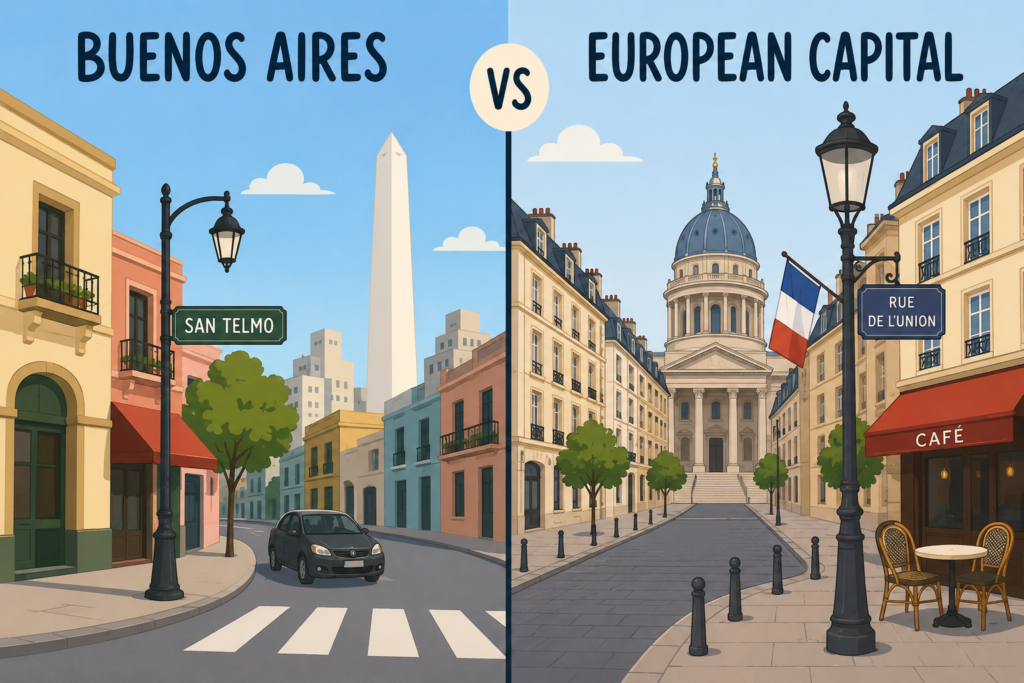
It’s by far the most Westernized, most European country in Latin America.
Walk through Buenos Aires and you could convince yourself you’re in Madrid or Paris.
The café culture, the architecture, the late dinners.
The English backs it up.
Argentina is the only country in the region in EF’s High proficiency band, the best English in Latin America, with Buenos Aires scoring higher than any other city on the continent.
Now, the money.
Argentina spent years as the internet’s favorite arbitrage story, and that story is over.
The currency controls came off, the parallel exchange rate converged with the official one, and Buenos Aires is no longer the fire-sale it was a few years ago.
Anyone still pitching you Argentina as dirt cheap is reading old blog posts.
Here’s the current reality, and it’s still very good.
Overall costs run about 39% below the US.
A steak dinner with a bottle of Malbec that would run you $100+ in Austin costs about $35 in Buenos Aires.
Beef is $4 to $6 a pound.
A professional living well in the capital spends $1,500 to $2,000 a month, total.
What that means for you: An Argentine professional earning a US-pegged salary is living well, which makes your offer strong and your retention stronger.
You’re not buying cheap.
You’re buying the best English in the region, in the most European city on the continent, at a price that still makes the math easy.
Best for: Client-facing roles, EAs, anything where English polish is the job.
Brazil and Colombia: The Creative Engines
I’m grouping these because they share a superpower: Creative talent.
Designers, Video Editors, Creative Strategists.
Something about these cultures produces people with a visual sense you can’t teach.
Add deep pools, 213 million people in Brazil and 53 million in Colombia, and you have the 2 countries where we go hunting for creative roles first.
Colombia adds a second weapon: It’s on Eastern time and has a massive sales-and-service workforce built on years of serving US companies.
For SDRs and Appointment Setters, Bogotá and Medellín are the first cities on our list.
The catch for both: The English averages are low, B1 territory.
The C1 speakers are in there, and remember what that C1 means in a country like this.
Someone chose it, fought for it, and wants exactly the kind of opportunity you’re offering.
But you will interview through a lot of B1 to find them, and if your screening process can’t tell the difference in the first five minutes, this is where it’ll cost you.
Best for: Creative roles, sales roles (Colombia especially), e-commerce operations.
The Cheap Unknowns: Paraguay, Ecuador, Honduras
Here’s a tier most agencies won’t even mention, because they have no bench there.
These are low-cost countries with good people and small pools.
- Honduras, interestingly, posts better average English than Brazil, Colombia, or Mexico.
- Paraguay is one of the cheapest labor markets in the region.
- Ecuador sits in a sweet spot on Eastern time.
The trade-off is pure numbers.
Ecuador has 17 million people.
Honduras has 10 million.
Paraguay has 7 million.
Nobody has a deep bench in these countries, and anyone who claims to is lying.
What you can do is get lucky with a great individual hire at a great price, if your sourcing goes wide and your screening is sharp.
Best for: Budget-conscious hires where you’re willing to search longer for the right person.
The Ones We Skip: Chile, Uruguay, Panama, Costa Rica, Peru
This might be the most useful part of this article, because nobody selling Latin American talent will tell you which countries to avoid.
Chile, Uruguay, Panama, and Costa Rica share a problem, and the problem is that they’re doing great.
These are the richest countries in the region.
Uruguay has the highest income per person in all of Latin America and the region’s largest middle class.
Chile, Panama, and Costa Rica aren’t far behind.
Good for them.
Bad for you.
When a country’s professionals have strong local salaries, stable currencies, and comfortable careers at home, very few of them are hunting for remote contractor work with a foreign company.
The pool of people who want the job you’re offering is thin, and the ones who do want it price accordingly.
Peru is a different story with the same conclusion: The remote-work candidate pool has just never developed the depth of Colombia or Brazil.
We’ve looked.
It’s thin.
Could you find a great hire in Santiago or Montevideo?
Sure.
But when a client asks where to spend their search budget, we point at the deep, hungry pools, not the comfortable ones.
The Real Problem Isn’t Finding People. It’s Vetting Them.
Here’s the thing you’ve probably already figured out if you’ve tried this yourself.
If you’re trying to hire Latin American talent, sourcing candidates is the easy part.
Post a role and you’ll drown in applications.
LinkedIn, job boards, marketplaces, they’ll all deliver you hundreds of resumes by Friday.
Then what?
Everything in this article, the flakiness risk, the English gap between B1 and C1, the difference between a $2,000 “senior” and a $5,000 actual senior, every single one of those is a vetting problem when you hire Latin American talent.
The region’s upside is real, and it is entirely locked behind your ability to tell the top of the pool from the middle in a 30-minute interview.
Most companies can’t.
Not because they’re not smart, but because they’ve never had to build the muscle.
You’ve hired Americans your whole career.
Your instincts are calibrated for American resumes, American accents, American interview behavior.
The first time a candidate from Barranquilla with a beautiful resume no-shows your second interview, you’re not unlucky.
You’re uncalibrated.
How We Hire Latin American Talent Differently
This is where I tell you what we actually sell, because it’s not access to candidates.
I’ve personally screened over 10,000 resumes and interviews building this company.
Out of that came a scoring system that every one of our Recruiters runs on every single candidate before a client ever sees them.
It grades the things that predict success in a remote international hire, and it’s deliberately unforgiving.
Candidates either clear the bar or they don’t get submitted.
No gut feelings, no “let’s see how the client likes them.”
That system, and the retention numbers it produces, is the product.
The flakiness stigma, the English gap, the churn problem, we didn’t read about those.
We built the filter for them, one screwed-up hire lesson at a time.
It’s an unfair edge over every company still hiring on gut feel, and I’m not going to print the rubric in a blog post.
What I will tell you is what it produces: Candidates who show up, who’ve already been graded on the exact things that were going to bite you, and who stick.
And if a bad hire slips through anyway?
We replace them.
That guarantee only works as a business model if your vetting is good enough that you almost never pay it out.
By the way, if you want to see what candidates say about how recruiting companies in this space treat people, go read Reddit.
The threads are full of good candidates describing being ghosted, ignored, and processed like ticket numbers by Latin American staffing firms.
That treatment shows up in your hire’s attitude before day one.
We treat candidates like future teammates, because that’s what they are, and it’s part of why our placements stay.
Sometimes Hiring Latin American Talent Isn’t the Right Answer. We’ll Tell You.
One last thing, and it’s the reason this article can be honest where the others can’t.
A Latin America-only recruiting firm has exactly one answer to every hiring question you ask.
Developer? – Latin America.
EA? – Latin America.
Bookkeeper, Designer, SDR? – Latin America, Latin America, Latin America.
They’re not lying to you.
They just have nothing else on the shelf.
We place across 35 countries.
When you tell us what you’re hiring for, we can give you the real answer.
That’s the unfair advantage.
It’s in the name.
HireUA: The UA stands for Unfair Advantage, and this is what it looks like in practice.
Sales role? Latin America, full stop, probably Colombia or Mexico.
Senior Developer? We’re probably sending you to Eastern Europe, and we’ll tell you exactly why.
Executive Assistant? Depends on your hours, your budget, and how much polish the role needs.
Could be Buenos Aires.
Could be Belgrade.
That’s the conversation.
Not a pitch for a region.
A diagnosis for your actual role, from a company that’s placed 1,100+ people and has no incentive to force your hire into the one region it knows.
Book a discovery call and tell us what you’re trying to build.
If Latin America is the answer, we’ll find you the top of the pool.
If it’s not, we’ll tell you that too, and then we’ll find you the right person anyway.
That’s the whole offer.