
Vancouver, 2006.
A 29-year-old Mozilla programmer named Graydon Hoare comes home from work and finds his building’s elevator out of order.
The elevator’s software crashed.
Again.
He lives on the 21st floor.
Somewhere around flight 15, climbing past door after door, he’s thinking: We put a man on the moon, and I can’t get a ride to my apartment because a computer program fell over.
Most people would get to the top, catch their breath, and forget about it.
Hoare opened his laptop and started designing a programming language.
One built so that software like that elevator’s could never crash that way again.
He named it Rust, and today it runs some of the most critical systems on the planet.
Here’s why this matters when you hire backend developers:
Every major backend language exists because one specific person ran out of patience with one specific problem.
All of them.
Java, Python, Node, the language behind Shopify — each one was born from a moment exactly like that stairwell.
And the problem each founder was solving tells you precisely what that language is good at, what got built on it, and what it will cost you to hire for it.
That’s the fastest education in backend hiring you will ever get, and it’s the rest of this article.
But first, one uncomfortable fact from our side of the table.
TLDR
- Graydon Hoare created Rust to solve frustrations with software failures, highlighting that programming languages often stem from specific problems.
- Hiring for a specific backend language, like Python or Java, is more important than the label ‘Backend Developer.’
- Each language has intrinsic qualities that influence hiring: Java for stability, Python for data and AI, and Node for real-time applications.
- Knowing your existing backend language matters greatly when hiring, as it affects the candidate pool and the type of expertise needed.
- Costs to hire backend developers vary widely based on language and region, with mid-level developers overseas ranging from $2,500 to $6,000 per month.
Table of Contents
- Nobody Actually Hires a “Backend Developer”
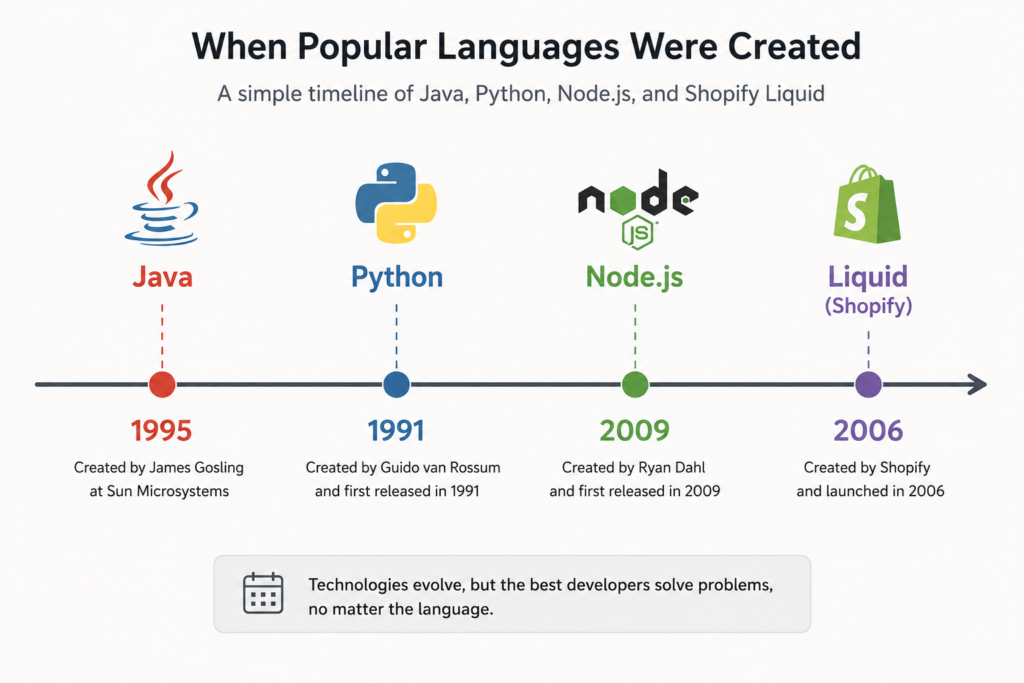
- Java: Built for TV Boxes, Ended Up Running the Banks
- Python: A Christmas Hobby That Ate the World
- Node: A Progress Bar Changed Everything
- Shopify: A Snowboarder Who Hated Every Store Ever Built
- The Ones You Probably Don’t Need
- The Question That Actually Decides Your Hire
- “But I Don’t Know Which Language I Need”
- What It Costs to Hire Backend Developers
- Frequently Asked Questions
- The Bottom Line
Nobody Actually Hires a “Backend Developer”
We’ve made over 1,100 placements across 35 countries.
Number of clients who have ever asked me for a “Backend Developer”: Zero.
Not one.
In 7 years of discovery calls, booking forms, and late-night Slack messages from founders in a panic, nobody has ever said those words.
You know what they say instead?
“I need a Python guy.”
“We’re a Java shop and our lead just quit.”
“Can you find me someone who knows Node?”
“Backend Developer” is a job title that exists on agency landing pages and nowhere else.
It’s a label stretched over a dozen completely different specialists who don’t share tools, don’t share communities, and mostly can’t do each other’s work.
What they share is a language.
And the language your business runs on matters more than almost anything on any individual candidate’s resume.
Quick definition for anyone who needs it, then we meet the annoyed people.
Your product has 2 halves.
— The front end is everything your customer sees and touches: Pages, buttons, checkout forms.
— The back end is everything behind the wall: The database storing your orders, the logic processing your payments, the code deciding what happens when 500 people hit your site at once.
I’ve written before that back-end quality is invisible to you.
You cannot look at a database and know if it’s built well.
That hasn’t changed.
What I didn’t tell you is that “which backend language” is a bigger decision than “which backend candidate.”
Watch.
Java: Built for TV Boxes, Ended Up Running the Banks
1991: A team at Sun Microsystems, led by James Gosling, is out of patience with existing languages — none of them can do what television set-top boxes need.
Machines with tiny memory that can never crash and have to run identical code on completely different hardware.
So they build their own… They name it Oak, after a tree outside Gosling’s office window.
Then the whole thing fails.
They bid on a major set-top box contract in 1993, get told they have the best technology in the room, and lose anyway on business politics.
They chase the interactive TV market until 1994 and finally admit it isn’t real.
So they point the language at this new thing called the internet, rename it Java because “Oak” is already trademarked, and accidentally build the most important business language in history.
What this means for your hire: Java kept the DNA of its failed mission.
It was engineered for machines that can’t crash and code that outlives its authors.
That’s exactly why banks, insurance companies, and enterprise systems run on it 35 years later.
If your business runs on Java, you’re not hiring for speed or flash. You’re hiring someone who can walk into a codebase older than they are and not break anything.
Java candidates skew senior, careful, and experienced — and they’re one of the deepest talent pools we place from.
Python: A Christmas Hobby That Ate the World
December 1989.
A Dutch programmer named Guido van Rossum is out of patience with something much smaller: He’s bored over the holidays.
So he writes a programming language.
He names it after Monty Python’s Flying Circus — not the snake — and designs it around one obsession: The code should be readable.
A human should be able to look at Python and understand what it does.
That readability is why scientists adopted it.
- Which is why data work moved there
- Which is why machine learning lives there
- Which is why, when the AI wave hit, it hit in Python
What this means for your hire: Python means data, automation, AI, and APIs.
It also means the largest and most polluted candidate pool of any language on this list — because Python is what every bootcamp on Earth teaches first.
When a client asks us for a Python Developer, the real question is always: Which Python?
The one who builds machine learning pipelines and the one who writes web apps share a language and almost nothing else.
Screening Python is 80% figuring out which Python you actually need.
Node: A Progress Bar Changed Everything
This one is my favorite.
Around 2009, a programmer named Ryan Dahl watches a demo on Flickr.
You upload a photo and a progress bar fills up on screen.
People are amazed…
Dahl looks at how it works under the hood and runs out of patience on the spot. The browser has to keep tapping the server on the shoulder:
How much have I uploaded now?
How about now?
And the server, busy holding that one upload, struggles to handle anyone else at the same time.
He thinks there has to be a better way.
So he takes JavaScript — a language that had only ever lived inside browsers — and makes it run on servers.
He builds it over six months of eight-hour days in a Starbucks in Cologne, Germany. A Starbucks without WiFi.
That project became Node.
What this means for your hire: Node is built for handling thousands of small things at once.
- Chat
- Notifications
- Live updates
- APIs
It’s the backbone of the modern startup stack, and it comes with a quiet hiring superpower: Because Node is JavaScript, one language can run your entire product, front to back.
For a small team, that flexibility is worth real money.
One warning: “JavaScript Developer” is one of the emptiest titles in hiring, and I wrote a whole article on the React version of the same problem.
A front-end JavaScript person is not a Node person.
Ask which side of the wall they live on.
Shopify: A Snowboarder Who Hated Every Store Ever Built
Early 2000s.
A German programmer named Tobias Lütke wants to do something simple: Sell snowboards online.
He tries the e-commerce software that exists…
All of it.
And he runs out of patience with every single option — clunky, ugly, built by people who had clearly never tried to run a store themselves.
So he builds his own snowboard store from scratch.
And somewhere along the way he realizes the store software he built to sell snowboards is worth more than the snowboards.
That software became Shopify.
And the template language Lütke wrote for it — Liquid — is now its own hiring category, because millions of stores run on it and most developers have never touched it.
What this means for your hire: If your business runs on Shopify, general backend talent isn’t your answer.
You need someone who lives in Liquid and knows the platform’s walls, because Shopify decides what your developer can and can’t touch.
Different enough world that I wrote a full guide on hiring Shopify Developers.
The Ones You Probably Don’t Need
Somewhere in your research, someone will mention Go or Rust.
Let me save you the detour.
Go was built at Google in 2007 by three engineers out of patience with waiting — the origin story involves a single build of one program taking 45 minutes.
Go is what you hire for when you have Google-scale infrastructure problems.
And Rust, you already know… The elevator language.
Built for software that is never allowed to fail: Operating systems, medical devices, financial infrastructure.
Both are brilliant.
Both are expensive.
And if you’re reading a hiring guide to learn what backend developer means, you almost certainly need neither.
If an agency is pushing Rust on your five-person company, they’re selling you a Formula 1 engine for a grocery run.
The Question That Actually Decides Your Hire
Forget the resume for a second.
Forget the interview questions.
Here’s the fork in the road, and it’s the first thing we establish on every developer call:
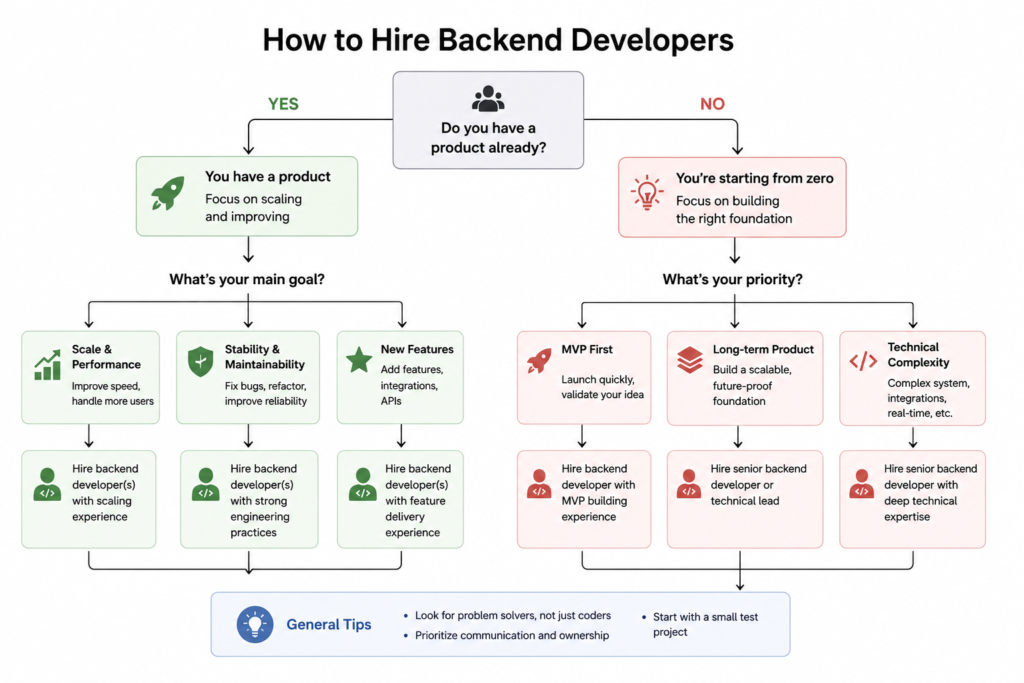
Do you already have a product, or are you starting from zero?
If you already have a product, congratulations: Your language decision was made years ago, probably by a developer you’ve never met.
Your codebase is Java, or Python, or Node, and that is now a fact of your business like your address.
You hire for the language you have.
A brilliant Python Developer is worth nothing to your Java codebase. This is why hiring for a generic “Backend Developer” gets you nowhere….
But if you’re starting from zero?
Read this part twice.
Your first backend hire is not just an employee. They are choosing your language for you.
Whatever they know best is what your product gets built in — and you will live with that decision for a decade, through every hire that comes after them.
Most founders agonize over the candidate and never think about the language.
That’s backwards.
The candidate is with you for a few years.
The language is with you forever…
“But I Don’t Know Which Language I Need”
Good.
That’s not a confession.
That’s a diagnosis.
If you can’t name the language, one of two things is true:
One: You have a product and simply don’t know what it’s built on.
That’s a five-minute fix — ask whoever built it, or send us access and we’ll tell you.
No shame in it.
Most non-technical founders who come to us can’t name their stack on the first call.
Two: You don’t have a product yet, which means you’re not looking for a Backend Developer at all.
You’re looking for someone to make the most important technical decision in your company’s history.
That’s a different search with a different profile, and treating it like a commodity hire is how companies end up rebuilding their product from scratch three years in.
Either way, the conversation you need isn’t with a job board.
Every developer we place goes through the same 100-point rubric, the same paid trial with real deliverables, and comes with the same one-year guarantee: If they leave or you let them go within 12 months, we replace them free.
I’ve covered the full screening reality — including the fake candidates and the deepfakes — in the remote developers guide, so I won’t repeat it here.
What I’ll add if I would hire a backend developer specifically:
This is the hire where our screening matters most, precisely because you can’t check the work yourself.
— The front end you can judge with your own eyes on your own phone.
— The back end, you’re trusting someone.
Make sure the someone you’re trusting has done this 1,100 times.
What It Costs to Hire Backend Developers
Short version, because I’ve published the full March 2026 cost breakdown already:
A strong mid-level developer from Eastern Europe or Latin America runs $2,500–$3,500 per month.
Senior talent with deep experience in one language runs $4,000–$6,000.
The same hire in the US costs $110,000–$160,000 per year before benefits.
The language moves the price.
Java seniors cost more because the roles they fill are critical and the companies hiring them have money.
Python juniors are the cheapest developers on the market because supply is bottomless — and screening them is correspondingly brutal.
Node sits in the middle with the deepest bench of startup-experienced talent — And per our internal data and candidate salary requests: Rates in the talent markets we hire from have actually softened over the past year while US salaries kept climbing.
The gap is wider right now than it’s been since we started.
Frequently Asked Questions
What does a Backend Developer actually do?
They build and maintain everything your customer never sees: Databases, servers, payment processing, the logic that makes your product work.
If the front end is the storefront, the back end is the warehouse, the ledger, and the security system.
Which backend language should my startup use?
Wrong question for an article, right question for a conversation.
It depends on what you’re building, who you can hire, and what you’ll need in three years.
If you’re forcing me to generalize: Node for most startups, Python if your product is data or AI, Java if you’re building for enterprises who will audit you.
Should I hire a Backend Developer or a Full-Stack Developer?
If you’re small and your backend needs are modest, an honest full-stack hire covers you.
But “full-stack” is the second-emptiest title in hiring — most are strong on one side and mediocre on the other.
Ask which side they’re stronger on.
The ones worth hiring will tell you.
How do I screen a Backend Developer if I can’t read code?
You don’t.
You make someone screen them who can, and you run a paid trial with real deliverables and pre-set kill criteria before you commit.
Backend is the one hire where the quality of the work is invisible to you, which makes your screening process the entire ballgame.
How much does it cost to hire backend developers overseas?
$2,500–$6,000 per month depending on seniority and language, from Eastern Europe or Latin America, working your hours.
Full breakdown in our offshore developers cost guide.
Do you place mobile developers too?
Yes — and mobile is different enough that Flutter got its own article.
The platform’s walled garden changes everything about screening and cost.
The Bottom Line
Every backend language exists because somebody ran out of patience.
An elevator that wouldn’t work… Store software that wouldn’t cooperate.
A progress bar that offended one man so deeply he moved into a Starbucks for six months.
Now it’s your turn.
You’ve run out of patience too — with the developer who quit, the product that’s stuck, the agencies who promise vetted talent and deliver resumes.
The difference is, you don’t have to build anything from scratch.
You just have to answer one question:
What language?
If you know the answer, your search just got easy — and we probably have your person already.
If you don’t, that’s exactly what the first call is for…
Book a discovery call and tell us what you’re building.
We’ll tell you what you’re actually hiring for.