

The cost of a bad hire on a $100,000 salary is about $150,000 — not the $30,000 everyone quotes and not “up to 30% of first-year earnings.”
$150,000, plus roughly 2 full work weeks of your own life that you will never get back.
I run a recruiting company.
We’ve made over 1,100 placements across 35 countries.
I’ve watched hires fail from every angle there is — the client’s side, the candidate’s side, and inside my own company.
And when I finally sat down and ran the actual numbers on what a failed hire costs, the figure the entire hiring industry has been quoting for two decades didn’t just look low.
It looked like it was measuring the wrong thing entirely.
Let me show you the math.
Then let me show you where the famous number came from, because that part is worse.
TLDR
- The cost of a bad hire significantly exceeds the common $30,000 figure, often reaching about $150,000 for a $100,000 salary.
- This cost includes not only salary but also lost productivity and the time spent hiring again.
- The traditional 30% estimate lacks a credible source and fails to reflect the true expenses faced by founders.
- Bad hires often last longer than expected due to sunk costs, causing additional missed opportunities.
- The article argues that addressing the hiring process proactively can reduce the overall cost of a bad hire.
Table of contents
- The Statistic With No Source
- The Cost of a Bad Hire: The 30% Is Only Hard Costs
- What It Costs to Fill One Seat Yourself
- Nobody Hires to Break Even
- The Real Timeline: 9 Months, Not 90 Days
- The Full Math on a $100,000 Bad Hire
- The Same Math on a $3,000/Month Sales Rep
- The Reference Check That Told You Nothing
- So Why Do Bad Hires Happen to Smart People?
- The Trap Disappears When Starting Over Is Cheap
- Cost of a Bad Hire: FAQ
- Bottom Line
The Statistic With No Source
If you’ve read anything about the true cost of a bad hire, you’ve seen this line:
“According to the U.S. Department of Labor, a bad hire costs at least 30% of the employee’s first-year earnings.”
It is everywhere…
It’s in HR presentations.
It’s in recruiting pitch decks.
So I went looking for the study.
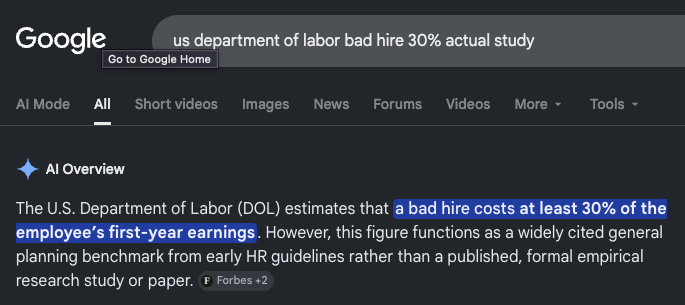
There isn’t one.
Even the AI answer at the top of the results admits it: a “widely cited general planning benchmark” — not a published, formal study.
The sources that bother to date the figure trace it to 2003.
Some say 2023…
Nobody — and I mean nobody — links to an actual Department of Labor document, because no such document can be found.
What you find instead is a domino effect…articles citing articles citing articles, going back twenty-plus years, with the original source missing from every single link in the chain.
Basically, it’s a myth.
The most-quoted statistic in the hiring industry is a decades-old estimate that got passed hand to hand until everyone forgot to check whether it was ever real.
And here’s the detail that should make you squint:
The people quoting the number are almost always the people selling the fix.
The 30% figure is the perfect size for that job.
- Big enough to scare you.
- Small enough that the invoice for preventing it looks reasonable sitting next to it.
Anyway.
Even if the number were real, it would still be wrong for you. Unfortunately the actual number is worse when you start picking it apart.
Here’s why.
The Cost of a Bad Hire: The 30% Is Only Hard Costs
Think about what goes into a corporate cost-per-hire calculation.
- Job board fees
- A recruiter’s salary
- HR processing time
- Onboarding admin
- Training budgets
Those are the costs of a business where hiring is somebody’s job.
Now, if you’re a founder or an operator.
There is no HR department…
There is no in-house recruiter…
When a hire needs to happen, the person doing the hiring is you — squeezed between everything else you’re already doing.
Your cost structure is completely different, your biggest line item doesn’t appear in the corporate math at all.
Who is your biggest line item? – It’s you.
What It Costs to Fill One Seat Yourself
Let’s count the hours — Not agency hours.
Your hours, doing this yourself, the way most business owners actually do it.
- You post the job.
- You get 500 applications, because every posting gets 500 applications now.
- You spend one minute per resume — which is fast, by the way, that’s a skim — and you’ve burned 8 hours before you’ve spoken to a single human.
Next comes the scheduling:
- The back-and-forth emails
- The timezone juggling
- The reschedules
- The no-shows you chase down
10 hours.
After that, the screening layer:
- Reviewing intro videos
- Running quick screening calls to thin the pile
8 hours.
Real interviews follow.
Ten candidates at 45 minutes each, except they never run 45 minutes, because there’s notes between calls and overruns and the two people who no-show and get rescheduled.
8 hours.
Round 2 comes last, with your three finalists, and these run longer because now it matters.
4 hours.
Realistic Hiring Time:
- Skimming 500 resumes: 8 hours
- Scheduling: 10 hours
- Screening calls: 8 hours
- Real interviews: 8 hours
- Round two: 4 hours
- Total: 38 hours
That’s a full work week, more or less, to fill one seat.
A week where you weren’t selling, weren’t serving clients, weren’t building anything…
Now here’s the part that matters for this article: If the hire fails, you do the whole thing again.
76 hours.
Nearly 2 work weeks of the highest-paid person in the company doing a job they don’t do for a living.
Run the math on that: A standard working year is about 2,000 hours…
Therefore, 76 hours is 3.8% of your entire year — pushing 4% of everything you’ll work between January and December, spent reading resumes and sitting in interviews for one seat.
That cost appears in exactly zero of the calculations behind the 30% figure.
And it’s still not the biggest number.
Not even close…
Nobody Hires to Break Even
Here’s the thing:
You don’t hire someone hoping to get back exactly what you pay them.
Nobody signs up for that trade.
- You hire because you expect a return — and across most businesses, the bar is at least 3x.
- You hire a Sales Rep at $3,000 a month expecting them to produce $9,000 or more in revenue.
- You hire an Executive Assistant at $8,333 a month — $100,000 a year — expecting to get back at least $25,000 a month worth of your time and capacity.
That’s just the minimum math that makes the hire rational.
So the deal on that $100,000 Executive Assistant looks like this:
- $8,333 goes out every month
- $25,000 of value comes back
- Net gain: $16,667 a month
That’s what you bought.
A bad hire is the version where you keep paying the first number and never receive the second one.
And that gap — the return you paid for and never got — is the true cost of a bad hire.
It’s also the number the entire industry leaves out, because it’s harder to count than a salary.
Let’s count it anyway.
The Real Timeline: 9 Months, Not 90 Days
Before we can run the math, we need to be real about how long a bad hire actually stays.
The clean version everyone imagines goes like this: something’s off at month two, you make the call at day 90, done.
Tidy.
That’s not what happens.
What happens is a breakup.
- You know it’s not working long before you admit it’s not working
- You remember how good the interviews were
- You think about the time you’ve already invested in training
- You tell yourself it’s a ramp problem, not a person problem
- You give it another month
- Then another…
Here’s how it actually plays out in most professional environments:
Months 1-2: Something’s off, but you call it a learning curve. New tools, new processes — everyone needs time, right?
Months 3-4: You can’t pretend anymore, so now you’re coaching. Extra check-ins. Re-explaining things you already explained. More of your hours going in, not coming out.
Months 5-6: The formal version of hope — a performance improvement plan, or your informal equivalent of one. A documented last chance that fails at the same rate the undocumented chances did.
Months 7-8: They’re finally gone, and the seat is empty while you run the entire 38-hour search again.
Month 9: The replacement is here, learning your business, at half speed.
9 months.
In practice, notice what powered the first 6 of them: every dollar you’d already spent made it harder to walk away.
The salary paid, the training hours, the emotional investment — all of it whispering the same thing: you’ve come this far, give it 1 more month…
That’s the sunk cost trap, and it’s the engine of the whole disaster.
Because every month the sunk cost keeps you holding on, the opportunity cost — the bigger number — quietly grows.
Bad hires are expensive because sunk cost and opportunity cost are pouring gas onto the same fire.
The money you’ve already spent keeps you standing there.
And every month you stand there, the bigger number burns higher.
The Full Math on a $100,000 Bad Hire
Now we can count everything — same Executive Assistant.
$100,000 a year, $8,333 a month, hired to return $25,000 a month in value.
Let’s even be generous to the bad hire…
They’re not producing nothing — they’re producing badly.
Call it 40% of what you hired them for.
Some tasks get done. Just not the ones that matter, not at the level that matters, and you’re checking all of it.
The return you paid for and never received:
- 6 months with the wrong person in the seat, delivering 40% of the value you hired for. You’re missing roughly $15,000 of expected return every month. That’s $90,000.
- 2 months with the seat empty while you search again. The full $16,667 of monthly net gain, gone. Another $33,000.
- One month of the replacement ramping at half speed. Call it $12,500.
Subtotal: about $135,000.
The money that left the account:
- Payroll burden and benefits on six months of salary — roughly $14,000
- Equipment, software, and onboarding, paid twice — about $2,500
Subtotal: about $16,500.
Total: roughly $150,000. Plus 76 hours of your own life.
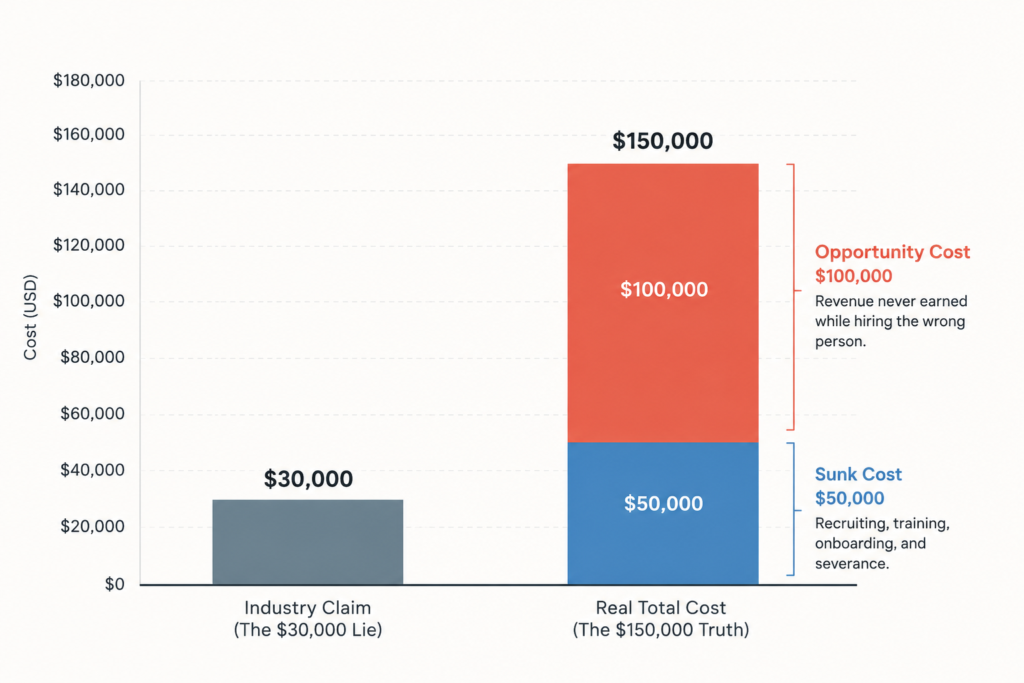
On a $100,000 hire.
The industry says $30,000.
They’re off by 5 times, and the entire gap is the part they don’t measure.
Look at the split: only a small slice of that $150,000 is money you can point to on a bank statement.
The rest is the return you bought and never received — invisible on any P&L, and very real in what your business didn’t become during those nine months.
The standard number counts the paycheck.
The paycheck was never the expensive part…
The Same Math on a $3,000/Month Sales Rep
Maybe you’re thinking this only applies to six-figure roles.
It doesn’t.
Run it on a Sales Rep at $3,000 a month — $36,000 a year — and the shape holds.
The failure just works differently…a Sales Rep needs ramp time before they produce.
60 days is typical — some businesses and offers run 90. Which creates a brutal wrinkle the Executive Assistant version doesn’t have:
When you catch a bad Executive Assistant at month 3, you’ve lost 3 months of production.
When you catch a bad Sales Rep at month three, there was never any production to lose.
You paid for the entire ramp, watched them fail the month it ended, and now you get to pay for the ramp again with the next person.
You hired at $3,000 a month expecting $9,000 or more in monthly revenue once ramped.
Ideally $15,000.
That return never showed up — and every month of the same nine-month arc, the missing number compounds.
Add the pipeline they worked badly, the leads that went cold under their follow-up, the forecast you built plans around.
The details differ — The total doesn’t, much.
Run the full arc on a $36,000 Sales Rep and you land somewhere between $55,000 and $70,000.
Two completely different roles…
- Completely different price points.
- Completely different failure modes.
And both land in the same place: roughly one and a half times annual salary.
The 30% figure isn’t just too low — it’s the wrong shape.
The true cost of a bad hire doesn’t scale with what you pay the person.
It scales with the return you hired them to produce — and the months the sunk cost trap keeps you from acting.
The Reference Check That Told You Nothing
One more cost center worth naming, because it’s where a lot of these disasters get waved through: the reference check.
Here’s what most people do: they email the references.
“Hi, how was your experience working with Sarah?”
And back comes a warm, polished paragraph that says nothing.
Of course it does.
The candidate picked those references — Nobody lists the manager who fired them.
And in 2026, half those replies are written by AI anyway — you’re reading machine-generated praise of a candidate you’re about to bet $150,000 on.
An emailed reference check isn’t verification.
It’s theater with extra steps.
The information you need exists — it just doesn’t come out in writing, and it doesn’t come out to soft questions.
It comes out on a phone call, in the pauses, in what a former manager doesn’t say when you ask the right thing directly.
Most people never make that call.
It shows.
So Why Do Bad Hires Happen to Smart People?
Everything above is the bill.
Here’s how the bill gets generated — because it’s almost never that the business owner is careless.
Walk through any founder’s bad-hire story and you find the same 5 conditions, every time:
1. They hired desperate.
The seat had been empty for 2 months. Work was piling up. The best available candidate started looking like the right candidate, because “keep searching” had become the most painful option on the table.
Ask anyone who’s made a bad hire when it happened. The answer is almost always: when we needed someone yesterday.
2. The pool was thin.
One job posting. 500 inbound applicants — which sounds like a lot until you realize it’s 500 people who happened to see one ad, self-selected, from wherever that ad happened to reach.
The best person for the role probably never saw it.
3. They’d done this maybe twice before.
Hiring well is pattern recognition, and pattern recognition takes reps. A founder hires a few times a year at most.
There’s no library of “I’ve seen this exact interview performance before, and here’s how it ends” to draw on. Every candidate is a first.
4. The references were a show.
See above.
5. And then they held on for six months.
Because starting over meant another 38 hours, another empty seat, another round of desperation. The cost of replacing the person is exactly what kept the wrong person in the chair.
Read that list again.
Not one item on it is a character flaw.
Which brings me to the fix.
The Trap Disappears When Starting Over Is Cheap
Here’s what changes when hiring stops being a once-a-year emergency and becomes something done constantly, at volume:
- The pattern library exists. When you’ve screened thousands of candidates for a role, the polished interviewer who can’t execute stops being a surprise. You’ve seen that exact performance before. You know how it ends.
- The pool stops being one job ad. It’s active pipelines across dozens of markets — people who never saw your posting because they weren’t looking at postings.
- Desperation leaves the equation. When a seat can be refilled in days instead of months, you never reach the point where “good enough” starts sounding like “good.”
- The sunk cost trap loses its teeth — and this is the big one, the one that dissolves the $135,000. When replacing someone is fast and cheap, you stop holding on for month six, because month six only ever made sense when starting over cost you 38 hours and two months of an empty seat.
Take that away and you make the call in week 3.
The largest number in this entire article — the opportunity cost that compounds month after month — simply never gets the time it needs to grow.
We hire for a living, at volume, across 35 countries — which means we get it right more often for the same reason a pro golfer loses less golf balls than you do.
Reps.
And when we place someone, you’re covered if it doesn’t work out, because we can refill a seat at a speed that makes holding onto the wrong person pointless.
The math in this article is the math of doing it yourself, once every year or two, under pressure.
There’s a different math available.
Book a call and my team will walk you through it.
Cost of a Bad Hire: FAQ
What is the average cost of a bad hire?
The commonly cited figure is 30% of first-year earnings, attributed to the U.S. Department of Labor — but no original study can be located, and the estimate dates back to roughly 2003.
According to SHRM Cost-Per-Hire Research, real benchmark data looks very different when your own time and lost return are counted.
When you count the full picture — salary and benefits paid, your own hours across two searches, and the return you hired for but never received across the real timeline of a failed hire — the total lands closer to 1.5x annual salary.
On a $100,000 role, that’s roughly $150,000.
What is the TRUE cost of a bad hire?
Count 2 layers.
1. First, sunk cost: salary and payroll burden paid, equipment and onboarding (paid twice), and your own hours recruiting, training, and managing — roughly 38 hours per search for a business owner doing it alone.
2. Second, opportunity cost: the monthly return you hired the person to produce, multiplied by every month you didn’t receive it — including the months the seat sat empty and the month the replacement spent ramping.
The second layer is almost always the bigger number.
Is the cost of a bad hire really 30% of salary?
That figure only counts direct, trackable expenses — the costs of a company with an HR department.
It excludes the 2 largest costs a founder actually eats: their own time and the missing return. It also can’t be traced to an original source.
Treat it as a floor from a different kind of company, not an estimate of your risk.
How long does a bad hire usually last before being let go?
Far longer than 90 days.
In most professional environments the real arc runs about 9 months: 2 months before the problem is admitted, 2 months of coaching, 2 months on a formal improvement plan, 2 months to refill the seat, and a month for the replacement to ramp.
The delay is driven by sunk cost — every month already invested makes the next month easier to justify.
Does a bad hire cost more for senior roles?
The dollar amount grows with the role, but not because of the salary.
It grows because the expected return grows.
A senior hire is brought in to produce a larger multiple of their comp, so every month of failure burns a larger number.
The ratio stays surprisingly stable — roughly 1.5x annual salary across role levels — because the cost scales with the return you hired for, not the paycheck.
Bottom Line
The famous 30% statistic has no findable source, was built for companies with HR departments, and measures the cheapest slice of the damage.
The true cost of a bad hire is the return you paid for and never received, multiplied by the 9 months the sunk cost trap keeps you from acting — plus 2 work weeks of your own life running the search twice.
On a $100,000 hire, that’s about $150,000.
The number is that big for one reason: replacing someone slowly, alone, and once every year or two is expensive — so people hold on.
Make starting over cheap, and the biggest cost in this article never has time to happen.
That’s the version we sell.