

You posted a job on Monday.
By Wednesday you have 400 resumes.
And every single one of them was written by the same person.
- “Results-oriented leader with a proven track record of success.”
- “Self-starter who thrives in fast-paced environments.”
- “Dynamic team player with strong communication skills.”
- “Detail-oriented professional dedicated to continuous improvement.”
- “Seeking to leverage my skills in a challenging new role.”
Sound familiar?
Of course it does.
You’ve read those exact sentences 400 times this week. Because nobody writes their own resume anymore. They type “write me a resume” into a chatbot, hit apply on 200 jobs before lunch, and one of those 200 was yours.
So the real question isn’t how to screen a resume.
But is how the hell you’re supposed to tell 400 identical people apart.
I can help with that!
I run a recruiting agency that has made over 1,100 placements across 35 countries. My team screens resumes every single day, all day, and we’ve turned it into a repeatable system.
On a recent training call, I went through 224 applicants for one Operations role in 29 minutes.
Recorded, timed, in front of my whole team.
That’s not a brag!
That’s the pace this job requires now.
Below are the 11 things I check on every resume, in the order I check them.
The first few take less than a second each…
And stick around for number 11, because it circles back to those 5 sentences you just read, and it’s the check that tells you more about a candidate than their entire work history.
Key Takeaways
- You receive many identical resumes due to candidates using AI tools, making it hard to differentiate them.
- Screening a resume requires a mindset shift: focus on filtering out candidates quickly, rather than reading every detail.
- The 11 checks include assessing page count, formatting, the hook, and the use of stock phrases; these help identify quality candidates.
- Job-history patterns and how candidates describe their experience provide crucial insights into their capabilities.
- Software can’t replace human judgment; it can’t assess photos or individual writing style in resumes.
Table of contents
- Why The First Pass Takes Seconds, Not Minutes
- 1. The Page Count
- 2. The Formatting
- 3. The Font and Colors
- 4. The “Hook”
- 5. The Intro Paragraph
- 6. The Photo
- 7. How They Describe Their Experience
- 8. The Numbers
- 9. Where the Education Sits
- 10. The Job-Hop Pattern
- 11. The Stock Phrases
- What the Screening Software Can’t See
- The Part I Can’t Write
Why The First Pass Takes Seconds, Not Minutes
Quick math before the list.
Say 400 applications come in.
Your job is to turn that pile into maybe 40 people worth a closer look, and 10 worth an interview.
If you spent 5 minutes reading each resume…that’s 33 hours.
Almost a full work week!
On the first pass alone…
Before a single interview happens…
While your actual job sits there waiting…
Nobody does that.
Nobody should do that.
The first pass isn’t reading.
It’s filtering!
You’re not looking for reasons to say yes.
You’re looking for reasons to say no, as fast as possible, so the maybes rise to the top of the pile where you can give them real attention.
That mindset shift matters.
Once you accept that the first pass is a filter, the 11 checks make sense.
Here they are:
1. The Page Count
When you screen a resume,
One page is ideal.
Two is fine.
Beyond that, you’re holding a document written by someone who couldn’t decide what matters.
A resume is a prioritization test that candidates don’t know they’re taking.
Their entire career, ranked and compressed onto two pages.
If they can’t do that with their own life, what happens when you hand them your inbox, your project, your budget?
Five pages isn’t more information…
It’s less judgment.
2. The Formatting
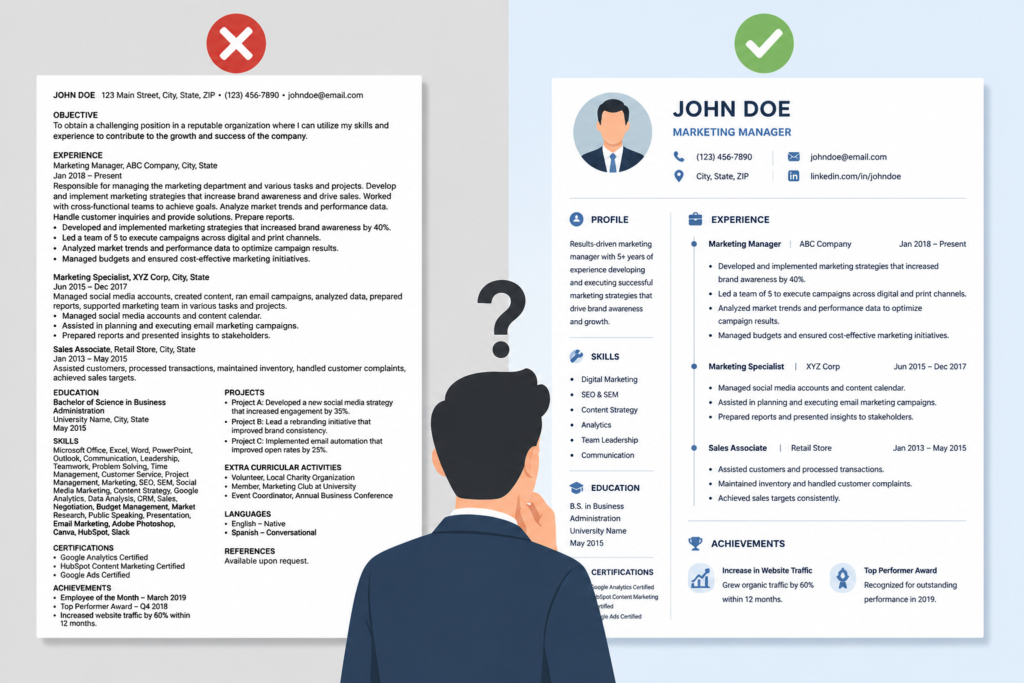
Before you read one word, look at the page the way you’d look at it from across the room.
Is there air on it?
- Clear breaks between sections.
- Bullets.
- White space.
- Room to breathe.
Or is it a wall of text?
A wall of text is a no, and here’s the thing:
You didn’t need to read it to know.
The candidate had one document to convince a stranger to keep looking, and they produced something that physically hurts to look at.
That’s not a formatting problem…
That’s a signal about how they’ll build everything else.
3. The Font and Colors
This one takes half a second and people think I’m joking when I say it matters…
I’m not joking!
Font and color are a taste check, and taste has to match the role.
A Bookkeeper or an Operations Manager can hand you a black-and-white resume full of numbers and that’s exactly right.
A Graphic Designer or Social Media Manager who hands you a bland template with default fonts is telling on themselves before you’ve seen their portfolio.
And bright, loud colors on an Operations or Finance resume?
It better be one hell of a resume underneath.
You’re not judging whether the resume is pretty.
You’re judging whether this person understands what’s appropriate for the room they’re trying to enter.
4. The “Hook”
The top third of the first page is the most valuable real estate on the entire document.
It’s the first thing your eyes land on!
So look at what the candidate chose to put there…
The good ones put their strongest material right at the top:
- What they do.
- How long they’ve done it.
- Something they’ve actually accomplished.
The rest fill that space with:
- A paragraph about their hopes and dreams.
- What kind of role they’re seeking.
- What kind of environment they’d like to grow in.
Here’s the problem with that.
You have an open role and a pile of work not getting done.
That CV says: Me, me, me.
And the number one rule of sales…talk to the prospect about their pains. Don’t blabber your own.
You opened this resume to answer exactly one question:
Can this person solve my problem?
A candidate who spends their most valuable real estate on what they want, instead of what they can do for you, has answered a question nobody asked.
5. The Intro Paragraph
The fastest tell on the page.
Read the summary at the top, if there is one, and ask a simple question: Does this tell me anything specific?
“Motivated professional passionate about operational excellence” tells you nothing.
Strip out the adjectives and all that’s left is “I am a professional.”
Congratulations!
So are the other 399 people in the pile.
Compare that to: “Operations Manager. 7 years. Built the fulfillment process for a company that grew from 8 to 45 people.”
– One of those was written by a person who knows what they’re worth.
The other was written by a machine, for a person who never checked its work.
Which brings up an uncomfortable point…
3 years ago, a bad intro at least had personality.
Now the bot writes the same intro for everyone, which means a generic summary costs the candidate double.
It says nothing, and it says nothing in the exact same words as everyone else…
6. The Photo
Time for some honesty that most hiring advice won’t touch.
Here’s the honest version:
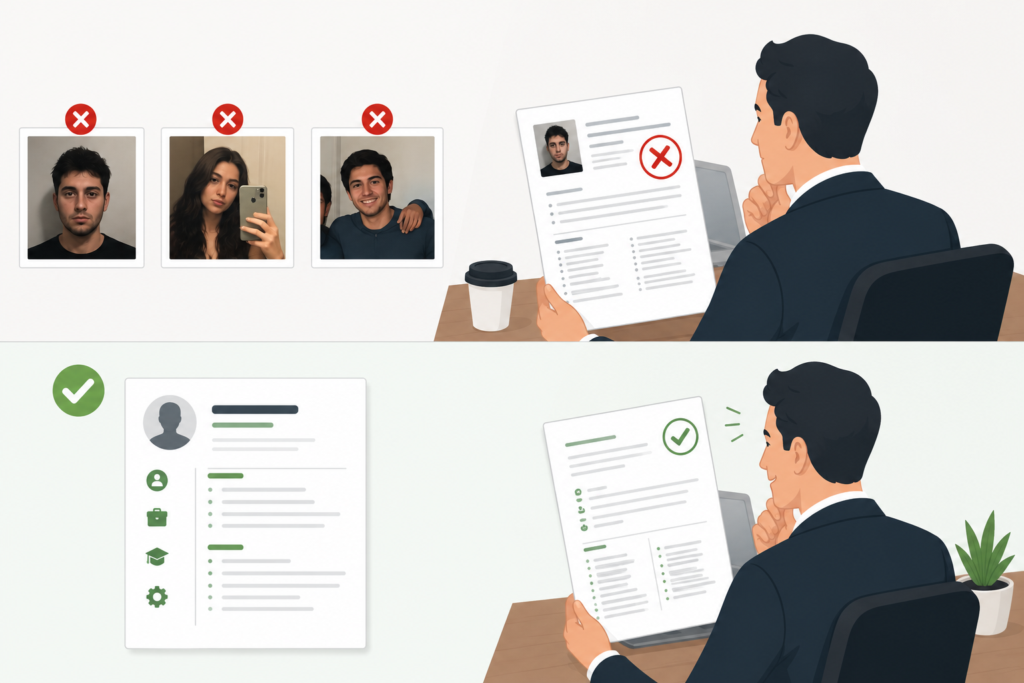
If the photo looks like a mugshot, there is almost nothing below it that will save the candidate…
- That’s just true.
- Dark, blurry, dead-eyed passport shots.
- Selfies.
- Photos clearly cropped out of a group shot with somebody’s arm still visible.
Each of those was a choice the candidate made about their own first impression, and choices are fair game.
Now the twist, and this is a green flag most people miss:
A resume with no photo at all that still pulls you in is more impressive than a good photo.
That candidate won you over with nothing but substance.
Pay attention to those!
7. How They Describe Their Experience
Now you’re actually reading.
Here’s what to read for.
When you screen a resume, there are two kinds of experience sections :
- One lists responsibilities.
- The other lists results.
“Managed a team of 12.”
That’s not an accomplishment.
That’s a job description.
It tells you what their title was, not what they did with it.
The question you’re silently asking of every line: What changed because you were there?
Better: “Managed a team of 12 and achieved 120% of KPI goal for 3 quarters in a row.
- Did the team grow?
- Did output improve?
- Did they build something that still runs today?
A candidate who answers that question on paper, without being asked, understands their own value.
A candidate who lists duties is hoping their title does the work for them.
8. The Numbers
This is the check most hiring managers get wrong, and it’s the one worth the most.
“Improved efficiency of the sales team.”
Who cares?
What does that even mean?
Improved it how?
By how much?
Says who?
Improved operational efficiency by 27%.
Now that’s a claim!
A specific one.
Something you can dig into on a call and watch whether they can defend it.
Most people screening resumes overweight what’s listed and never press for what was accomplished. They see “improved efficiency” and mentally file it as a win.
It’s not a win.
It’s a sentence.
Numbers are what separate the candidate who did the thing from the candidate who watched the thing get done and put it on their resume.
And the numbers don’t need to be huge.
“Cut onboarding time from 3 weeks to 5 days” beats “dramatically improved onboarding” every single time.
Small and specific is believable.
Big and vague is what everyone claims.
9. Where the Education Sits
Simple rule when you screen a resume: After the first year or 2 of a career, education goes at the bottom.
A candidate with 6 years of real experience who leads with their degree is telling you they don’t understand what they’re selling.
Their bachelor’s from 2018 is not the product.
The 6 years are the product.
You’ll see resumes where the top line is something like “Business Administration Graduate” from a person who held a senior role at a serious company.
They buried the one thing that would make you keep reading, and led with the thing nobody was asking about…
That’s not a dealbreaker on its own.
But it’s a judgment error on the exact document where judgment is being tested.
10. The Job-Hop Pattern
Look at the dates.
Just the dates.
Are they climbing somewhere, or bouncing?
Three jobs in 8 years with growing titles is a career.
Eight jobs in 3 years is a pattern, and the pattern is the answer to a question you haven’t asked yet.
Watch for overlapping positions too.
Two full-time jobs at the same time is either a formatting mistake or something worth asking about, and neither is great…
None of these are automatic kills.
Gaps happen…
Layoffs happen…
Whole industries collapse…
But every oddity in the timeline is a question, and a borderline resume with three open questions is a no!
A strong resume with one question is a conversation.
11. The Stock Phrases
Remember those 5 sentences from the top of this article?
Go back and count how many appear in the resume you’re holding.
“Proven track record.”
“Fast-paced environment.”
“Dynamic team player.”
“Detail-oriented professional.”
“Passionate about excellence.”
Every one of those phrases is a small confession.
It says: When it was time to make my single most important professional document, I let a machine write it, and I didn’t care enough to check whether it sounded like me.
Because it doesn’t sound like anyone.
That’s the point.
It’s the sound of 400 people typing the same prompt!
And to be clear, the confession isn’t that they used AI…
The confession is how little they gave it.
The lazy candidate types “write me a resume for this job,” pastes the posting, and ships whatever comes out.
The serious candidate sits down with the same tool and works:
- Here’s my actual experience.
- Here are my numbers.
- Here’s the role I’m going after, so lead with this and not that.
Ask me questions until you have what you need.
That candidate comes out the other side with a document full of specifics, tailored to your role, that no stock phrase could produce.
Same tool.
And you can tell them apart from across the room, because effort survives the machine and laziness does too.
Why Generic Resume Phrases Are a Red Flag
Here’s the predictive part, the reason this check matters more than any credential on the page:
The resume is a work sample.
It’s the one deliverable where the candidate had unlimited time, full control, and maximum motivation.
If the best they produced under those conditions is a paste of borrowed phrases, that’s the ceiling.
That’s their best work!
It does not get better after you hire them…
A resume stitched together from stock phrases isn’t neutral.
It’s evidence.
What the Screening Software Can’t See
Somewhere around number 4, you might have wondered why you can’t just buy a tool for this.
Plenty of companies sell resume screening software…
- Keyword filters
- Parsers
- AI scorers
- Automated rankers
And they all share the same fatal flaw: They match words.
That’s it.
That’s the whole trick.
Which worked fine, right up until every resume started containing every word…
The same AI that floods your inbox with 400 applications learned to beat the keyword filter years ago.
The bot writing the resume and the bot screening the resume are pattern-matching against the same job description.
They cancel each other out, and what’s left is noise.
Software can’t smell a mugshot photo.
It can’t tell a real 27% from an invented one.
It can’t read taste, or judgment, or whether the top third of the page was spent on substance or dreams.
Every check on this list that actually separates candidates is a check a keyword filter cannot run.
There’s no tool for this.
There’s just reps.
The Part I Can’t Write
The 11 checks will take you from 400 resumes to a shortlist of about 20. Faster than you thought possible, with better candidates surviving the cut.
But I’ll be straight with you about what happens next.
The shortlist is where hiring is actually won or lost…
- The scoring system we run candidates through.
- The thresholds that decide who gets in front of a client and who doesn’t.
- What we listen for in the first 2 minutes of a call.
- When a borderline candidate deserves a second look and when they don’t.
That system took 1,100+ placements to build, and it’s the difference between hiring a star and hiring a very convincing mistake.
And here’s the math nobody wants to say out loud.
My recruiters do this full-time; they are screening resumes and place up to 10 people a month.
Each.
You’ll run this process once, maybe twice a year, squeezed in between the actual job you were hired to do.
You will be a beginner every single time.
The 400 resumes don’t care how busy you are.
So learn the 11 checks.
Use them.
They’ll make you sharper than most of the people doing this professionally.
Or skip the pile entirely and let us hand you the 5 people worth your time.