

You have 8 tabs open right now.
8 virtual assistant companies in the Philippines.
All with clean websites, smiling headshots, and a button that says “Book a Free Consultation“
And every single one of them tells you the same thing: we only place the top 1%.
Go check.
I’ll wait.
- One says top 1% of Filipino virtual assistants
- Another says top 1% of candidates
- A third got creative and says top 0.89%
- One went all the way down to 0.5%
- Another claims 0.7%, endorsed annually
8 companies.
Same country.
Same claim.
They can’t all be right.
Because the virtual assistant companies in the Philippines are all fishing in the same pond.
Somebody’s top 1% is somebody else’s reject pile.
So before you book a single call, I want you to ask the only question that matters on this entire topic:
One percent of what?
TLDR
- Many virtual assistant companies in the Philippines claim to hire the top 1% of candidates, but this number often refers to a small pool of applicants rather than the entire population.
- The actual top 1% typically represents applicants who responded to specific job postings, raising questions about the significance of these claims.
- The Philippines has a high number of virtual assistant companies due to low startup costs, leading to many players in the market with similar offerings.
- While the Philippines can provide excellent general administrative support, hiring for specialized roles may require casting a wider net beyond the local talent pool.
- Clients should ask critical questions about the sourcing processes and candidate pools to ensure quality hires from virtual assistant companies in the Philippines.
Table of contents
Do the Math With Me
The Philippines has about 117 million people.
The top 1% of that country is 1.17 million people.
Has any company on your screen screened 1.17 million people?
Has any company on Earth?
No.
So the claim isn’t 1% of the Philippines.
It’s 1% of something much, much smaller.
Do that math too.
That’s about 131 people. Out of a country where over 1.3 million people already work in remote support roles.
Their “top 1%” is the top 1% of people who answered their job posting.
Not the top 1% of the Philippines.
Not the top 1% of Filipino Virtual Assistants.
The top 1% of whoever happened to see an ad and click apply.
Every one of the virtual assistant companies in the Philippines making this claim is doing the same thing.
The denominator is always the applicant pile.
And the applicant pile is always the same pool of people, applying to the same postings, on the same job boards, at the same time.
The race to a smaller decimal is on, by the way.
2%.
1%.
0.89%.
0.7%.
0.5%.
Give it a year and somebody’s homepage will say top 0.1%, and it will mean exactly as much as it means today:
Nothing.
It’s a number on a landing page.
My name is Kyle Mau. I’m the founder of HireUA.
We’ve placed over 1,100 people into businesses across 35 countries, and yes, we place people from the Philippines.
We also compete with every company in your tabs.
Which is exactly why I’m going to tell you some things they never will.
Why There Are So Many Virtual Assistant Companies in the Philippines
Here’s a number that should bother you more than any percentage claim.
We got our start in Ukraine, then expanded across the rest of Eastern Europe before we ever touched Latin America, South Africa, the Middle East, or the Philippines.
And in all of Eastern Europe, I can name exactly one other staffing firm that places the roles we place.
One.
And I wouldn’t even call them a real competitor. More a copycat.
The place where we started had no competition. Now look at the Philippines.
Hundreds of virtual assistant companies in the Philippines by anyone’s count. Nobody knows the real number, because nobody can keep up with it.
New ones launch every month. The listicles ranking them have to set minimum requirements just to weed out the pop-up operations.
Both regions are full of extraordinary people. So the gap isn’t about talent.
The gap tells you what it costs to start the company.
In Eastern Europe, you need local knowledge across a dozen small countries with a dozen languages.
- Ukraine has 40 million people
- Serbia has under 7 million
- Lithuania has under 3 million
And for an entire generation across the region, English wasn’t taught at all.
Under communist rule, the approved second language was the party’s, not the West’s.
Finding candidates there means going and getting them, one by one, in markets where the best people are not sitting on a public job board.
The Barrier to Entry Is Almost Zero
In the Philippines, you need a domain name and a job board login.
- Post the job on OnlineJobs.ph
- Collect the applications
- Forward the polished ones
- Charge the spread
No capital.
No constraint.
Nothing proprietary.
When a business is that easy to start, that many people start it.
The sheer number of companies standing between you and your hire is the most honest data point in this entire industry.
Hundreds of companies didn’t appear because hundreds of founders love Filipino culture.
They appeared because the spreadsheet was obvious.
The Audi Lot Problem

Walk onto an Audi lot. Everything on that lot is fine.
Better than fine.
Rows of sedans, hatchbacks, SUVs. Beautiful machines at real prices.
Now tell the salesman you need a pickup truck.
Audi does not make a pickup truck.
Never has.
Watch what happens next, because it will not be the salesman pointing you across the street to the Ford dealer.
He is going to walk you over to the Q7, open the tailgate, fold the seats down flat, and explain that this is basically a truck.
More refined, actually.
You’ll thank him later.
He’s not lying to you. He just doesn’t have a truck on the lot, and he still has to eat.
Every one of the Virtual Assistant companies in the Philippines is a single-make lot.
Ask them whether your Appointment Setter should be calling US prospects from Manila or from Latin America.
They will tell you Manila.
Ask them whether your Operations Manager search would be stronger if it included Eastern Europe.
They will tell you Manila.
Ask them anything at all, and the answer was decided before you finished the question.
Not because they researched it.
Because Manila is the only thing in the building.
The Recommendation Was Decided Before You Asked
A company locked to one region is structurally incapable of telling you to go somewhere else.
Which means every recommendation they make is worthless, including the correct ones, because you can never know which kind you got.
Here’s the part that should really get you.
The biggest companies in this space already figured this out.
Several of the oldest, largest virtual assistant companies in the Philippines have quietly expanded into Latin America and Africa over the past few years.
The industry leaders stopped being single-lot dealers.
The hundreds of shops below them didn’t.
Statistically, you’re about to book a call with one of those.
When the Philippines Is the Right Answer
Now let me tell you what those hundreds of companies are right about, because this article is not “don’t hire from the Philippines.”
We place people from the Philippines.
Some of the best hires I’ve ever made were Filipino.
I wrote an entire guide on hiring Filipino Virtual Assistants because the talent there is real.
If you need a Virtual Assistant for admin work, and cost is your main constraint, and you need it done quickly, you will have a hard time doing better than the Philippines.
English is everywhere.
The remote work culture is a decade deep.
The talent pool for general admin, customer service, and ecommerce support is enormous.
For that role, at that budget, the virtual assistant companies in the Philippines have exactly the car you need on the lot.
Buy it.
The Role Changes the Equation
The problem starts when the role gets heavier.
An Executive Assistant who functions as your right hand.
An Operations Manager who pushes back on you.
An Appointment Setter with the exact accent and cadence for cold-calling American plumbing companies.
A developer.
Can you find a great Executive Assistant or Operations Manager in the Philippines?
Absolutely.
We have.
They exist, and when we find one, we place them without hesitation.
But for those searches, you expand the pool.
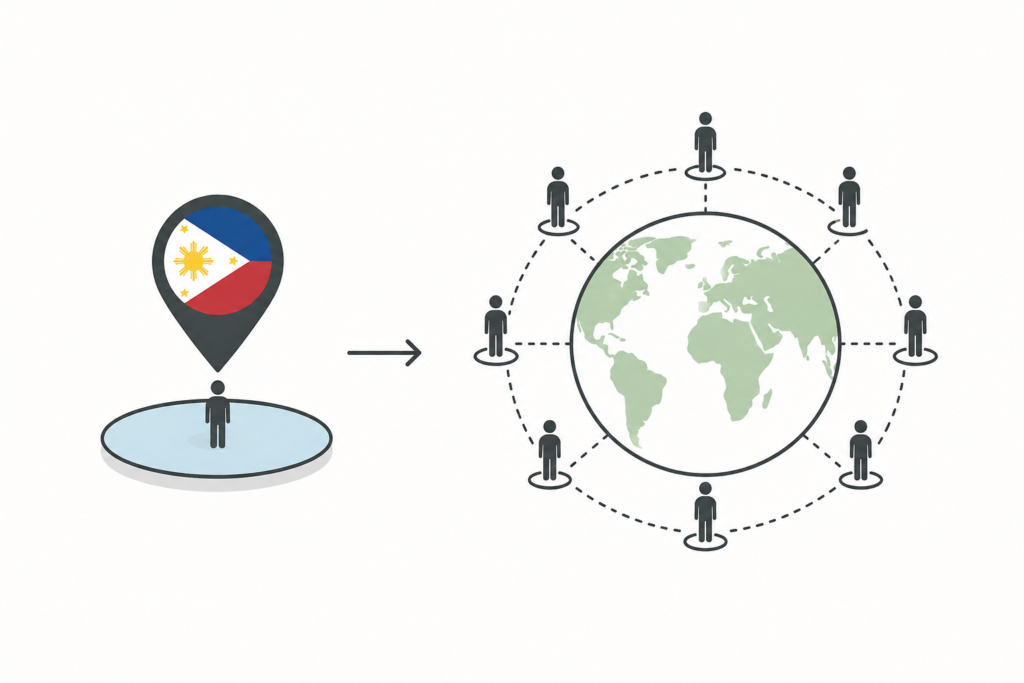
You fish everywhere at once and let the best person win the seat, regardless of what’s stamped on their passport.
Because the odds of the single best available candidate for your exact role happening to live in the one country your agency sells from are not odds.
They’re a coincidence you’re paying for.
Most of the burned clients who come to us didn’t get bad people from the Philippines.
They got a good country and a random person, sold to them by a company whose entire inventory was that country.
They hired the region for the cost, and the region was never the problem.
The seat was wrong.
And nobody on that lot was ever going to say so.
The Filter That Doesn’t Filter
Every company in your tabs screens hard on one thing: English.
- Exceptional English
- Fluent English
- Neutral accent
It’s on every homepage.
Let me be clear about what I’m about to say, because it’s about fishing, not about the fish.
There are brilliant, sharp, extraordinary people in the Philippines.
We find them and place them.
This is purely about what the English test can and cannot tell you when you’re the one holding the net.
In the Philippines, English is ambient.
It’s the language of school, of media, of business. It’s an official language of the country. The same applies to India, and the same hiring/sourcing problems exist there, as well.
When the overwhelming majority of your candidate pool speaks strong English, screening for English is like screening drivers for owning shoes.
Congratulations.
You’ve narrowed it down to everybody.
Same Skill. Different Signal.
Now go to Eastern Europe. For an entire generation, English was locked out.
The over-50 crowd across the whole region barely speaks a word of it, in any country I’ve lived in or hired from.
It wasn’t in the schools. It wasn’t on TV.
The party decided what languages people learned, and English wasn’t one of them.
Which means fluent English in Ukraine is a completely different signal than fluent English in Manila.
In Manila, it tells you the person grew up there.
In Kyiv, it tells you the person made a deliberate, years-long decision to build a skill their parents were never allowed to have, because they wanted the Western opportunity that came with it.
Same test.
Same score.
Completely different information.
So when virtual assistant companies in the Philippines tell you they screen for exceptional English, understand what they’ve actually done.
They’ve run the one filter that doesn’t filter, called it vetting, and stamped “top 1%” on the result.
Finding the exceptional people in a pool where everyone passes the obvious test requires a much better net. More on that in a minute.
Who Actually Founded the Virtual Assistant Companies in the Philippines
Go do something the listicles never do.
Look up who founded the virtual assistant companies in the Philippines sitting in your tabs.
I did.
Here’s the pattern.
One of the biggest names in the space was founded by a real estate coach. Another was started by a guy who, by his own LinkedIn, was working in boat sales a few years back.
One of the loudest brands on the first page doesn’t name a founder anywhere on its website.
The About page says the leadership team has “decades of experience.”
No names.
No faces.
You cannot find out who owns the company you’re about to hand a role to.
None of this is a scandal.
It’s just the honest origin story of the industry.
A domestic operator hires one Filipino VA for his own business.
It works.
He looks at the invoice, looks at the salary, and realizes the gap between them is a business. And he productizes it.
He never moves anywhere.
He never has to.
I’m not going to pretend I found this industry any differently.
I hired my first Filipino Virtual Assistant in 2016 for $400 a month, and she was so good my friend still employs her today, a decade later.
The difference is what happened after.
I’ve lived overseas for over 10 years. I married abroad.
- I’ve built teams
- Bought property
- Raised a kid
- Run payroll across borders
And what that buys my clients isn’t a philosophy.
It’s a thousand small things a founder who never left home cannot see.
Let me show you three.
1. The Confidence Misread
American candidates brag.
It’s cultural.
A US founder interviewing Americans spends the interview pulling exaggerations back down to Earth.
Candidates abroad run the opposite direction. The resume says “improved project efficiency.”
You grill into it, and the real answer is they cut delivery time from 60 days to 25. They cut it by more than half and wrote 4 flat words about it.
A founder who’s only ever interviewed Americans reads that modesty as mediocrity, passes on the strongest person in the pipeline, and hires whoever talked the biggest.
2. The Small Talk Tax
American managers open every call with warmth.
Kids, dogs, weekend plans.
At home, that builds rapport.
Abroad, it can read as overbearing.
In most of Eastern Europe, you don’t chat with cashiers about your children. Conversations with strangers rarely go past “how are you today.”
Candidates aren’t offended by the American style.
They’re thrown off by it.
An interviewer who doesn’t know that walks away thinking the candidate was cold, when the candidate was being respectful.
3. The EpiPen Problem
Years ago, a waitress at a theme park restaurant in Florida asked if my daughter had any food allergies.
We said no.
She grinned and said, “Good, I wouldn’t want to have to get the EpiPen out.” Then she brought a dish with nuts and joked about it again.
I understood the joke.
It was still tasteless.
But I could process it, because I grew up with that register of American service-industry humor.
Now put that same instinct in front of a candidate in Kyiv.
Restaurants there don’t ask about allergies at all. He has never heard the word EpiPen.
He doesn’t laugh. No, he doesn’t get offended either.
He just quietly concludes you’re not serious, finishes the interview politely, and takes the other offer.
And the founder never finds out why his best candidate went cold, because the founder doesn’t know there was anything to find out.
Multiply that by salary customs, banking realities, what currency people actually trust, what an understated answer means, and a hundred other paper cuts.
That’s the gap between an agency run by someone who lived it and an agency run from a home office that’s never left the time zone.
What Real Sourcing Looks Like
There’s one more thing the hundreds of companies share, and it’s the engine underneath everything above.
Most Virtual Assistant companies in the Philippines source the same way: post the job, wait, and review whoever shows up.
That’s why every denominator is an applicant pile.
That’s why every shortlist looks the same.
When you post and pray, you are selecting from the people who are actively looking, actively applying, and actively available.
Some of them are excellent.
But the best people are almost never in that pile.
The best people are employed, busy, and not refreshing a job board.
If you want them, someone has to go get them.
The Best Candidates Don’t Apply
Here’s what that looks like at our shop, with real numbers.
To put 5 candidates in front of a client, our recruiters typically reach out to 50 to 100 people. Of those, they’ll have real conversations with 12 to 15.
Depending on the role, somewhere between 30% and 50% of the people a recruiter interviews ever get passed to the client at all.
Every candidate who survives that funnel is then scored against a 100-point rubric we’ve built and rebuilt over 10,000+ interviews.
Candidates are scored in blocks of 5, so there’s no fudging and no “gut feel” inflation. And a zero in any single category disqualifies, no matter how impressive the rest of the sheet looks.
A candidate can score in the 90s and still never reach you.
What’s actually on that rubric, and what earns a candidate a zero?
That’s exactly the kind of thing we walk through on a call.
Book one and ask me.
I’ll show you how we’d run your search, and you’ll understand in about 10 minutes why an applicant pile can’t compete with it.
And here’s a question you can take into any other discovery call, with any company in your tabs.
“Walk me through how the last candidate you placed actually entered your pipeline.”
A company with a real sourcing mechanism will tell you a story with names, numbers, and outreach in it.
A company running a job posting will say the word “vetted” a lot and change the subject.
One Percent of What
So here’s where this leaves you.
If you need a solid admin Virtual Assistant, fast and affordable, the Philippines is a damn good answer, and plenty of the Virtual Assistant companies in the Philippines can get you a perfectly fine one.
The country was never the problem.
But if the role matters, ask the questions the listicles won’t.
Ask them: one percent of what?
Make them name the denominator.
Watch what happens.
Ask them: if the Philippines weren’t the right region for this role, would you tell me?
Then remember they don’t stock anything else.
Ask them: how long is your replacement guarantee?
Most will say 90 days, maybe 6 months.
Ours is one full year, double the industry standard, because our process means we almost never have to use it.
Then ask them why theirs isn’t longer.
We compete with every one of the Virtual Assistant companies in the Philippines you’ve been reading about, and we’ll still tell you where your hire should actually come from — even when the answer is the Philippines, because we stock the whole lot.
That’s the difference between a company that sells a region and a company that helps you hire.
Book a discovery call with HireUA: