

In the movie The Bounty Hunter, Gerard Butler plays an ex-cop turned bounty hunter who gets hired to track down his ex-wife — played by Jennifer Aniston — after she skips bail and a court date.
He finds her.
She doesn’t want to go.
He throws her in the trunk of his car anyway.
I think about that movie every time someone asks me about headhunting.
Because that’s what headhunting is. You find a person who has a job. Who is not looking for a new one. And you convince them — through some combination of charm, persistence, and money — to leave.
Sometimes they come willingly.
Sometimes…they end up in the trunk.
And sometimes…they end up in a job because they saw your job posting and thought, “Yeah. I want this job.” *Clicks Apply*.
Here’s the thing:
The recruiting industry treats headhunting like it’s the pinnacle of the profession. It’s not. It’s one tool. And it’s the most expensive one.
A headhunter costs 15-40% of the hire’s first-year salary. For a $150,000 role, that’s $30,000-$60,000. For a C-suite executive, it can be six figures.
This article breaks down exactly what those fees look like, why they exist, when they’re worth it, when they’re not, and what the alternative looks like when you don’t need someone dragged out of their current job.
Last Updated: March 13th, 2026
Table of Contents
- What a Headhunter Actually Costs (The Numbers)
- What You’re Actually Paying For (And What You’re Not)
- The 3 Fee Models
- The Headhunting Fetish (And Why It’s Costing You Candidates)
- What Actually Happens When You Headhunt Someone
- When Headhunting IS the Right Call
- What the Alternative Looks Like
- Can I Hire a Headhunter to Find ME a Job?
- FAQ
- How Much Does a Headhunter Charge for an Entry-Level Position?
- Is It Worth It to Hire a Headhunter?
- What’s the Difference Between a Headhunter and a Recruiter?
- Do Headhunters Charge the Candidate or the Employer?
- How Much Does a Headhunter Cost for a Project Manager?
- How Much Does a Headhunter Cost for a Developer?
- How Much Does a Headhunter Cost for a Marketing Role?
- Can You Negotiate Headhunter Fees?
- What’s the Difference Between a Retained Search and a Contingency Search?
- The Bottom Line
What a Headhunter Actually Costs (The Numbers)
The standard headhunter fee is 15-30% of the new hire’s first-year salary.
For executive and retained searches, that can go as high as 40%.
Here’s what that looks like in real dollars:
| Role | Salary | Fee at 20% | Fee at 30% |
|---|---|---|---|
| Marketing Manager | $80,000 | $16,000 | $24,000 |
| Director of Operations | $120,000 | $24,000 | $36,000 |
| Creative Strategist | $150,000 | $30,000 | $45,000 |
| VP of Engineering | $200,000 | $40,000 | $60,000 |
| CFO | $300,000 | $60,000 | $90,000 |
That’s the range. The specific number depends on the role’s seniority, how hard it is to fill, the headhunter’s fee model, and how quickly you need the seat filled.
I know this because I live in this world. I had a prospect on a call recently who wanted a Creative Strategist based in America. The headhunter they were talking to was quoting 18% with no cap on the fee. Any decent CS in America is commanding at least $150K.
Do the math.
That’s $27,000. For one hire.
I also know this because I’ve been on the other end of it. I was headhunted out of Hitachi to go work at the RAND Corporation. RAND wanted someone with Hitachi’s specific data systems experience — ideally someone who actually worked there.
So that’s exactly what happened.
Cold email. Pitch. Months of back and forth.
Then a grueling interview day where nine people interviewed me back to back to back.
That process probably cost RAND $20,000-$30,000 in recruiter fees. And that was for a mid-level storage engineer in 2012, not a C-suite executive.
(My starting offer was for $86,000 so you can do the math.)
That’s what a retained search looks like. It works. It’s expensive. And for some roles, it’s the only option.
But for most roles?
There is a better way.
And I’m about to show you.
What You’re Actually Paying For (And What You’re Not)
When you pay a headhunter 20-30% of a salary, you’re paying for the chase.
The headhunter’s job is to find a person who already has a job, who is not looking for a new one, convince them to take a phone call, sell them on your company, navigate their objections, manage their expectations, negotiate their compensation, and get them across the finish line before they get cold feet or their current employer makes a counter-offer.
That is a real skill. It takes time. It’s labor-intensive.
But here’s what you’re NOT paying for:
A guarantee the person will thrive.
A headhunter can find you the most qualified candidate on the planet. They can negotiate a beautiful offer. They can get a signature on the dotted line.
But they have zero control over what happens next.
- How’s your onboarding process?
- Your company culture?
- Your management style?
- Is the hiring manager someone people actually want to work for?
- Is the role what you described in the interview, or is it something completely different once they show up?
- (Most people would be shocked how often this happens)
That’s all you.
Most headhunter guarantees cover 60-90 days. If the person leaves on day 91 because the job wasn’t what they were told, or because the culture was toxic, or because their manager micromanaged them into oblivion — that’s not the headhunter’s fault.
But…you’re still out $30,000.
And starting from scratch.
The headhunter delivered the body. Maybe they used the trunk. Maybe the candidates were tied up.
Regardless.
What you did with it was up to you.
This isn’t to let bad headhunters off the hook. Plenty of them screen poorly, rush placements, and prioritize speed over fit. The contingency model — where the recruiter only gets paid when a butt hits the chair — actively incentivizes this.
But the honest truth is that retention is a two-player game. The recruiter controls the match. The company controls everything after.
The 3 Fee Models
Contingency
You pay nothing upfront. The headhunter gets paid only if they successfully place a candidate. Fee is typically 15-25% of first-year salary.
Sounds low-risk. The catch: The headhunter is racing against time — and potentially other contingency firms working the same role — to fill the seat before anyone else does. Speed gets rewarded. Thoroughness doesn’t.
Retained
You pay an upfront engagement fee — usually one-third of the estimated total fee — to secure the headhunter’s dedicated focus. Another third at the shortlist milestone. Final third on placement.
A shortlist is a curated group of 3-5 vetted, interviewed, and qualified candidates presented for your review. The headhunter has already screened dozens (sometimes hundreds) to narrow it down to these finalists. You interview the shortlist. You pick.
Total retained fee is typically 25-40% of salary.
The headhunter works exclusively on your search — meaning they don’t take on competing assignments for the same type of role. This exclusivity exists because the economics demand it. If you’re paying $30,000+ upfront, you want dedicated focus. And the headhunter wants to know they’re not racing a contingency firm or your own LinkedIn job post to the finish line.
In offshore and remote staffing, exclusivity essentially doesn’t exist. The fee structure is completely different — monthly managed fees instead of one lump sum — so there’s no upfront retainer to justify it.
Retained search is the model used for C-suite and senior executive roles.
Flat Fee / Hybrid
Less common.
A fixed fee regardless of salary, or a small upfront retainer plus a success fee. Some newer firms are experimenting with subscription or project-based pricing. If you find one that works, great. Just read the fine print on what “success” means and what kind of guarantee backs it up.
The Headhunting Fetish (And Why It’s Costing You Candidates)
Now we get to the part I really want to talk about.
Open LinkedIn right now and search for recruiters who talk about headhunting. You’ll find posts like this:

Or this:
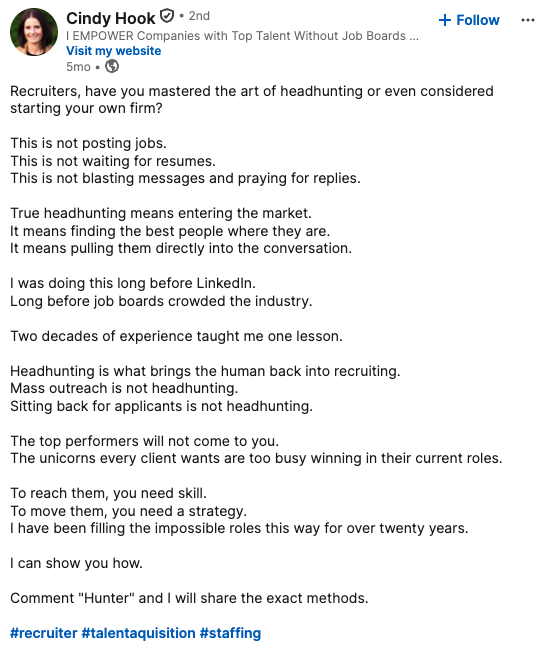
“True headhunting means entering the market. It means finding the best people where they are. It means pulling them directly into the conversation. Sitting back for applicants is not headhunting.”
…..
These are real posts. From real recruiters. Posted without a hint of irony.
They’re talking about cold calling with the same reverence that a new mom talks about their firstborn child.
And here’s the thing:
No smart salesperson in the history of business has ever bragged about how many cold calls they made.
They brag about how many deals they closed.
They brag about their conversion rate.
They brag about the warm inbound leads they converted in 24 hours.
Recruiting and sales overlap more than most recruiters want to admit. There are only three ways to acquire anything — content (inbound), cold outreach (outbound), or paying for eyeballs. It’s the same in recruiting as it is in selling software or headphones or consulting services.
And in sales, everyone knows the warm lead converts better than the cold call. Every time.
But in recruiting?
The industry has somehow convinced itself that the hard way is the prestigious way. That dragging someone out of their current job is more impressive than having someone walk through the door excited to work for you.
That’s not recruiting strategy.
That’s a weird fetish.
And it’s not just cringe LinkedIn content. It actually hurts you, the person hiring.
A recruiter who refuses to process inbound applicants because they want the pride of headhunting is actively shrinking your candidate pool. They’re giving you fewer people to choose from. They’re ignoring the applicants who actually WANT the job in favor of chasing people who don’t.
It’s like a salesperson who refuses to follow up on website leads because they’d rather cold call. Nobody would tolerate that in sales. But in recruiting, it gets celebrated.
Here’s what I’ve noticed after years of running a recruiting firm and interviewing thousands of candidates:
Inbound applicants — the ones who applied on their own — almost always interview better than headhunted candidates. They’re more engaged. They have opinions. They show up with personality. They answer with energy.
The headhunted candidates? Many of them interview like a cardboard box. They’re not excited. They’re evaluating. They’re lukewarm. They showed up because someone dangled more money, not because they actually want to be there.
And the cardboard boxes are the ones the industry glorifies chasing down.
What Actually Happens When You Headhunt Someone
This is the part that the “headhunting is an art” crowd never talks about.
When you headhunt someone — meaning you cold approach a person who is currently employed and not looking — here’s what you’re signing up for:
The Scheduling Problem
An inbound applicant will jump on a call the same day or within 24 hours. A headhunted candidate has a 9-to-5. They can’t just hop on a Zoom at 2pm on Tuesday.
So you’re waiting 72 hours. 96 hours. A week. Sometimes more.
Every day that passes is a day they’re still at their current job, still comfortable, still settling back into the routine that made them not look for a new job in the first place. Your hiring timeline just doubled — and the candidate’s enthusiasm is leaking out with every passing day.
The Negotiation Problem
Inbound applicants have already decided they want this kind of role at this kind of company. They’re pre-qualified by their own interest. They’ve read your job description and thought, “That’s me.”
Headhunted candidates haven’t decided anything.
Every conversation is a negotiation. Every step forward comes with conditions.
“I’ll take the call, but I need to know the salary range first.”
“I’m interested, but I need to think about it.”
“Can we push the interview to next week? Something came up at my real job.”
They haven’t chosen you. You chose them. And that power dynamic never fully reverses.
The Counter-Offer Problem
This is the big one.
If you headhunt someone successfully — you found them, pitched them, they interviewed, they loved it, you made an offer — and their current employer finds out they’re leaving?
The counter-offer comes.
And the counter is devastating.
Here’s why it’s so unfair:
As the recruiter, you’re working with one, singular, data point.
You know what you offered. You might have a ballpark of what they’re currently making. But you don’t really know how much it’s going to take to convince this person to upend their life.
The current employer has two data points plus the emotional ammunition.
They know the person’s current salary — because they set it. And they know (or can guess very closely) what they got offered — because the candidate told them, either directly or through body language and hints (hint: it’s usually directly). So the counter knows the exact gap they need to close. They know the precise number that made this person’s head turn.
But it gets worse…
The current employer also knows the person. Their emotional psyche. What they actually care about. Why they were considering leaving in the first place. And they can promise to fix it.
New title. More money. Restructured team. “We were already planning to promote you.” Sweet nothings that may or may not materialize — but in the moment, they feel real. And they’re coming from a familiar voice, not a stranger.
The candidate is sitting there with two options.
Door Number 1: Everything changes. New company, new boss, new commute, new culture, new everything.
Scary.
Door Number 2: Everything stays the same, but better. More money, maybe a new title, same friends, same routine, same commute, same desk.
Door Number Two wins more often than recruiters will ever admit.
And here’s the strangest part:
You can counter the counter. You can come back with a higher number, a signing bonus, a start date that works better.
And it almost never works.
I think it’s because by the time someone accepts a counter from their current employer, the emotional decision is already made. They’ve decided to stay.
The relief of “I don’t have to change anything” is so powerful that no number can compete with it. You’re not fighting a salary anymore. You’re fighting comfort, familiarity, and the human brain’s deep preference for the status quo.
So you lose weeks or months of effort. The position is still open. And you’re back to square one.
Now compare that to an inbound applicant who applied because they want to work for you. No counter-offer risk. No scheduling headaches. No lengthy courtship.
And, oh yeah, they can start Monday.
Which one sounds like a better use of your time and money?
The Scope Creep Problem
This one’s sneaky.
A company comes to us wanting an Executive Assistant. Straightforward. Inbound applicants flooding in. Great candidates. Easy search.
Then the requirements start shifting.
“Actually, we also need them to manage projects.”
“Can they also handle some light bookkeeping?”
“We’re thinking this person should really be running operations.”
What started as an EA search is now a COO search. And the candidate pool that was full of enthusiastic applicants has narrowed to a sliver.
Now you have to headhunt. Which means everything I just described — the scheduling, the negotiation, the counter-offers — all kicks in.
The timeline stretches.
The cost goes up.
The difficulty multiplies.
This isn’t the recruiter’s fault and it’s not the client’s fault. It’s just what happens when a role evolves during the search. It happens.
But it’s important to understand: The more specific and senior the requirements become, the more likely you are to need headhunting — and the more it’s going to cost you in time, money, and risk.
When Headhunting IS the Right Call
I’m not here to tell you headhunting is always wrong. It’s not.
There are specific situations where a retained executive search firm is absolutely the right move:
C-Suite and Senior Leadership Roles. If you’re hiring a CFO, a VP of Engineering, or a CTO — the pool of qualified candidates is small, they’re all employed, and they’re not browsing job boards. A retained search at 30-40% of a $300,000 salary is expensive. It’s also the only realistic option.
Confidential Searches. If you need to replace a current executive without the company knowing, you can’t exactly post the role on LinkedIn. A retained headhunter handles the discretion.
Hyper-Niche Roles. If you need a Shopify Plus developer with specific DTC e-commerce experience who has scaled brands from $50K to $1M monthly — that person isn’t applying to job ads. That’s a headhunting role. We do this ourselves for certain positions.
What retained search looks like in practice: You pay an engagement fee (usually one-third of the total estimated fee) upfront. The firm dedicates a team to your search exclusively. They research, source, approach, screen, and present a shortlist — usually within 4-8 weeks. You pay the second third at shortlist delivery. The final third on placement. There’s typically a 6-12 month guarantee, which is significantly longer than the 60-90 days you get with contingency.
For a $300K CFO search, that’s $90,000-$120,000 all in.
That is not what HireUA does. If you need that level of search, use a retained executive search firm. That’s what they exist for. We’ll be the first to tell you.
What the Alternative Looks Like
For the vast majority of roles — the VAs, the EAs, the Bookkeepers, the Web Designers, the Operations Managers, the Developers, the marketing people — headhunting is overkill.
You don’t need someone thrown in the trunk.
You need to open the door and let the right person walk through it.
That’s what we do at HireUA.
Our model is managed staffing with flat monthly fee, or, a one-time placement cost. Not a $40,000 invoice on day one.
Here’s what it looks like:
A $500 refundable starting deposit that puts our recruiting team to work. You interview 3-5 pre-vetted candidates. You hire. We bill you monthly for the candidate’s compensation plus our UnfairCare management fee. If you’d rather work directly with the candidate, a one-time buyout.
Replacement guarantee if it doesn’t work out. No five-figure restart fee.
The reason this model works is because we don’t rely exclusively on headhunting. We post. We source. We process inbound applicants. We headhunt when the role demands it. And we don’t pretend that one method is inherently superior to the others.
Can I Hire a Headhunter to Find ME a Job?
A lot of people searching this question are candidates, not employers. So let me address this directly.
Traditional headhunters work for the employer, not for you.
The company pays the fee. The headhunter’s loyalty is to the client who writes the check. Money talks.
You cannot typically hire a headhunter to go find you a job. That’s not how the economics work.
What you CAN do:
Make yourself findable. A strong LinkedIn profile, a visible portfolio, and an active professional network are the single best things you can do to get a headhunter’s attention.
Respond when they reach out. If a recruiter contacts you about a role, take the call. Even if you’re not looking. Even if the role isn’t right. The relationship matters. You blow them away, you’re at the top of the list the next time they have a similar role. Or maybe they know a friend whose been grinding away at a search for months and you get passed right along.
Again, warm introductions have so much value in the world.
Everything I said about inbound vs headhunting earlier is proven here too.
Know your market value. If a headhunter does approach you, know what you’re worth so you can evaluate whether the opportunity makes sense.
We’re building out more resources specifically for candidates in the near future. For now, the best advice is simple: Be excellent at what you do, make sure the right people can find you, and don’t ignore the cold email from a recruiter — it might be the best job you never applied for.
FAQ
How Much Does a Headhunter Charge for an Entry-Level Position?
They usually don’t.
Headhunting is designed for mid-to-senior level roles where the candidates are employed and not actively looking. If you’re hiring for entry-level, a headhunter is the wrong tool. Use a job board, a staffing agency, or a recruiting firm that processes inbound applicants — not one that exclusively headhunts.
Is It Worth It to Hire a Headhunter?
It depends entirely on the role.
For a $300K CFO with a confidential search? Yes. For a $60K Marketing Coordinator who has 200 applicants waiting on Indeed? Absolutely not. The question isn’t “Is headhunting worth it” — it’s “Does this role actually require headhunting, or is the recruiter just charging headhunter fees for job-board work?”
What’s the Difference Between a Headhunter and a Recruiter?
Technically, a headhunter specifically targets passive candidates — people who aren’t looking for a job.
A recruiter is a broader term that includes headhunters but also includes people who process inbound applications, screen candidates from job boards, and manage the hiring pipeline. In practice, the terms are used interchangeably, and most agencies do both. The distinction matters when you’re evaluating what you’re actually paying for.
Do Headhunters Charge the Candidate or the Employer?
The employer. Always.
If a “headhunter” asks you — as a candidate — to pay a fee, that is a scam. Walk away. Legitimate headhunters are paid by the company doing the hiring, typically as a percentage of the placed candidate’s first-year salary.
How Much Does a Headhunter Cost for a Project Manager?
A Project Manager in the US typically earns $80,000-$130,000 depending on industry and seniority.
At a standard headhunter rate of 20-25%, you’re looking at $16,000-$32,500. Through a managed staffing model like HireUA, an Eastern European or Latin American PM with equivalent skills costs $2,500-$4,500 per month — no percentage fee, no five-figure invoice on day one.
How Much Does a Headhunter Cost for a Developer?
US Developers range from $90,000-$180,000+ depending on stack and seniority.
At 20-25%, the headhunter fee alone is $18,000-$45,000. For remote Developers from Eastern Europe — where the talent is strong and deeply technical — monthly costs through HireUA range from $4,000-$7,000 with no percentage-based placement fee. We’ve written a full breakdown of Developer hiring costs.
How Much Does a Headhunter Cost for a Marketing Role?
Marketing roles span a huge range — from a $50K Social Media Manager to a $200K VP of Marketing. The headhunter fee scales with the salary.
At 20%, a $100K Marketing Manager costs $20,000 to place through a headhunter. The question is whether you need a headhunter at all. Marketing talent is generally abundant in the applicant pool. Unless you’re hiring a CMO or a niche specialist, headhunting is probably not the right approach.
Can You Negotiate Headhunter Fees?
You can try.
Most established firms have standard rates and limited flexibility.
Where you have leverage: Offering exclusivity (retained), bringing repeat business, or having a role that’s easy to fill (which the headhunter wants because it’s fast revenue).
Where you don’t have leverage: Desperate timing, niche roles, or competing with other clients for the firm’s attention. If the fee is the sticking point, the real question might be whether you need a headhunter at all.
What’s the Difference Between a Retained Search and a Contingency Search?
Retained:
You pay upfront (usually in thirds), the headhunter works exclusively on your search, and the search is guaranteed until the role is filled.
Typical fee: 25-40% of salary.
Used for senior and executive roles.
Contingency:
You pay nothing until a hire is made. The headhunter competes with other firms (and your own internal efforts) to fill the role first.
Typical fee: 15-25% of salary.
Used for mid-level roles. The tradeoff is commitment. Retained gets you dedicated focus. Contingency gets you zero financial risk but no guarantee of effort.
The Bottom Line
A headhunter costs 15-40% of the hire’s first-year salary. For most roles, that’s $15,000-$50,000. For executive roles, it can be six figures.
Sometimes that’s the right investment. C-Suite searches. Confidential replacements. Hyper-niche roles where the candidates are all employed and not looking — those are legitimate headhunting situations.
But for the overwhelming majority of hires?
You don’t need someone thrown in the trunk.
You need someone who opens the door, posts the role, processes the applicants who walk through, and screens them properly. Someone who headhunts when the role demands it — not because they think it makes them a more impressive recruiter.
That’s what we do.
If you’re looking to build a team without the five-figure placement fees, we’d love to talk.
Click here to get started: