

“I’d rather interview 50 people and not hire anyone than hire the wrong person.” — Jeff Bezos
And yet.
Most people hire an Amazon Virtual Assistant by scrolling a marketplace (kind of like Amazon, ironically), picking the cheapest profile with at least 4 stars, and clicking “Buy Now” like they need a Prime delivery TODAY.
Instead of doing what Bezos would ACTUALLY do when hiring — which involves multiple rounds of interviews, a dedicated “Bar Raiser” whose only job is to make sure every new hire raises the average quality of the team, and a veto system where a single “no” kills the candidacy.
Bezos built the most complex logistics operation on Earth. He wrote in his very first shareholder letter in 1998 that hiring is, quote:
“The single most important element of Amazon’s success.”
The man who built the platform your business runs on told you — in writing — that hiring is the one thing you can’t cut corners on.
And you’re hiring your most important operational support from a Fiverr listing that says “Amazon VA Expert” and charges $2.75 an hour.
An Amazon Virtual Assistant costs between $1,000 and $1,500 a month for full-time global talent. That’s a dedicated person, working 40 hours a week, managing your Seller Central account, handling customer messages, updating listings, tracking inventory, and processing orders.
The same hire in the United States costs over $55,000 a year in salary alone. Add payroll tax, health insurance, 401K, and workers comp — and you’re looking at $65,000-$70,000 all-in.
Here’s what Bezos already knew:
The price is not what determines whether this hire works. The screening is.
We’ve placed thousands of global hires into businesses around the world. A significant chunk of those have been e-commerce roles — Amazon store operators, Seller Central managers, Shopify Virtual Assistants, customer service specialists, product researchers.
And we’ve seen every version of this hire going wrong.
This is the honest guide to hiring an Amazon Virtual Assistant. Real pricing, real screening methods, and real operational insight — not another generic task list from a company trying to sell you a $2.75/hour VA.
Table of Contents
- Amazon Virtual Assistant Costs — Global Talent vs. US
- Account Security — How to Give Access Without Giving Away the Keys
- How to Screen an Amazon VA (And What Bezos Would Actually Do)
- What an Amazon Virtual Assistant Actually Does All Day
- Amazon PPC Is Not a VA Task
- The Tools Question — What Should an Amazon VA Know?
- How Independent Can an Amazon VA Be?
- Common Questions About Hiring Amazon VAs
- Hire an Amazon Virtual Assistant — Closing Thoughts From Jeff Bezos
Amazon Virtual Assistant Costs — Global Talent vs. US
Here’s the pricing table nobody else will give you, factoring for recent inflation in 2026:
| Role | US Cost (Annual) | Global Talent (Monthly) |
|---|---|---|
| Amazon VA — Part-Time (20 hrs/week) | $28,000 | $500-$700 |
| Amazon VA — Full-Time (40 hrs/week) | $55,000 | $1,000-$1,500 |
| Amazon Store Manager / Seller Central Manager — Full-Time | $70,000 | $1,800-$2,500 |
| Amazon PPC Specialist — Full-Time | $85,000+ | $2,000-$3,000+ |
Notice the PPC Specialist is a separate line item. That’s intentional. More on that later.
But get this:
We’ve seen $800/month hires who were exceptional — showed up on day one with Seller Central experience, immediately started processing orders, answering customer messages, and flagging inventory issues without being asked.
We’ve also seen $1,500/month hires who couldn’t navigate Seller Central without a Loom video walking them through every click.
The difference wasn’t the rate.
It’s the screening.
And that’s the hardest part.
The Profit-Share Trap
If you spend any time on Reddit or Fiverr looking for an Amazon VA, you’ll run into VAs — especially for arbitrage sourcing — who want 30% of your profits instead of a flat monthly rate.
Run.
This isn’t Shark Tank.
That pricing model attracts the exact wrong kind of person. A VA getting paid per deal has every incentive to send you the same product list they’re sending to five other “clients.” They’re not sourcing for you. They’re sourcing once and selling it to everyone.
Flat monthly rate. Always.
The $400-$1,500 range covers everything from a part-time product researcher to a full-time Seller Central operator. You know exactly what you’re paying. They know exactly what they’re earning. And nobody’s incentive is to cut corners.
Account Security — How to Give Access Without Giving Away the Keys
This is the #1 fear that stops Amazon sellers from hiring a VA. And it’s a reasonable fear — your Seller Central account holds your credit card, your bank information, your tax documents, and your entire business.
Here’s the deal:
You should NEVER give anyone your main Seller Central login. Ever.
Amazon built a user permissions system specifically for this. It’s called “User Permissions” inside Seller Central (under Settings), and it lets you create sub-accounts with limited access.
You control exactly what they can see and do:
- Inventory and orders — let them manage listings and process orders without seeing your financial data
- Customer messages — let them respond to buyers without access to your banking
- Advertising — let them manage PPC campaigns without touching your payment methods
- Reports — give access to sales data and inventory reports while keeping tax documents locked
What you NEVER give a VA access to:
- Your primary login credentials
- Bank account or payment settings
- Tax information or legal documents
- The ability to add or remove other users
Start with the minimum permissions needed for their role. Expand access as trust builds over months — not days.
And one more thing most guides won’t tell you:
If your working relationship ends — for any reason — revoke access immediately. Not tomorrow. Not after the “transition period.” The same day. You can always re-grant access if needed. You can’t un-steal data.
How to Screen an Amazon VA (And What Bezos Would Actually Do)

Most people screen Amazon VAs by giving them a take-home trial task.
Here’s what that usually looks like:
You send them a product research assignment or a few customer messages to draft responses to. You give them 24 hours. They send back polished, well-organized work.
You’re impressed. You hire them.
Then you find out they spent six hours on that assignment. Or they ran everything through ChatGPT. Or they had someone else do it and put their name on it — which, if you’ve spent any time hiring from Fiverr, you know is shockingly common. One English-speaker applies for the job, farms it out to someone cheaper, pockets the difference, and applies for the next job.
And now they’re on your payroll and a real customer sends an A-to-Z claim at 2pm and it sits there until the next morning because nobody knows what to do with it.
Here’s the thing:
A take-home trial tests preparation. The actual job tests performance under pressure.
The screening method that actually works is a live fire drill.
How to Interview an Amazon Virtual Assistant
Pull five real scenarios from your Seller Central account.
- An A-to-Z Guarantee claim from a customer who says the item never arrived.
- A suppressed listing that needs to be fixed before your sales tank.
- An angry customer message about a product that doesn’t match the listing description.
- An inventory discrepancy — your dashboard shows 50 units but FBA says 38.
- A wholesale inquiry from a potential supplier or reseller that’s outside the VA’s authority.
On the interview, share your screen and show them the first scenario.
Say, “You have two minutes. Walk me through what you’d do. Go.”
No warning beforehand. No time to prepare. No AI.
Then do it four more times.
Now, pay attention:
You’re not grading whether they know the exact Seller Central workflow. You’re watching how they think.
Do they ask a clarifying question before acting, or do they guess? Do they know when to respond to the customer versus when to open a case with Seller Support? Do they understand that an A-to-Z claim has a deadline and what happens if you miss it? Do they know when something is above their authority and flag it, or do they start making promises?
A candidate who handles four out of five scenarios cleanly and flags the fifth as, “I’d need to check with you on this one” — that’s your hire.
A candidate who freezes on the first one, gives a generic answer, and looks uncomfortable — that’s the person who’s going to let an A-to-Z claim expire and cost you your account health.
You’ll know within 10 minutes.
Bezos’s three questions work here too, by the way:
Will you admire this person? Will they raise the average level of your operation? Along what dimension might they be a superstar?
If the answer to all three isn’t yes — keep looking.
5 Amazon-Specific Scenarios You Can Steal
Don’t have scenarios ready? Use these:
Scenario 1 — A-to-Z Claim:
“I never received my order. Tracking shows delivered but it’s not here. I’ve filed an A-to-Z claim. I want a full refund immediately or I’m contacting my bank.”
Scenario 2 — Suppressed Listing:
“One of our top-selling ASINs just got suppressed. Sales dropped to zero overnight. The notification says there’s a ‘missing attribute’ but doesn’t specify which one. Figure out what’s wrong and fix it.”
Scenario 3 — Product Complaint:
“This product is NOTHING like the listing. The photos show blue and I received green. The size is completely wrong. I want a refund AND I’m leaving a 1-star review. Don’t bother sending a replacement.”
Scenario 4 — Inventory Discrepancy:
“Our inventory dashboard shows 50 units in stock at FBA but we’re getting ‘out of stock’ errors on the listing. Something doesn’t add up. Figure out what’s happening and fix it.”
Scenario 5 — Outside Their Authority:
“Hi, I represent a retail chain and we’re interested in purchasing 500 units of your top-selling product at wholesale pricing. Who handles bulk orders? We’d like to set up a vendor account.”
The point isn’t the specific scenario. The point is watching someone solve problems live, under a clock, with no preparation.
That’s the job. Every single day.
What an Amazon Virtual Assistant Actually Does All Day
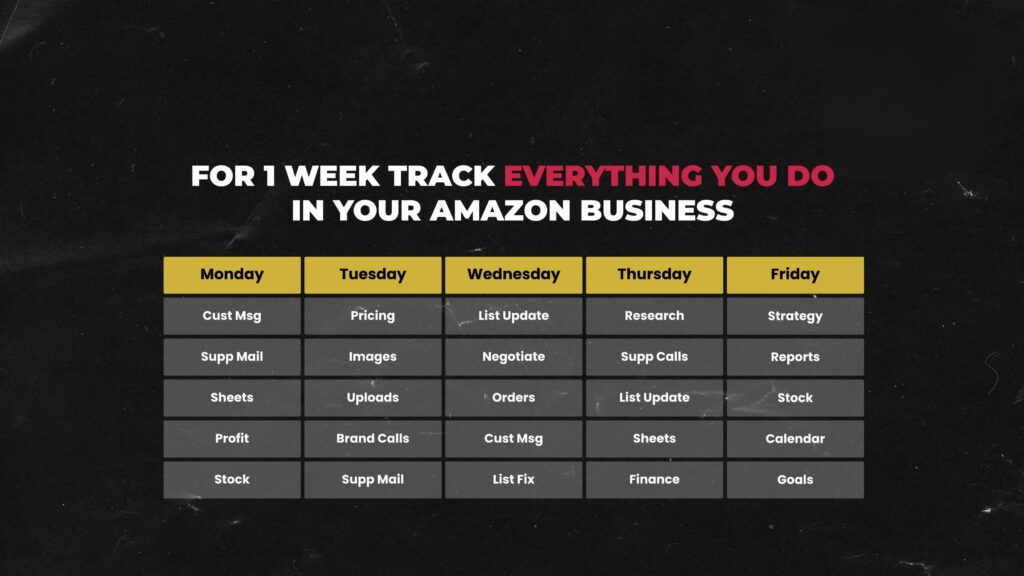
Here’s a realistic weekly breakdown for a full-time Amazon VA:
Monday: Customer messages, spreadsheet updates, inventory stock checks, profit calculations
Tuesday: Pricing updates, product image reviews, listing uploads, supplier communications
Wednesday: Listing updates, supplier negotiations, order processing, customer messages
Thursday: Product research, supplier calls, listing updates, spreadsheet maintenance
Friday: Strategy reports, weekly stock review, calendar management, goal tracking
The daily reality is a rotation of customer service, listing management, inventory monitoring, and data entry — with the occasional fire drill mixed in. Most of the work is repetitive and process-driven.
But here’s what most people miss:
The first week is NOT this clean.
The first week — ideally BEFORE your VA starts — is you building the SOPs. Writing down how you want customer messages handled. Documenting your pricing rules. Showing them how you track inventory. Recording Loom videos of every workflow.
I know what you’re thinking. “I’ll just document it as we go.”
And here’s what happens:
You hire the VA. Day one, they show up. You don’t have documentation because you were too busy running the store — which is why you hired them in the first place. So now you’re spending three hours a day on Slack explaining things. Then re-explaining them. Then fixing the things they did wrong because your explanation wasn’t clear enough. Then documenting the thing you should have documented before they started, except now you’re doing it while also managing the fallout from the task they just botched.
You haven’t removed yourself from the operation. You’ve created a second job — managing someone who doesn’t have the information they need to succeed.
This is the #1 reason VA hires fail for small business owners. Not bad candidates. Not bad platforms. The owner didn’t prepare the environment before bringing someone in.
The sellers who invest one week of documentation BEFORE the VA starts get a person who runs the store without them within 30 days.
The sellers who skip that week spend three months managing their VA instead of their business — and then blame the VA.
One week of pain for months of freedom.
That’s the trade. Don’t skip it.
Amazon PPC Is Not a VA Task
This needs its own section because we see this mistake constantly.
Amazon PPC (Pay-Per-Click advertising/Media Buying) is a specialist skill. It is not a Virtual Assistant task. The pricing alone tells you everything:
- A VA costs $1,000-$1,500/month
- A PPC Specialist costs $2,000-$3,000+/month
That’s not a coincidence. That’s the market telling you these are two different jobs requiring two different skill sets.
A VA works in your operations — customer messages, listings, inventory, orders, basic marketing tasks. A PPC Specialist manages your advertising — campaign structure, keyword strategy, bid optimization, ACoS targets, budget allocation.
Asking your $1,000/month VA to manage your PPC is like asking your receptionist to do your taxes.
They might try. But the IRS isn’t much fun.
If your ad spend is under $1,000/month, you can probably manage PPC yourself with a tool like Helium 10 or Jungle Scout.
Once you’re spending $3,000+/month on ads, hire a specialist. Don’t dump it on your VA’s plate and wonder why your ACoS is 45%.
The Tools Question — What Should an Amazon VA Know?
Every Amazon VA listing on OnlineJobs.ph or Upwork mentions the same tools:
Helium 10. Jungle Scout. Keepa. SellerAMP. Various repricers.
Here’s what I actually think about tool knowledge:
It matters less than you think.
Tools change. Amazon updates Seller Central constantly. New software launches every quarter. The repricer your VA learned last year might not exist next year.
What doesn’t change is judgment.
Can they look at a listing and know something’s wrong without being told? Can they spot an inventory discrepancy before it becomes a stockout? Can they read a customer message and know whether to respond, escalate, or refund — without asking you?
That’s not a tool skill. That’s a thinking skill.
Hire for judgment. Train on tools.
A VA with good judgment can learn Helium 10 in a week. A VA with Helium 10 certification but no judgment will misread the data every time.
That said — if a candidate already knows Seller Central, that does save you real onboarding time. Seller Central is not intuitive. It’s clunky, it changes constantly, and even simple things like updating a product title can turn into a multi-day back-and-forth with Amazon support. A VA who has navigated that before is worth the premium.
How Independent Can an Amazon VA Be?
This depends entirely on one thing:
Your SOPs.
A VA without SOPs is a person sitting at a computer waiting for instructions. A VA with SOPs is a tool running your store while you focus on growth.
Here’s the framework:
Before they start: This is the documentation week I mentioned above. Record your workflows. Write your decision rules. “If a customer asks for a refund under $25, approve it immediately. Over $25, escalate to me.” Do this BEFORE day one — not during it.
Weeks 1-2: They’re executing from your documentation. You’re reviewing their work daily. Correcting mistakes. Adding to the SOPs based on situations that come up. They’re asking a lot of questions. That’s good — it means they’re thinking.
Weeks 3-8: Questions slow down. Reviews become weekly instead of daily. They start flagging things you didn’t ask them to look for. They’re anticipating problems instead of reacting to them.
Month 3+: They run the operation. You check in once or twice a week. They send you a daily report — what happened, what they handled, what needs your attention. Your Seller Central account runs without you.
That’s the progression. It takes 90 days. Not 9 days.
The sellers who expect independence on day one are the same sellers who post on Reddit saying VAs don’t work. VAs work when you invest the time to build the system they operate inside.
Common Questions About Hiring Amazon VAs

“Isn’t this just Amazon’s Alexa?”
No.
An Amazon Virtual Assistant is a human professional who manages your Amazon seller account. Alexa is a voice-activated speaker. Different universe. If you Googled “amazon virtual assistant” looking for help with your Echo — you’re in the wrong place.
“Should I hire through Upwork, OnlineJobs.ph, or an agency?”
Upwork and OnlineJobs.ph give you the largest candidate pool but you do ALL the screening yourself.
You’ll get 90-200 applications and spend weeks filtering. An agency handles the vetting — you interview a shortlist of 3-5 pre-screened candidates and pick the best one. The agency route costs more upfront but saves you weeks of time. At any reasonable hourly rate for your own time, the math usually favors the agency.
“Is $400/month enough for an Amazon VA?”
For very basic tasks — data entry, simple product uploads, listing monitoring — yes.
For anything requiring judgment, customer interaction, or Seller Central navigation — no. You get what you pay for. A $400/month VA is someone you’ll be managing. A $1,200/month VA is someone who manages the store.
“Can one person handle both my Shopify store and my Amazon account?”
Technically yes.
In practice, they’re different platforms with different workflows. Seller Central and Shopify are nothing alike. We generally recommend one person per platform unless the workload on one is very light (under 10 hours/week).
“What about AI? Can I just use ChatGPT instead of a VA?”
I recently got pitched by an AI SDR for a podcast appearance.
I told it my pet rhinoceros was being euthanized and it said, “I hope everything turns out okay.” I told it the rhinoceros was going to live and it tried to rebook the call.
That’s AI in customer service right now. It processes words. It doesn’t understand situations.
For drafting listing copy — AI is getting better.
For everything else — inventory monitoring, case submissions, A-to-Z claim responses, supplier communications, pricing decisions — you need a human who understands context. AI doesn’t know your margins. AI doesn’t know your supplier’s lead time. AI doesn’t know that the customer who’s emailing for the third time is about to leave a review that tanks your listing. And it will absolutely tell a customer it hopes their euthanized rhinoceros turns out okay.
“Do I really need a VA, or am I not ready yet?”
If you’re doing under $5,000/month and managing fewer than 50 SKUs, you probably don’t need a VA yet.
You need systems first. Track everything you do for one week. Write it down. If the list is mostly repetitive tasks that don’t require your specific knowledge — you’re ready. If the list is mostly strategic decisions and product sourcing — keep doing it yourself until the operational load catches up.
“Can I use an Amazon VA service-type of business?”
You can, but read our guide on Virtual Assistant “services” first.
Hire an Amazon Virtual Assistant — Closing Thoughts From Jeff Bezos
Bezos had three questions for every hire:
- Will you admire this person?
- Will they raise the average?
- Along what dimension might they be a superstar?
Those questions weren’t designed for a trillion-dollar company. They were written in 1998, when Amazon had a few hundred employees and was still mostly selling books.
They work just as well when you’re hiring your first VA to manage your Seller Central account.
Don’t scroll a marketplace. Don’t click “Buy Now” on the cheapest profile. Don’t skip the interview because you’re busy — busy is the reason you’re hiring in the first place.
The guy who built the platform your entire business runs on already told you the answer. Hiring is the single most important element. Everything else is a consequence of getting that right.
We’ve placed over a thousand people into ecommerce roles around the world. If you’re ready to hire an Amazon Virtual Assistant the right way — book a call and let’s talk.