

In 2016, I hired my first Filipino Virtual Assistant.
Her name was Joxanne. She was from the Philippines. Cebu, if I recall right. $400 a month, full time, 40 hours a week.
I was running a blog at the time. My first business.
Joxanne handled…everything.
- Long-form SEO articles.
- Interlinking, images.
- Customer tickets for my fledging ecommerce store.
- Social media. Graphic design.
- Everything you’d assign to five different hires today — she was doing it all, quietly, from her laptop in the Philippines, while I focused on growing the business.
Years later, I exited that business to start what eventually became HireUA.
When I wound everything down, I recommended Joxanne to a friend running an ecommerce business.
He hired her on the spot.
She’s still there. A decade later.
4 years with me. 6 years with him. Same quiet competence. Same extraordinary work ethic. Same person I found for $400 a month in 2016.
This is the Filipino Virtual Assistant hire…when it works.
And I’m going to spend the rest of this article telling you how to find a Joxanne of your own — because she exists, there are more like her out there, and almost nothing on the first page of Google is going to help you find her.
Most of what you’ll read about hiring from the Philippines was written in 2010.
The pricing is wrong. The platforms are wrong. The advice is wrong.
The reader ends up doing what everyone else does — posting on OnlineJobs.ph, getting buried in 542 applications, hiring the most polished-looking one, and discovering three weeks in that the polish was a ChatGPT job.
There’s a better way.
This is the honest, in-the-trenches guide to hiring a Filipino Virtual Assistant in 2026. Real screening. Real cultural landmines.
And the 37 things most hiring agencies won’t tell you.
Section 1: The Insider Secrets Nobody Else Is Telling You
1. English-Official Countries Produce MORE Unqualified Applicants, Not Fewer
This sounds backwards. It isn’t.
Because English is an official language in the Philippines, the barrier to entry for “Virtual Assistant” work is effectively zero. Anyone with a laptop, a Gmail address, and a resume template can apply. And they do.
542 applications in 12 hours is normal.
535 of them will be terrible.
Many other country on the planet, English is a second language. Therefore, by posting the job in English, you only get applicants who actually had to work to learn the language. The effort itself is a filter. You get fewer applications, but the ones you get are serious.
In the Philippines, you don’t get that very convenient filter.
This is the #1 reason most first-time Filipino VA hires end in disappointment. You were never going to spot the good one in 542 resumes.
Which is why this whole article exists. You’re not looking for a Filipino Virtual Assistant…you’re looking for a needle in a haystack.
And we’ve spent years simply building the needle factory so you can bypass all of that.
2. “200,000 Filipino Virtual Assistants Available!” Is…A Problem
Every Filipino VA aggregator or platform site has this banner.
“200,000 VAs on our platform!”
“Over 1 million Filipino virtual staff!”
Great. You’re not hiring 200,000 people. You want one, or maybe a dozen. Not 6-figures.
Volume isn’t a quality signal.
It’s just sold as a “feature” — but it’s actually just…more work.
Let me explain:
More candidates means more time you spend sorting, more interviews you conduct, more false starts, more rejection emails, more three-month experiments that end in “it’s just not working out.”
What you actually want is a smaller number. A pre-vetted 5-10. A shortlist you can trust without doing the sorting yourself.
We submit candidates who score 80 or higher on a 100-point rubric across seven categories. We’ve built this rubric across 1,100+ global hires from 35 (and counting) countries.
Everyone else gets filtered out before they reach your inbox. That’s the number that matters — not 200,000. Five.
3. You’re About to Become an Unpaid Recruiter
Here’s what happens the moment you post a Filipino VA job on OnlineJobs.ph, Upwork, Fiverr, or a Facebook group:
You become a full-time Recruiter. You just don’t know it yet.
- 3 hours scrolling profiles on day one.
- 4 hours on day two reading cover letters.
- 2 more hours reviewing Looms the next day.
- Interview round 1 — 15 people, 15 to 20 minutes each.
- That’s 5 hours of calls.
- 50% of them don’t show up.
- A third of the ones who do show up clearly aren’t who they said they were.
Round two. Trial task. Three people submit. Two of them clearly had someone else do it for them.
Like I said…
You’re now a full-time Recruiter. Welcome to the job.
This is the hidden cost that nobody in the $4-per-hour advertising bracket mentions. Your time is likely worth significantly more than that. You just burned 40 hours of it.
4. The $3/Hour Filipino VA Either Doesn’t Exist…or Doesn’t Work Out
They used to exist. Tim Ferriss wrote a whole book about them in 2007.
That era is over.
The global labor market has risen. Cost of living in the Philippines has risen. And the Filipinos who built real careers over the last decade — who’ve now worked for five Western clients, who know how to use the tools, who understand Western business culture — they’re not working for $3 an hour anymore.
The people who are still charging $3 an hour are either brand new (no experience, you’re training them from scratch), or they’re so bad at the job that nobody else will pay them more.
Neither of those is who you want touching your business.
Budget accordingly. A competent, full-time, experienced Filipino VA is a real hire at a real professional rate. We’ll tell you exactly what that looks like on a call.
5. The 4-Hour Workweek Playbook Is Dead
For the record: Tim Ferriss’s book was great. In 2007.
The playbook was: Post a job on a bulletin board, hire three people for $200 a month each, live on a beach in Thailand.
Needless to say, a lot’s changed in 20 years.
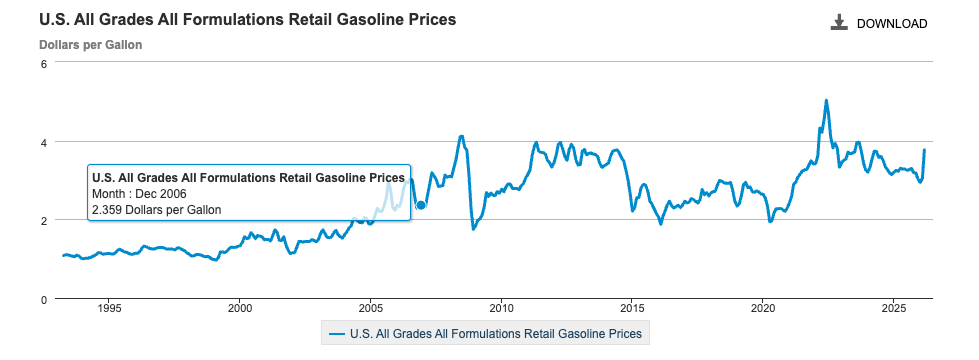
Gas was as low as $2.35/gallon in 2006. Where I’m from in California it’s $6 now. Expecting wages from 2 decades ago is not realistic.
Filipino Virtual Assistants know the market rate.
They know when they’re being underpaid — and they leave.
The people still trying to run the 2007 wage scale are the ones failing in 2026. They post on OnlineJobs.ph with a $300/month budget, get 400 applicants, all of them wrong, and conclude that a Filipino Virtual Assistant is never going to work for them.
Filipino VAs work great if you do it right. The playbook just needs to match the decade.
6. The Rising Tide Is Actually Good News
When wages rise in the Philippines, the talent pool gets stronger, not weaker.
The people who survived the transition from the cheap-cheap-cheap era into the professional market built real careers. They built real skills. They learned real platforms, handled real clients, stayed with the same business for years.
The market matured around them.
The real opportunity in 2026 isn’t finding the cheapest Filipino VA.
It’s finding the ones who stuck around through the maturation, who are now seasoned operators, and who want to work for the small number of businesses that pay fairly and treat them well.
Section 2: The Platform Trap
7. OnlineJobs.ph Isn’t a Service. It’s a Database You Rent Access to.
It is, technically, the largest Filipino VA platform.
250,000+ profiles.
You can search by skill, location, English level, availability. The interface is fine.
But…again, do you need 250,000?
If you’re car shopping, you don’t say “Oh it’s great you have 400 models in stock on your lot I can look at.”
That’s not how it works.
You want them to have maybe 5 cars with a few color variations and options packages of the model you’re looking for.
You don’t walk into a dealership and say that you’re open to a Chevy Malibu or a Tahoe, you have it narrowed down before that.
Here’s what OnlineJobsPH can’t do.
- It doesn’t vet anyone
- It doesn’t verify work experience
- It doesn’t catch the AI-generated cover letter
- It doesn’t run a live English test
- It doesn’t catch the person who’s applying to 47 other jobs the same day
- It doesn’t spot the candidate who already has three other full-time clients
It’s a phone book. Those died, you guessed it, back in 2007.
You pay the subscription, you get access, you become the recruiter. That’s the deal.
This is fine if you love recruiting. If you don’t — and you’re reading this article, so I’m guessing you don’t — you’re about to learn why a database isn’t the same as a placement service.
8. Upwork and Fiverr Are a Race to the Bottom
Post a Filipino VA job on Upwork. Here’s what happens in the first hour:
- 40 proposals, all of them $4/hour
- 15 of those 40 used the same template (the names and a few adjectives changed)
- 8 proposals from people who clearly aren’t from the Philippines but tagged it anyway
- 3 proposals that say “I will work hard for you please consider me”
- 2 good ones, buried at the bottom, that you’ll never see because you stopped scrolling at proposal #15
Upwork and Fiverr exist to drive pricing DOWN.
That’s the whole business model. Every buyer is competing to pay as little as possible. Every freelancer is competing to undercut the next person. The marketplace equilibrium is trash, because the buyer pool is dominated by people who think $3/hour is normal.
You will not find your Joxanne on Upwork.
If you’re paying Upwork rates and expecting Upwork outcomes, you already know what you’re getting.
9. Facebook Groups — The “Interested!” Spam Flood
There’s a growing movement of people telling you to post your Filipino VA job in Facebook groups.
They’re not entirely wrong. The groups exist. Some of them are active. You can post for free.
Here’s what happens the moment you click submit:
The first five comments are “interested!” from profiles with 11 friends and no posts. The next ten are “can I PM you?” followed by a direct-message pitch that reads like it was sent to 50 other people today.
By hour three, you’ve got 80 comments, 40 DMs, and absolutely no way to tell which of these people are real candidates versus which are VAs who run a side hustle applying to literally every VA post they can find.
Some people do find great talent this way. Most people find an inbox overflow.
10. The Seat-Rental Model — You’re Not Hiring a Person, You’re Renting a Chair
There’s a category of companies that call themselves “workforce extension” providers. Or “staff augmentation.” Or “dedicated remote team builders.”
Read their websites closely. What they actually are is call centers with a new coat of paint.
The model is seat rental. You’re not hiring a person. You’re renting a chair in their office, and they fill the chair with whoever’s available. You don’t choose the VA. They pick one for you from their roster. You don’t see the individual — you see a slot in their operation.
If the “VA” leaves, they swap in a new one the next day and charge you the same rate. You don’t own the relationship. You don’t own the hire. You can’t take the person with you if the contract ends. You’re renting access to a call center’s workforce, and the call center can rotate the chair underneath you whenever they want.
This model has its place. If you’re a 500-person company that needs 40 support agents yesterday and doesn’t care who any of them are — seat rental is the fastest way to scale a body count.
If you’re a founder, a small business, or anyone who actually needs a specific person for a specific role — you’re paying for a chair, not a hire.
That’s the difference. A real hire is a relationship with one person who belongs to your business. A seat is a slot in someone else’s operation that you pay for monthly access to.
We do the first one.
11. The Referral from a Current VA Beats Every Platform
You know how Joxanne got hired by my friend for the six years after I exited?
I made one introduction.
Just a Whatsapp text, “Hey dude, do you need anyone?”
That’s the entire sourcing story. No job post. No 400-applicant filter. No screening interview. Just “this person is great, you should talk to her.”
The best Filipino VAs know other great Filipino VAs. They went to school together. They worked at the same BPO together. They’re in the same Facebook groups together. When a spot opens up at a good client — one who pays fairly, communicates well, isn’t abusive — they refer someone they vouch for.
Our candidate pipeline is heavily referral-driven for exactly this reason. The person we just placed with your competitor last month knows three more people who’d be a great fit for you. You never would have found them. We did.
This is why the platform-versus-agency decision matters. Platforms are a firehose of strangers. A real recruiting agency is a network of people who vouch for people.
Section 3: The Country and Cultural Realities
12. The Filipino Work Calendar Will Blindside You
Somewhere between October and April, there’s a stretch where your Filipino Virtual Assistant might be…pretty unavailable.
Christmas starts in September. Not December. September. Filipinos call these “the ber months” — September, October, November, December — and by October the mall Santas are out and the Christmas parties are being planned. Productivity doesn’t collapse, but it shifts. Extended family obligations start early. Many Filipinos take extended leave in mid-December through early January.
Holy Week is a full week the country shuts down. Not a holiday. A week. Most businesses close Holy Thursday through Easter Monday. Your VA is not working. Neither is anyone they’d need to contact. Neither is the bank, the internet provider, or the food delivery service. Honestly this is true in many parts of the world, May in Eastern Europe (where I lived for a decade) is basically a shutdown for 3/4 weeks of the month.
The Philippines has 16 national holidays. You have 10. That’s six days a year your US office is open and your VA isn’t. Put them on the calendar. Come to an agreement.
The fix isn’t to fight it. It’s to know it before day one.
We brief every client on the Filipino work calendar during onboarding. Nobody gets surprised by Maundy Thursday.
13. 13th Month Pay Is Legally Required — And Culturally Expected Even When It Isn’t
The Philippines is one of the few countries in the world that mandates a 13th month salary.
If you employ someone directly in the Philippines (not as a contractor), you are legally required to pay them one extra month of salary by December 24th each year.
If you’re hiring a Filipino VA as an independent contractor, this isn’t legally required.
Culturally, it still is.
Every other client they’ve worked for paid it. If you don’t, you’re either the cheap employer who didn’t know any better, or the cheap employer who knew and didn’t care. Both of those get you off the reference list.
Budget for it. Factor it into your annual cost. Pay it in December. Your retention will thank you.
14. Typhoons and Regional Infrastructure Will Impact Filipino Virtual Assistants
The Philippines is an archipelago of 7,000+ islands. Internet and power quality vary dramatically by region.
Metro Manila has the best infrastructure. Cebu is second. Davao, Iloilo, and the other major cities are decent. The rural provinces are a different story.
Between June and November, typhoon season can knock out power and internet for hours or days at a time. This isn’t an excuse your VA is making up. It’s a fact of life.
The fix: ask where they live during screening. Confirm they have a backup — a mobile hotspot, a secondary power source, a coworking space they can get to. We screen for this explicitly. If someone says they live in a typhoon-prone rural area with no backup plan, they don’t get submitted.
15. Service Culture Is Real — And It’s a Feature When You Hire Right
The Philippines has decades of service industry dominance. BPO call centers. Hospitality. Client and account management for every major Western brand.
What that means, practically:
Filipino Virtual Assistants are culturally wired to be helpful, warm, and pleasant. The default tone on every email, every Slack message, every Zoom call is respectful. They check in. They confirm. They say “yes, of course” when you ask them to do something.
For client-facing work, customer service, hospitality businesses, or any role where the VA is a direct extension of your brand — this is incredible. It’s one of the strongest cases for hiring from the Philippines specifically.
Nobody else produces this combination of warmth and professionalism at this price.
The trade-off, which we’ll get to next.
16. The “Yes Boss” Culture — Sometimes “Yes” Means “Maybe”
I’ll say this as plainly as I can, and I’ll say it as someone whose last name is Mau.
I’m Asian. I grew up in an Asian household. There’s a deference thing that happens in Asian cultures — including Filipino culture — and it’s real.
Don’t embarrass your superior. Don’t push back in front of the group. Don’t say “this won’t work” when the boss just said it will. Agree publicly, figure out the logistics privately.
What that looks like on your Slack:
You send a task at 4pm your time. You ask “can you get this done by end of week?” They say “yes, Boss. No problem.” Friday rolls around. It’s not done. You ask why. They say “oh, I had some trouble with X and Y, but I’m working on it now.”
They didn’t lie.
They just said yes when they meant “I’ll try.”
The cultural default is to commit publicly and work out the problems privately.
The fix: Invite pushback explicitly. Borderline demand it.
Ask “what could go wrong with this?” instead of “can you do this?” Ask “what would you need from me to make this happen?” instead of “will you have it by Friday?”
Reward the VA who says “this won’t work by Friday but I can do it by Monday.”
Over time, the pattern shifts.
Our onboarding explicitly trains both sides on this dynamic. The client learns what to ask. The VA learns that pushback is rewarded, not punished. It sounds small. It isn’t. This is the #1 communication breakdown we see in Filipino VA placements that fail.
17. The Sir/Ma’am Dynamic — Trained Deference Is the Default
Tied to the “yes boss” dynamic: Filipino culture includes a deep formal respect for authority. “Sir” and “Ma’am” are default honorifics. Addressing your client by first name feels uncomfortable at first.
For most roles, this is fine. Actually charming.
For the role where you need a VA to tell you “your idea is bad, here’s why” — this is a structural problem. The cultural training runs the other direction. They will not volunteer the contrary opinion unless you have explicitly, repeatedly, created the conditions where contrary opinions are safe.
If your role requires a true thought partner, a devil’s advocate, someone who’ll tell you you’re wrong — that’s a different hire. You can find that person in the Philippines, but you have to screen for it specifically, and they cost more than the default hire. Most VAs are trained as executors. Which is exactly what most roles need.
We screen for executor versus initiator separately.
Both exist.
You just have to know how to find them. That’s the hard part.
Section 4: Vetting and Screening
18. AI-Generated Cover Letters Are 80% of Applications Now
Open your inbox after posting a VA job in 2026. Here’s what you’ll see:
“Dear Hiring Manager, I am writing to express my strong interest in the Virtual Assistant position you have advertised. With my extensive experience in administrative support, customer service, and social media management, I am confident I would be an excellent addition to your team. Throughout my career, I have demonstrated a commitment to excellence and a passion for…”
That’s ChatGPT.
Every single word of it.
The problem isn’t that AI helps candidates write better cover letters. The problem is that AI obscures who can actually communicate versus who can’t. The person who wrote that cover letter might be extraordinary. Or they might not even speak conversational English. You have no way to tell from the text.
The way to catch it:
- Send a follow-up message that requires a specific, non-templated response (“What’s one question you have about this role?”)
- Put them on a live video call within 48 hours — unscripted, 15 minutes, just a conversation
- Watch the gap between written English and spoken English
The fakers collapse in under three minutes on video. The real candidates sound exactly like their cover letter — because they actually wrote it.
Our recruiting team conducts the live English screening on every candidate before they reach you. The AI-generated mirage never makes it to your inbox.
19. The Resume Template Industry — Everyone Looks the Same on Paper
There are approximately three resume templates in circulation among Filipino VA applicants. You’ll see them all within your first 20 resumes.
- Clean sans-serif header.
- Photo in the top-right corner.
- “Professional Summary” in blue italic.
- Bullet points that all start with “-” and all use the same action verbs.
- Core Skills section with eight to twelve identical items:
- “Microsoft Office Suite, Google Workspace, Canva, Calendly, Slack, Trello, Asana, Customer Service, Time Management, Attention to Detail.”
They aren’t lying. Most of them have actually used those tools. But someone knowing Google Docs doesn’t help you at all.
The problem is you can’t tell them apart.
The fix isn’t to judge the resume.
It’s to skip it.
Go straight to the 15-minute live call. The resume exists to get them past the first filter, and in the Philippines the first filter is broken. You have to build your own.
20. “5 Years of Experience” Often Means 5 Years Across 15 Clients
Read a Filipino VA resume carefully. You’ll often see something like:
- Virtual Assistant – 2022-Present (Various Clients)
- Customer Service Representative – 2020-2022 (Various Clients)
- Administrative Assistant – 2018-2020
That middle “Various Clients” on a multi-year line is doing a lot of work.
What it usually means: they had 15 different short-term gigs in those two years. Some lasted a month. Some lasted a week. Some were 10-hour projects that inflated into “a role.”
That’s not the same as five continuous years of genuine experience with one or two businesses where they learned the work, made mistakes, and grew.
Here’s the thing most hiring managers don’t know how to do:
You can’t just ask “how long was that job?” They’ll give you a polished answer. You have to probe without alienating them — without making them feel defensive or accused of lying. If you push too hard, the “yes boss” instinct kicks in and they shut down. If you don’t push at all, you get the surface-level answer and miss the truth.
The question that actually works: “Walk me through your three longest client relationships. How did you find them, what did you do for them, and why did those relationships end?”
The real operator answers immediately and specifically — names, dates, specific projects, clean explanations for why it ended. The resume-inflater stumbles over the third one.
Our recruiters do this every day.
They’ve conducted tens of thousands of these interviews.
They know exactly where the soft spots are and exactly how to press without alienating. It’s pattern recognition trained on volume — the kind of thing you get one shot to learn on your own hire, and we’ve already made every mistake on someone else’s time.
21. Written English vs. Spoken English — The Gap Is Real
Filipinos learn English from age 6 in school. Most of it is reading, writing, and formal composition. Speaking English in casual, fast-paced business conversation is a different skill.
You’ll see Filipino VAs with flawless written English — grammatically perfect emails, well-structured Slack messages, polished reports — who struggle to keep up with a 5-minute Zoom call at natural speaking pace.
This matters a lot for some roles and almost nothing for others.
If the role is 80% written work — drafting emails, managing documents, responding to messages — written English is the skill that matters. Spoken English almost never comes up. The hire is fine.
If the role involves client calls, internal meetings, real-time Zoom collaboration, phone-based customer service — spoken English is everything. A written-English star can be a spoken-English liability here.
The only way to test this: Live video call, 15 minutes minimum, no script.
Our recruiters operate at C1-C2 English level themselves — they catch the gap in the first three minutes.
22. Portfolio Samples Get Borrowed. Trial Tasks Get Farmed Out.
This sounds cynical. It’s not. It’s the market reality.
Portfolio samples get borrowed. You ask a VA for examples of their work. They send you screenshots of a customer service dashboard, a beautifully designed social media grid, a well-organized inventory spreadsheet.
Great work. Professional. Polished.
You hire them.
Their actual work product looks nothing like the samples.
The samples were their cousin’s. Or their coworker’s at a previous BPO. Or pulled from a template library online. There’s an entire secondary market in the Philippines for “portfolio content” that VAs buy or borrow to send to prospective clients.
Trial tasks get farmed out. The candidate pays someone else $5 to do your trial task. The polished output you get back isn’t theirs. When you hire them, the work on Monday looks nothing like the trial task.
The only tests that work are the ones they can’t prepare for:
- A live call where you show them a specific real scenario from your business and ask what they’d do
- A 5-scenario “fire drill” with no preparation time
- A question that requires opinion and judgment in real time, not facts
Which brings us to…
23. The Live Fire Drill — Five Scenarios, Two Minutes Each, No Preparation
This is the single most effective screening technique for any VA role.
Pull five real scenarios from your business. Not hypotheticals. Real situations you’ve actually faced in the last three months.
For an Ecommerce Virtual Assistant: a chargeback dispute, a supplier communication, a listing that got suppressed, an angry customer review.
For an Executive Assistant: A calendar conflict, a sensitive email draft, a travel rebooking, a confidential file handling.
For a Marketing VA: A social media comment crisis, a competitor mention, a content calendar question, a tool permissions issue.
Get on a Zoom call. Share your screen. Show them scenario #1. Say: “You have two minutes. Walk me through what you’d do. Go.”
No prep time. No AI. No Google. Just their brain, your clock, and their first instinct.
Then do it four more times.
You’re not grading whether they know the exact right answer. You’re watching how they think. Do they ask clarifying questions? Do they guess? Do they flag what’s outside their authority? Do they make promises they can’t keep?
A candidate who handles four out of five cleanly and flags the fifth as “I’d need to check with you on this one” — that’s your hire.
A candidate who freezes, gives generic answers, and looks uncomfortable — that’s the person who’ll freeze on your real fire drill in month two.
You’ll know in 10 minutes. It’s not a hunch. It’s the test.
24. The 100-Point Rubric
Every candidate we submit to a client has been scored on a 100-point rubric across seven categories:
- Resume quality
- Direct experience
- Similar experience
- Appearance and professionalism
- Technical setup
- English level
- Vibe
Minimum submission score: 80 out of 100.
Most applicants never get close. Most of the ones who do still don’t clear the bar in every category. The ones who do are the 5 people you actually see.
That’s the rubric that separates the candidates in your inbox from the 700+ applications you don’t have to read.
We’ve developed it over years of placements across every industry you can name. You get the benefit of it on every hire.
Section 5: Managing A Filipino Virtual Assistant

25. The Cost-of-Living Math — And Why Retention Tracks It
What you pay your Filipino VA doesn’t just determine whether they take the job. It determines whether they stay.
At the aforementioned $400 a month, a Filipino Virtual Assistant is in survival territory — rent, food, basic bills, nothing left over for anything else. This person is going to leave you the moment someone offers $450.
The math isn’t “pay them as little as possible.” The math is “pay them enough that leaving would hurt them more than staying.”
That’s the lowest-churn employer position in any market. Filipinos are no different.
26. They WILL Leave You for $50/Month More…Because It’s 10%.
Here’s the part most Western employers don’t connect.
If you’re paying your Filipino VA $500 a month and a competitor offers them $550, that’s a 7% raise. Anyone anywhere in the world moves jobs for a 10% raise. You would. I would.
The instinct is to be indignant: “After everything I’ve done for them, they leave for $50 a month?”
Yes. Because $50 a month is 10%.
Most people would leave a job paying you $90k to make $100k.
Every 6-12 months, look at what you’re paying versus the current market. Bump it before they ask. The small raise you give now prevents the full replacement cost later — which is months of retraining, lost institutional knowledge, and broken SOPs.
Or put some bonus structure in place that benefits your business directly and rewards them for driving revenue, whatever it is. Maybe it’s per article published, per lead that comes in, whatever.
27. Documentation Before Day One — Not As You Go
This is the #1 cause of Filipino Virtual Assistant failed hires. And it has nothing to do with the VA.
Here’s the pattern:
- You hire a great person. Day one, they show up, eager, ready.
- You don’t have any documentation because you were too busy running the business — which is why you hired them in the first place.
- So now you’re spending three hours a day on Slack explaining things. Then re-explaining them.
- Then fixing the things they did wrong because your explanation wasn’t clear.
- Then documenting the thing you should have documented before they started, except now you’re doing it while also managing the fallout from the task they just botched.
You haven’t removed yourself from the operation. You’ve created a second job — managing someone who doesn’t have the information they need to succeed.
One week of documentation before they start buys you three months of clean onboarding. The clients who skip that week spend three months managing their VA instead of their business — and then blame the Filipino Virtual Assistant when it doesn’t work.
28. Voice Notes and Looms Beat Written SOPs — And Turn Into Documentation Automatically
You don’t have time to write SOPs. You do have time to talk.
Record a 3-minute Loom every time you explain something new to your VA. Record a voice note when you’re walking through a task. Send it in Slack. Move on with your day.
Two things happen:
- The VA has a better, richer, more intuitive version of the instruction than any written SOP could ever be. They see your screen, hear your reasoning, catch the little “oh and by the way” details.
- You just accidentally built documentation. The Loom library becomes the SOP library. The voice notes become the process manual. You didn’t have to carve out a weekend to write anything.
This is the single biggest unlock for busy founders who can’t imagine when they’d ever write the documentation.
You don’t write it. You talk it. The VA turns it into the written version…here’s how.
29. Make Them Write (or Refresh) the SOPs
Better than you doing it yourself: have them do it.
After your Filipino Virtual Assistant watches the Loom or hears the voice note — have them write the SOP version. In writing. In their own words. In a shared document.
You review it, correct anything they misunderstood, and approve it.
That document is now the source of truth. The next VA you hire — and there will be a next VA someday — opens that document and onboards themselves.
The best version of this: Every time the VA learns something new, they add to the SOP. Every time the business changes something, they update the SOP. The documentation stays current because the VA owns it.
You just converted your Filipino Virtual Assistant from a task-doer into someone with deep understsanding. The business runs without you on those tasks forever.
If you already have SOPs — have them refresh. Most company SOPs are 18 months out of date the moment they’re written. Your VA can keep them alive.
30. Weekly 1:1s and Quarterly Reviews Aren’t Optional
Every Filipino VA relationship that goes well has one thing in common: structured, predictable, un-skipped check-ins.
Weekly 1:1
30 minutes. Same time every week. Zoom. Not Slack, not async. Video. They talk first — what’s working, what’s stuck, what they need from you. You talk second — priorities, feedback, coaching. Non-negotiable.
Quarterly Review
60-90 minutes. Formal. Scorecard review (see next point). Goals for the next quarter. Compensation conversation. Career conversation.
Most employers skip these because “we talk all day in Slack anyway.” That’s not the same thing.
Slack is task execution. The 1:1 is relationship, coaching, and the space where the VA tells you the things they wouldn’t put in a message.
The VAs who stay with one employer for years all got weekly 1:1s. Every one of them. It’s the single most predictive signal for retention.
31. Scorecards With Red and Green Beat Any EOS Dashboard
Forget any fancy dashboard platform. You don’t need them.
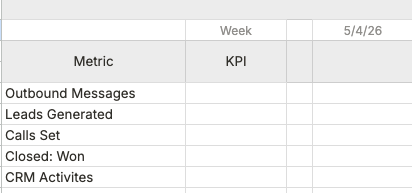
What you need is a spreadsheet. One tab per VA. Five to seven KPIs. Color-coded red, yellow, and green. Updated weekly.
That’s the entire system.
For a Shopify VA or Amazon VA: Average response time, tickets resolved per day, customer satisfaction score, SLA hit rate.
For a Social Media VA: Posts published per week, engagement rate, community response time, content calendar completion.
For an Real Estate VA: Listings posted per week, appointments scheduled, etc.
Pick the five to seven things that actually determine whether this role is being done well. Measure them. Share the scorecard with the VA. Review it in the weekly 1:1.
The difference between a Filipino VA who performs and one who drifts is whether you’re measuring.
Red and green on a simple spreadsheet does what $3,000-a-year dashboard tools promise and almost nobody actually uses.
It can literally look as simple as this. Simple scales.
Section 6: AI & Final Thoughts
32. AI Killed the Bottom Half of This Role — Judgment Is What’s Left
Half of what a Filipino VA was paid for in 2020 is now a prompt.
Drafting a standard response to a customer. Writing a LinkedIn post from a bullet-point outline. Resizing a batch of product images. Extracting data from a CSV. Formatting a report. ChatGPT does all of it in minutes.
What AI can’t do yet:
- Know when a customer is actually upset versus just venting
- Notice that something in your business isn’t right before you’ve said anything about it
- Remember that last Thursday you mentioned a project and now it’s been a week with no update
- Pick up the phone and handle a supplier who’s being difficult
- Sense that your tone is off in an email draft and rewrite it for the relationship
That’s judgment. That’s what’s left. And that’s what the Filipino Virtual Assistant of 2026 is being paid to do.
The cheap $3/hour VA’s job is being eaten by AI this year.
The judgment-based VA is as valuable than ever.
33. Job Stacking — Your “Full-Time” Hire Probably Has 2 Other Clients
This is the dirty secret of the whole industry.
The “full-time, dedicated, exclusive” Filipino Virtual Assistant you hired on OnlineJobs.ph at $600 a month? They’re probably working for two other clients simultaneously.
This isn’t always bad. Some VAs job-stack openly and manage their time beautifully. They work 60 hours a week and everyone gets good output.
But if your VA says they’re full-time and exclusive at a price that’s below market — they’re either brand new, desperate, or not telling you the truth about what else is on their plate.
The tell: Response times slow down. They’re “taking longer than expected” on tasks. They’re offline at weird times. They get confused about which client said what.
The fix: Pay above market (point 26 again), run the live screening (which catches job stackers — they can’t usually hide it when you watch them work), and include an exclusivity clause in the agreement with penalties for violation.
Our agreements are exclusive by default. Our screening catches the stackers. The clients we place don’t run into this.
34. We’ve Placed Across 35+ Countries and Counting

Here’s an uncomfortable truth.
Not every role is a perfect fit for the Philippines. Some are. Some aren’t.
If on the discovery call we figure out that your specific role — let’s say aggressive outbound sales, or creative strategy requiring deep US cultural nuance, or a specific niche where the talent happens to be concentrated elsewhere — we handle that too.
One hire. One process. Global.
We’ve placed across 35 countries and counting. You don’t need to shop four different agencies. You don’t need to wonder if you’re picking the wrong region. Tell us what you need, we tell you where the best talent for your specific role is most likely to be, and we find that person.
Most of our clients who start with “I want a Filipino Virtual Assistant” end up with exactly what they need.
35. The BPO Infrastructure Is Hollowing Senior Talent Out
Here’s the undercurrent in the Filipino VA market that most employers miss:
The BPO industry built the country’s remote work infrastructure. Thousands of call centers. Hundreds of thousands of workers. The English, the Western-schedule training, the home office setups — it all came from BPO.
And the BPO industry is now hollowing out.
The entry-level work — the stuff BPOs used to sell to Fortune 500 companies — is being automated. Junior agents are being replaced by AI chatbots. The ladder that used to take someone from a junior BPO agent to a senior manager to an independent VA with a decade of experience is getting shorter.
What this means for you:
The senior Filipino talent is still there. They’re more experienced than ever. But the pipeline behind them — the juniors who would have become the seniors in five years — is shrinking. The cream rises, but the layer below it is thinning.
This is another reason the 2026 Filipino VA hire is more about WHO you hire than WHERE you hire.
The quality gap between the top 10% and the bottom 50% has never been wider. And getting to that top 10% is, once again, what this article has been about. It’s not easy to find them. We have a whole database of them.
36. Process-Follower vs. Initiator — Most Filipino VAs Are Trained As Executors
This isn’t a flaw. It’s the market reality, and it matters for the hire.
The default Filipino VA has been trained — in school, in BPO, in customer service — to follow processes precisely. They execute what’s written. They follow the SOP. They do the task as specified. They do not improvise outside the brief.
For 80% of VA roles, this is exactly what you want.
Someone who takes the instruction and runs it flawlessly.
For the remaining 20% — roles where you need strategic thinking, independent judgment, proactive problem-solving — you need an initiator. That person exists in the Philippines, but they’re a smaller slice of the market.
We screen for executor-versus-initiator explicitly.
When you tell us what the role is, we match accordingly.
Most clients think they need an initiator and actually need an executor with clear SOPs. Some clients think they want an executor and actually need an initiator because their SOPs don’t exist yet. The discovery call sorts it out.
37. The Ultimate Test: After You Hire Them, Do You Ever Think About Them?
If your Filipino Virtual Assistant is on your mind constantly — if you’re checking in, worrying about whether a task got done, wondering if the customer message was answered right, spending mental energy on their work quality — they’re the wrong hire.
The right hire is the one you forget about.
They do the work. It gets done. You find out about it when you happen to glance at the customer inbox on Sunday night and realize every message has been handled perfectly by someone who wasn’t you.
Joxanne, back in 2016, was that hire. I didn’t think about her. I didn’t have to. She just did her job, for years, at a level that still impresses me a decade later. When I exited the business and recommended her to my friend, I didn’t write her a reference letter. I just said “hire her” — because everything I could have said in a reference was something he’d figure out in his first week anyway.
That’s the Filipino VA hire when it works.
That’s what we find for our clients.
Common Questions About Hiring Filipino Virtual Assistants
How much does a Filipino Virtual Assistant cost in 2026?
Global Filipino VA talent, full-time, through a proper agency: $2,500-$3,000/month all-in for a vetted professional who actually does the job.
The $3/hour era is effectively dead — the survivors of that transition are experienced, skilled, and command professional rates.
The US equivalent of this role costs $80,000-$90,000 annually plus benefits. The math does itself.
Should I hire from the Philippines or Latin America?
Timezone is the biggest practical difference. Latin America Virtual Assistants can overlap with US business hours. The Philippines is 12+ hours offset — your VA works your night shift to match your day.
Both regions produce strong talent. Your role determines the fit. We place across both and help you figure out which one is right for your specific need on the discovery call.
How do I verify English before hiring a Filipino VA?
Live video call. Not text. Not email. Not a written test.
15 minutes of unscripted, natural conversation. If they can hold it, the English is fine. If they can’t, no amount of polished writing will fix that on your actual team.
How do I handle payroll for a Filipino VA?
Most independent Filipino contractors are paid through Wise, PayPal, or Payoneer. Some prefer direct bank wire.
If you hire through HireUA, we handle payments, equipment compliance, and tax documentation. You write one check per month to us. We handle everything downstream, plus guarantee the hire for 1 year.
What about time zones? Is 12 hours offset a problem?
For some roles, yes. For most, no.
If you need live real-time collaboration during US business hours, a Filipino VA working at 3am isn’t ideal. If your work can be async — tasks completed overnight, reviewed the next morning — the offset is actually an advantage. You sleep, they work, you wake up to progress.
Many of our Filipino VA placements work a split shift (a few hours overlapping with US morning, the rest on Philippine time). We arrange this during onboarding.
Is it legal to hire a Filipino VA as a US business?
Yes.
Filipinos work as independent contractors for US businesses through standard service agreements. No visa sponsorship required. No work permit issues. They handle their local tax obligations in the Philippines. We handle the compliance paperwork.
How long does hiring a Filipino VA through HireUA take?
Candidates in your inbox within 3-5 business days. Scheduled on your calendar within 7-10. Typical placements close within two to three weeks from discovery call to start date.
Compare that to three months of solo recruiting on OnlineJobs.ph…
How We Hire Filipino Virtual Assistants
We’ve placed over 1,100 people into businesses around the world across 35 countries. Filipino Virtual Assistants are one of the most requested hires — and one of the most landmine-filled markets to navigate without a guide.
Here’s how it works:
You tell us what you’re building and what the role actually involves on a Monday morning. Not the job title — the actual work. What does this person do every day? What tools? What does “good” look like six months in?
We source from our network of pre-vetted talent across the Philippines — not from OnlineJobs.ph, not from aggregator sites, not from Facebook groups. From people we’ve already screened, tested, and referred.
Every candidate goes through our 100-point rubric across seven categories. We don’t submit anyone who scores below 80.
We catch the AI cover letters, the resume inflators, the job stackers, the portfolio borrowers, the trial-task farmers, and the English mismatches — before they reach your inbox.
You get pre-vetted candidates in five business days.
One flat monthly fee. No salary transparency games. Replacement guarantee.