

Fifteen years ago, I tried to hire offshore for the first time.
I was trying to get a side business off the ground, and the math only worked if I could find help that didn’t cost California prices.
So I did what you did back then:
Posted on some sketchy job board, exchanged emails with strangers, and wired money to people I’d never seen on video — because video calls barely existed.
No Slack.
No Loom.
No async anything.
You sent a Word doc into the void and hoped for the best.
Back then, hesitation made sense. Offshore hiring was a leap of faith, and plenty of people got burned making it.
Today, I run a company that has made over 1,100 offshore placements across 35+ countries. And you know what I still hear from companies every single week?
“We’re just not sure about hiring offshore…”
Not sure about what, exactly?
It’s not 2007. The tools got built. The talent got better. The world went remote. Anyone with a pulse can use Zoom and dial in to a meeting.
So here are 24 reasons to hire offshore — and one test at the beginning that every objection you’re currently holding will die against.
Last Updated: July 17th, 2026
Key Takeaways
- Hiring offshore is way more viable now due to improved tools, communication, and talent accessibility.
- Many objections to offshore hiring stem from outdated fears, like…2007.
- Offshore talent often provides insanely high-quality work at lower costs, and you give someone an amazing opportunity.
- Companies save money by eliminating domestic payroll burdens, office costs, and can often hire multiple team members for the price of one local hire.
- By hiring offshore, employers can offer life-changing opportunities. Truly.
The Part Nobody Wants to Admit
1. If You’d Hire an American Living Abroad for Half the Cost, You Already Agree With Me
Picture this:
A woman born in Ohio. Perfect English, obviously. Ten years of experience in exactly your industry.
She moved to a small Spanish town two years ago because she was tired of paying $3,400 a month for a one-bedroom apartment in Ohio.
Now she lives in the middle of a cultural hub with a hundred restaurants within a mile of her apartment. Perfect weather most of the year. Her entire cost of living — rent, food, everything — runs about $2,000 a month. The $70 dinner she used to grimace through back in Ohio is now $12 of tapas and a glass of wine on a terrace.
She’s not struggling. She’s pretty damn happy with how life ended up. And because her life costs less, she offers to do the job for half of what you’d pay locally (and she’s still coming out ahead).

You’d say yes before the Zoom call ended.
So what’s actually different when the same offer comes from someone in Serbia or Argentina or the Philippines? Not the time zone — she’s in a different one, too too. Not the distance — she’s just as far away.
The work is the work. The Slack messages look the same.
That’s the test.
Hold onto it, because every objection you raise for the next 23 reasons has to survive it. Most of them won’t.
2. It’s Not 2007 Anymore
Back when I first tried this 15 years ago, the fears were legitimate. There was no good way to communicate, no good way to train someone, no good way to see what anyone was doing.
Every one of those problems got solved.
Communication? You’re already on Slack or Teams all day — including with the person three desks away.
Training? Record your screen once while you talk through the task, like you would with a new hire sitting next to you. Send the link. Done.
Visibility? The same project management tool your local team uses. Meetings? You’ve been living on video calls since 2020, and so has the rest of the world.
There is no second, scarier internet that offshore employees use. It’s the same tools, the same calls, the same everything. The infrastructure caught up years ago. The hesitation just never got the memo.
3. Remote Already Is Here
Here’s the thing:
You already manage people you can’t see.
Maybe your team is fully remote. Maybe it’s hybrid. Either way, at some point in the last few years you accepted that work is a thing people do, not a place people sit.
And once someone isn’t in your office, whether they’re 30 miles away or 3,000 miles away stops mattering. They’re in the same Slack channels and the same meetings as everyone else. The work shows up the same way it always did.
You already crossed the hard bridge when your team went remote. Offshore isn’t any different, just requires a passport to get to them.
4. Your Competitors Already Hired Offshore
They’re just not announcing it.
Nobody puts out a press release that says, “We cut our operating costs 40% by hiring offshore staff.” They just quietly get faster and cheaper while you wonder how they can charge what they charge.
The companies you’re losing deals to on price? A good chunk of them didn’t find some magical efficiency. They found a bookkeeper in Colombia and a customer support team in the Philippines, and their payroll line looks nothing like yours.
You can be annoyed about that, or you can join them. Those are the options. “Neither” is not on the menu.
The Money
Let’s not dance around it. This is why everyone starts looking at offshore hiring. It’s just not why they stay — we’ll get to that.
5. You Skip the Payroll Load Entirely
A US salary is just like ordering food at a US restaurant…the bill’s always higher than what’s on the menu.
It’s staggering.
The $100,000 employee doesn’t cost $100,000. Add payroll taxes, health insurance, workers’ comp, unemployment insurance, and 401k matching, and the real number climbs fast. According to the Bureau of Labor Statistics, benefits alone account for 30% of what private employers actually spend on compensation — which works out to roughly 43 cents of extra cost on top of every salary dollar.
Your $100,000 hire costs you closer to $140,000.
Offshore, the number is the number. What you agree to is what you pay. Nothing hiding behind the offer letter.
6. Your Office Costs Go to $0
Every local employee comes with a hidden “physical/local” bill:
The desk, the chair, the square footage, the parking spot, the snacks, the second monitor, the birthday cake budget.
Thousands of dollars a year, per person.
With an offshore hire, that entire line disappears. Most offshore hires work as independent contractors, provide their own laptop, and run their own home office (plus get all the tax write-offs). You pay for the work. That’s it.
7. You Can Hire 2 People Instead of 1
Take the $80,000 you were about to spend on one local generalist — the “marketing person” who does a C+ job at six different things.
Offshore, that same budget fills two seats.
A specialist for the media buying of ads and a specialist for the content. Or one marketing hire and that Customer Support role you’ve been putting off. You don’t need two of the same person — you get to fill another need entirely.
It also changes how you can hire.
You can trial two candidates for a month, side by side on real work, and keep the better one. Try affording that experiment with local salaries (and the contract issues, to boot).
8. You Don’t Have to Wait Until You’re Desperate
The worst part of a big domestic hire isn’t the salary.
It’s how sure you have to be before you pull the trigger. So you wait. You wait until you’re drowning, until the work you should have delegated a year ago has already cost you clients.
At around $3,000 a month, all-in, the math flips.
You can hire when the problem shows up instead of six months after it became a crisis. The role pays for itself before a domestic hire would have finished their interview process.
9. Your Normal Is Their Life-Changing
This is the one that made me fall in love with this business, so I saved it for the end of the money section.
The salary that looks like a modest line item on your P&L is, in many of these markets, a top-tier professional income. The same dollars that barely move the needle for you completely change the trajectory of someone’s life — their family’s life.
Now think about what that does to effort.
One person shows up because it’s a job. The other shows up because it’s the opportunity. You cannot buy that second kind of energy at any price in your local market — but offshore, it comes standard.
Everybody wins.
Here are actual examples from the HireUA team.
The Talent
10. You’re Fishing in an Ocean, Not a Puddle (aka Your Zip Code)
If you’re hiring in a major US market, I have bad news about your position in the food chain.
Say you’re in San Francisco. Every company in that city — plus every hybrid company that only needs people in the office once a month — is fishing in your pond. The tech giants, the funded startups, the ones with breakfast included and childcare and a gym on site and all the other jazz and $200k salaries for 26-year-olds.
Take Google, as an example…look at these benefits.
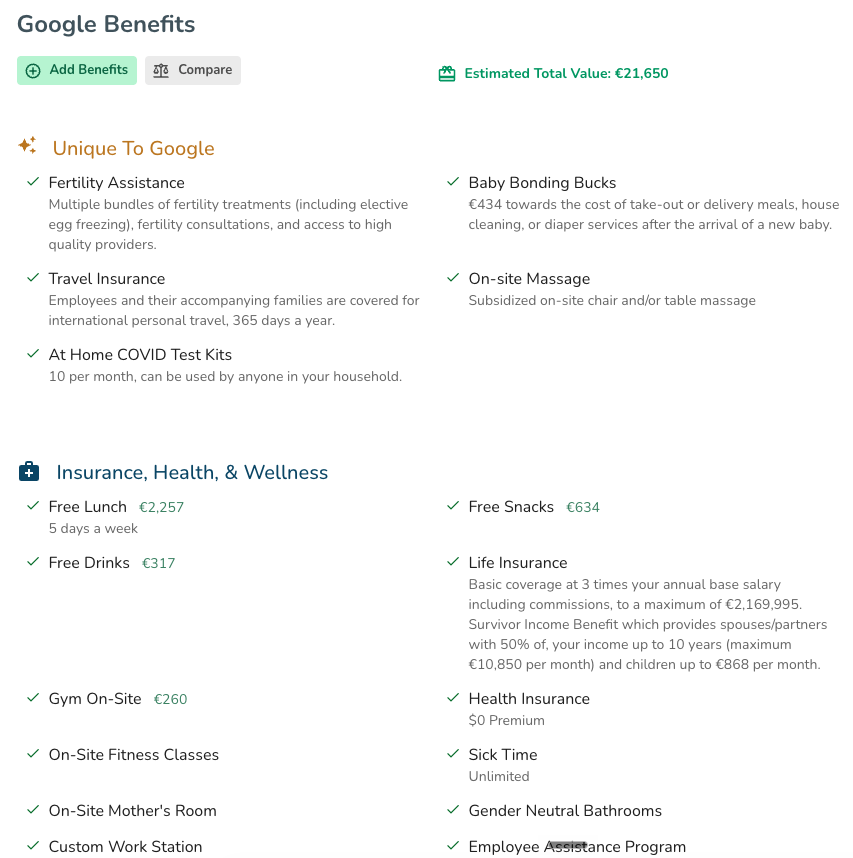
They’re the sharks.
You’re probably not a shark. You’re a guppy, swimming in the most over-fished pond in the world, wondering why every good candidate gets snatched before your second interview.
Hiring offshore isn’t just a bigger pond. It’s leaving the tank entirely — an ocean of millions of professionals where you’re suddenly one of the most attractive employers in the water due to the reasons mentioned above with costs of living.
11. The Hiring Cycle Drops From Months to Days
Think about the last domestic hire you made.
Agonizing about how to write the best job description.
The 400 resumes, 390 of them garbage. The scheduling ping-pong. The candidate who ghosted after round two. The counteroffer drama. The two weeks notice. The start date six weeks out.
Companies routinely burn months — or more — filling one seat.
Offshore, with the right pipeline, you’re talking to vetted candidates within days. The first time a company hires offshore, it’s usually about the money. The second time, it’s because they never want to run a domestic hiring process again.
12. Your Local Applicants Aren’t Hungry
In markets where a great US-dollar remote job is the prize — not one option among fifty — you get candidates who fight for the role and then keep fighting after they get it.
The 24-year-old in Kyiv or Bogotá with sharp skills and something to prove will run through walls that your local candidate, fielding three other offers, won’t even walk around.
You’re not exploiting that hunger. You’re rewarding it. See reason #9.
13. When You Hire Offshore, They Stay
Local employees job-hop every two or three years. That’s not a character flaw — it’s a rational response to a market where hopping is the fastest raise.
But when you’re the best opportunity in someone’s market (and paying well by local standards, you are), the calculus changes. Good offshore hires stay for years. Some of the best placements we’ve made are still in the same seat today, 5 years later, promoted twice, running teams.
Turnover is one of the most expensive line items no one puts on a spreadsheet. Offshore quietly deletes most of it.
14. The Overflow of Talent in Eastern Europe, Latin America, and Asia
Eastern Europe, Latin America, and Asia keep minting engineers, accountants, designers, and marketers faster than their local economies can absorb them.
Strong universities. Serious technical education. Cultures that take credentials seriously. And a local job market with a hard ceiling on what those credentials can earn.
That’s not a talent shortage. That’s a talent surplus — sitting there, educated and underpriced, while US companies fight to the death over the same shrinking domestic pool. You don’t need to outbid anyone. You just need to show up.
Timezones: The Honest Version
I’m going to break listicle rules here and tell you where the limits are, because the timezone pitch is where most offshore sales pages start lying to you.
15. Async Roles Are Great — the Rest Need a Plan
If the work is truly asynchronous — bookkeeping, content, design, development with clear specs — timezones are a gift. You hand something off in the evening, and it’s done when you wake up. Your business produces while you sleep.
But plenty of roles aren’t async, and pretending otherwise is silly.
The real picture:
Much of Europe naturally works later hours that overlap nicely with a US morning. Europeans don’t mind sleeping in and starting later. Trust me. I’ve lived out here for 10 years. Not many people rise before me.
The Philippines has an entire professional workforce accustomed to running on US time — it’s simply how their industry operates. Latin America barely has a gap at all.
Timezone is a solvable variable, not a magic trick. Solve it for the role you’re actually hiring, and it disappears. Ignore it, and it becomes the whole story.
16. Round-the-Clock Coverage — If You Actually Need It
Full disclosure: Most companies don’t need 24-hour coverage, and you shouldn’t buy it because it sounds impressive.
But if you’re in support, ecommerce, ops, or anything where a customer at 3am is real revenue — try building overnight coverage domestically. Night-shift differentials (and the pay for it), brutal turnover, and a hiring pool of people who don’t want to be there.
Offshore, someone’s 9-to-5 is your overnight. No differential, no resentment, no empty seat. The sun never sets on your business, and nobody had to suffer to make it happen.
The Reasons Nobody Tells You About
This is my favorite section, because these are the reasons that only show up after companies hire offshore. Nobody buys because of these. Everybody keeps hiring offshore because of them.
17. SOPs Stopped Being Hard
The classic excuse: “I can’t hire offshore, I don’t have anything documented.”
Neither does anyone else.
Here’s how you document a process in 2026 (really top-secret what I’m about to drop…sarcasm off):
Turn on a screen recorder. Do the task while talking through it, like you’re explaining it to a new hire sitting next to you. Do it two or three times. Then let AI turn your rambling into a clean checklist.
That’s it. That’s the whole discipline that used to take operations consultants weeks. The same technology wave that made offshore hiring easy made preparing for it easy too. The excuse is dead. It just doesn’t know it yet.
18. Onboarding Should Have a CALENDAR
Some companies onboard a new remote hire by sitting them on video calls for eight hours a day. That’s insane. Nobody learns that way — they’re dozing by hour 2.
Good onboarding for an offshore hire is embarrassingly simple: A calendar, and a checklist.
Day 1: Watch these three Looms, read this doc, do this small task, 30-minute call at the end.
Day 2: First real task, with the recording of you doing it. Questions in Slack.
Day 3: Same task, less hand-holding.
A week of that beats a month of meetings. If your onboarding plan doesn’t fit on one page, it’s not a plan — it’s a stall.
19. It Shows What’s Broken in Your Processes
Something uncomfortable happens when you prepare to hand a process to someone seven time zones away:
You discover you can’t explain it.
The process that “works fine” turns out to be three workarounds in a trench coat. The thing only Sarah knows how to do turns out to be a liability, not a quirk. The “system” turns out to live entirely in your head, which means your business has a single point of failure with your name on it.
Hiring offshore forces the X-ray. Companies come for the cost savings and accidentally fix operational rot they didn’t know they had. If you can’t document it, you never understood it — and now you do.
20. It Forces You to Define What “Done” Looks Like
In an office, you can get away with vague instructions. Someone’s confused, they swing by your desk, you clarify, repeat forever. It feels like management. It’s actually just proximity covering for bad instructions.
With an offshore hire, that crutch is gone.
So you’re forced into the habit you should have built years ago: Defining what done looks like before the work starts. Not “handle the invoices” — but “every invoice sent within 24 hours of delivery, logged in the sheet, flagged to me if it’s over $5,000.”
Every manager says they already do this. Almost none actually do. And once you build the habit, something funny happens: Your local team gets better too, because now they know what done means.
21. You Finally Stop Doing $10/Hour Work
Do the math you’ve been avoiding:
Take what your time is worth per hour — what you bill, what you generate, what your decisions are worth. Now list what you actually did yesterday. The inbox triage. The invoice chasing. The scheduling back-and-forth. The report formatting.
Half your day is work you could hand off for a fraction of what your hour costs — and you know it. You’ve known it for years. The only thing that’s been missing is a version of delegation cheap enough and good enough to make the decision easy.
That’s this. That’s the whole pitch. Stop being the most expensive admin at your own company.
The People
22. You Give Someone Their Life Back
I remember commuting in Southern California. Hours of my life, every day, fed into a freeway in exchange for the privilege of sitting in a building to do work I could have done anywhere.

Multiply that by an entire working life.
That’s what a job costs in most of the world, on top of the hours themselves.
When my wife was a student in Ukraine, she would walk 15 minutes to the Metro, sit on the Metro for 45 minutes, and walk another 10 minutes to her university. Her commute to any job in a central location would have been the same (although by that time we were living together in a more central area).
Her mom commuted roughly 90 minutes by bus every day for years (yes, EACH WAY).
That’s just…how things are in foreign cities. Traffic is insane in almost every metropolitan capital in the world, and second/third tier cities too.
When you hire someone remotely — offshore or otherwise — you hand them back two, three, sometimes four hours a day. Time with their kids. Time that used to belong to a bus, a train, a traffic jam.
You think I’m kidding? This is a normal day in Manila.

People do not phone it in for the company that gave them their life back. Which brings me to…
23. You Might Be the Best Job They’ve Ever Had
Stable US-dollar income. Remote.
A boss who communicates clearly and pays on time. In a lot of markets, that combination isn’t just a good job — it’s utopia.
If you are a Westerner…you would be shocked how common this is. Absolutely shocked. The horror stories are never-ending.
And people do not quit the best job of their life.
They protect it. They over-deliver for it. They tell their talented friends about it — which, by the way, is how your second and third hires get easier. That gratitude turns into effort you can’t buy at any price locally — and it never shows up on an invoice.
The One That Explains All the Horror Stories
24. The Bad Reputation Belongs to the Middlemen, Not the Model
You’ve heard the horror stories. Maybe you’ve lived one.
The agency that swore everyone was “pre-vetted” and sent you resumes that were fiction. The $4/hour hire that cost you $10,000 in cleanup.
Here’s what all those stories have in common: The failure was the middleman, not the model. Bad brokers running volume games, gambling that some percentage of mismatches will stick long enough to collect a fee.
Offshore hiring didn’t fail those companies. Their vendor did.
The model itself — great talent, in the wrong economy, matched carefully with a company that needs exactly what they do — works. It’s worked over 1,100 times at our company alone, across 35+ countries.
But it works the way anything works: When someone with skin in the game does the vetting, makes the match, and sticks around to stand behind it.
Choose the partner like the whole thing depends on it. Because it does.
So… Back to the Test
Remember reason #1?
If you’d hire the American living in Thailand for half the cost, then you were never actually against hiring offshore. You were against risk, and against bad experiences, and against sketchy middlemen — and fair enough. So were we. It’s why we built the company the way we built it.
But the hesitation itself? It’s stone age by now. The tools exist. The talent is waiting. Your competitors already figured it out.
If you want to skip the sketchy job boards, and go straight to talent that’s already been vetted by people who’ve done this 1,100+ times — that’s exactly what we do at HireUA.
Tell us what seat you need filled. We’ll take it from there.