

I run a remote staffing company focused on outsourced global talent. We’ve placed over 1,100 people into businesses across 35 countries.
Recruiting is literally how we make money.
And I’m about to talk a lot of you out of a hire.
If you found this page, it’s a fair guess that you’re a founder or a leader in a company with somewhere between 15 and 50 employees.
Something just happened — maybe a complaint you didn’t know how to handle, maybe a termination that got messy, maybe you’re hiring three people this quarter and you’re drowning in resumes.
Before you buy anything, we need to figure out what you actually mean when you say “Outsource HR”.
Most people searching for “outsourced HR” are actually looking for entirely different solutions.
Because “outsourcing HR” is two completely different conversations that the entire internet is treating as one.
TLDR — Outsource HR
- Outsourcing HR is often misunderstood; it involves two distinct areas: Recruiting and people management
- People management is often best handled internally, as it requires context and understanding of company culture — nobody likes being outsourced to a call center
- Hiring overseas simplifies HR responsibilities and leads to happier employees who complain less and stay longer, simple
- Companies with fewer than 50 employees often underestimate their capacity to handle complaints internally, making outsourced HR a massive cost for little work
Table of Contents
Two Conversations, One Google Search

Conversation one is recruiting.
Finding candidates, screening them, filling roles.
That’s a project.
It has a beginning and an end.
You need a Marketing Assistant — somebody goes and finds you five great candidates, you pick one, it’s done.
Outsourcing that makes perfect sense and it’s what staffing agencies like ours do every day.
Conversation two is people management.
- Somebody on your team has a problem with their manager.
- Somebody needs to file a complaint.
- Somebody has a question about their PTO policy.
- Your employee handbook needs updating.
- A termination needs to be handled properly.
That’s not a project.
That’s an ongoing relationship with real human beings who work at YOUR company.
And the moment you try to outsource that second conversation is the moment things start to fall apart.
Outsourced HR for Complaints…Read This First.

I want you to think about the last time you had a problem with your bank.
You called the number.
You got routed to a call center.
The person on the other end didn’t know your account, didn’t know your history, had no authority to actually fix anything, and read from a script that was designed to get you off the phone as efficiently as possible.
How did that feel?
Now imagine you’re an employee.
You have a real problem with your manager — maybe it’s serious, maybe it’s been building for months.
You finally work up the courage to say something.
And your company says, “Here’s the number for our outsourced HR provider.”
You’re sending them to a stranger.
Someone who doesn’t know your company culture.
Doesn’t know the people involved.
Has never walked into your office.
Has never met anyone on your team.
They’re the HR contact for ten other companies and your complaint just landed in their queue between a harassment report from a dental practice in Phoenix and a PTO dispute from a logistics company in Ohio.
And here’s what most people don’t realize:
There are always three parties in an HR situation.
- The employee who has the complaint.
- The company that needs the outcome.
- And the HR person — who has a job to justify.
The employee wants to feel heard.
The company wants the problem resolved in a way that protects the business.
The HR person wants the complaint closed.
Because that’s their KPI.
- Not “was this the right outcome.”
- Not “is the employee actually okay.”
- Not “did the company make the best long-term decision.”
The metric is: resolved. Next.
And when you start outsourcing that HR person, their incentive gets even worse — because now they’re also trying to keep YOU as a client.
They’re not going to push back on you.
They’re not going to tell you that your management style is the problem.
They’re going to process the complaint, send you a report, and move on to the next company in their portfolio.
You just paid someone to make the problem quieter.
Not better.
The Math That Should Bother You
Let’s say you have 30 employees.
How many real HR complaints do you get per year?
Serious ones — not “the coffee machine is broken” but actual interpersonal or policy issues that need formal attention.
Maybe five.
Maybe less.
How many roles do you fill per year?
At a stable 30-person company — probably three to five.
So we’re talking about roughly ten roles per year.
Less than one per month.
And for that, you’re either paying a full-time local HR manager $80,000-$100,000 per year.
Or you’re outsourcing HR services through a fractional provider for $3,000-$5,000 per month — $36,000-$60,000 per year — for someone who’s splitting their attention across a dozen other companies.
For comparison — our recruiters handle ten positions per month.
Each.
That’s the output of someone who does this full-time.
An HR manager filling five roles per year doesn’t develop that screening muscle.
They’re pattern-matching on resumes and hoping.
Here’s what I actually think:
If you’re a founder with 30 people, you probably already have a Operations Manager or an Executive Assistant.
You have department heads.
Your sales team has a leader.
Your product team has a lead.
Those people can handle complaints within their departments because they know their people, they know the context, and they can make a judgment call in real time.
And the five complaints per year that escalate beyond the department level?
You can sit two people down in a room and hash it out in 30 minutes.
That’s not a $100,000 annual salary.
That’s a Tuesday.
I know that sounds contrarian coming from a company that could sell HR placements all day.
But I’d rather tell you the truth and have you remember that than sell you something you don’t need and have you resent me for it.

Saved $200k by Hiring Global Talent
What Happens When You Hire Overseas
Every article on this Google search assumes you’re keeping all your employees local and shopping for the cheapest way to manage the overhead.
I think that’s the wrong starting point.
Because here’s what “outsourcing HR services” actually look like when you step outside the US employment model:
- Medical plan. Gone.
- Dental plan. Gone.
- Vision plan. Gone.
- 401(k). Gone.
- Workers’ comp. Gone.
- Multi-state employment law compliance. Gone.
- PEO fees. Gone.
- Fractional and outsourced HR fees. Gone.
All of it — every layer of complexity that makes HR feel like a second full-time job — disappears when the person you’re hiring is an overseas contractor operating through their own entity.
And before anyone panics about whether that’s “legal” or “compliant” — it’s the same model as a freelance web designer in the US opening an LLC in Delaware.
Most countries have some version of a freelancer or individual entrepreneur setup.
In Serbia, Colombia, Mexico, the Philippines — the person sets up a small registered business.
They bill you monthly.
They file their own taxes through a local accountant.
They write off their phone, their internet, their laptop — the same things you’d write off as a business owner.
It’s shockingly simple.
And it’s how thousands of companies already operate.
The person runs a business.
You are their primary client.
They send you an invoice.
You pay it.
They handle their compliance.
You handle yours.
- No benefits negotiations.
- No PEO co-employment agreements where your employees technically work for someone else’s company.
- No HR outsourcing firm charging you $3,000 a month to tell you what the Department of Labor already publishes for free.
But get this:
There’s another benefit nobody talks about.
When you hire someone overseas who’s getting paid well relative to their local market, who has the flexibility of working remotely, who doesn’t have to commute, who gets to set up their own business entity and take advantage of local tax benefits — they’re happier.
Not as a theory.
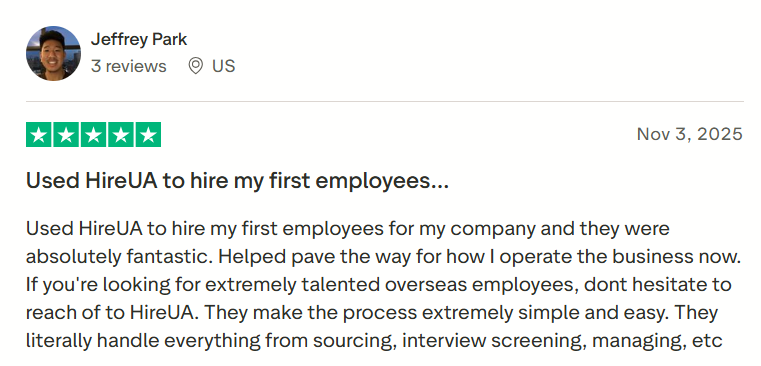
As a pattern we’ve seen across 1,100+ placements.
Happier people complain less.
They stay longer.
They perform better.
And suddenly you don’t need an HR department to manage dissatisfaction — because there isn’t much.
What You Should Actually Outsource (Recruiting)
Recruiting is the one part of “HR” that makes complete sense to outsource.
Because it IS a project.
It has a beginning (you need a person), a middle (someone finds and screens candidates), and an end (you hire one).
The smartest founders on earth — the ones who built the most valuable companies in history — all said the same thing.
Hiring the right people is the single most important thing you do.
And then most small companies hand that responsibility to an HR manager who fills five roles a year.
That math doesn’t work.
If Tiger Woods only played golf five times a year, he probably wouldn’t have won 15 majors.
If Michael Jordan only shot free throws five times a year, he probably wouldn’t have been the most clutch player in NBA history.

It’s not that they didn’t have the talent.
It’s that the talent only becomes deadly when you put in the reps.
Recruiting works the same way.
Someone who fills five roles a year is learning on the job with YOUR candidates.
They haven’t seen enough resumes to know what a red flag looks like until it’s too late.
They haven’t done enough interviews to know when someone is performing well in the conversation but will fall apart in the actual job.
They don’t know what’s happening in the market — new technologies, shifting salary expectations, which countries are producing the best talent right now — because they’re only dipping into the market a few times a year.
Someone who fills 15 roles a month sees all of it.
Every pattern.
Every trick.
Every new thing.
The reps build the instinct.
Recruiting is a skill that compounds with volume.
And unless you’re hiring constantly — which most 15-50 person companies aren’t — you don’t have the volume to build that skill internally.
This is what you should outsource.
- Not the complaints.
- Not the culture.
- Not the employee handbook.
The hiring.
What HireUA Actually Does
We place dedicated remote team members into your business.
One all-in monthly fee, or 1-time direct hire.
They work for you — not for us, not for a rotating agency bench.
Your team member, embedded in your systems, showing up every day.
But we also do something that most staffing companies don’t.
We function as the HR layer for the people we place.
Having placed 1,100+ people from Eastern Europe, Latin America, and the Philippines into businesses across 35 countries — we understand the cultural gaps that trip up working relationships.
Why a Ukrainian developer went quiet for a week.
Why a Colombian Project Manager communicates differently than an American one.
Why a Filipino Virtual Assistant says “yes” when they mean “I don’t understand the question.”
We mediate.
We resolve.
We coach — on both sides.
And if the person isn’t working out after genuine effort to make it right, we replace them. That’s the guarantee.
A local HR manager sitting in an office in Ohio doesn’t have this context.
They’ve never managed a cross-cultural remote team.
We’ve done it thousands of times.

Through HireUA — After 7 Failed Upwork Contractors
How Our Process Works
Book a call.
Tell us what you need — whether it’s an HR Generalist, an Operations Manager, a Developer, a Marketing Coordinator, or any other role.
We present vetted candidates within 5 business days.
You interview.
You choose.
One all-in monthly fee.
No hidden salary breakdown.
No surprise costs.
If the hire doesn’t work, we replace them — covered by the longest replacement guarantee in the industry (1 year).
Outsource HR: FAQs
What’s the difference between a PEO and an HR outsourcing company?
A PEO (Professional Employer Organization) becomes the legal co-employer of your workers.
Your employees technically work for the PEO’s entity, not yours. Companies like Insperity, TriNet, and Justworks use this model. The pitch is “big-company benefits for small companies.” The trade-off is you’re handing significant control to someone else’s system — and paying $500-$1,500 per employee per month for the privilege.
An HR outsourcing company keeps your employees as yours.
They handle specific functions — payroll processing, compliance, benefits administration — without the co-employment relationship.
Neither model solves the fundamental question: do you actually need this level of HR infrastructure for a company your size?
What does outsourcing HR cost?
Depends on the model.
- A PEO runs $500-$1,500 per employee per month.
- Fractional HR providers charge $3,000-$5,000 per month for part-time attention.
- Full HR outsourcing firms range from $500-$2,500 per month depending on scope.
For comparison — a dedicated full-time remote HR Generalist hired through us costs $2,000-$3,000 per month.
That person works exclusively for your company, learns your culture, and is available five days a week. Not splitting attention between ten clients. Not reading from someone else’s playbook. Yours.
When does a company actually need a dedicated HR person?
When the complaint volume exceeds what your existing leadership can handle.
For most companies under 50 employees, that line hasn’t been crossed — they just think it has because they’ve never asked their ops manager or department heads to handle it.
Once you cross roughly 50-75 employees, a dedicated HR person starts making sense — not because the work is complex, but because the volume makes it unreasonable for your leadership team to absorb.
Can I outsource just the recruiting part?
Yes.
And you probably should.
That’s the part where expertise, speed, and screening volume actually matter. An agency that fills dozens of roles per month will find better candidates faster than an internal HR person who fills a handful per year.
What’s the biggest mistake companies make with HR outsourcing?
Lumping recruiting and people management into one conversation.
They’re completely different functions with completely different requirements.
- Recruiting is a project — outsource it.
- People management is a relationship — handle it internally or hire a dedicated person who actually knows your team.
Is it really that simple to outsource hiring overseas?
For most roles — yes.
The contractor sets up a business entity in their country, invoices you monthly, handles their own tax obligations, and operates as an independent business. It’s the same structure as any freelancer or consultant you’d hire domestically. The only difference is the time zone — and we help you navigate that.
Outsourcing HR: The Bottom Line
HR exists because companies get big enough that the founder can’t sit in on every conversation.
Fair enough.
But somewhere along the way, a function that was supposed to keep things running smoothly became an industry — with PEOs, HROs, ASOs, fractional providers, compliance consultants, and subscription platforms all competing to sell you a piece of something you might not need.
If you have 30 people and a real complaint, handle it.
You built a company.
You can handle a conversation.
If you need to fill roles, hire someone who does it for a living — not someone who does it five times a year between updating the employee handbook and planning the company picnic.
And if you’re still paying $100,000 a year for someone whose main job is to make sure nobody sues you — maybe the question isn’t “how do I outsource this.”
Maybe it’s “why do I have this problem in the first place.”
If you want to talk about what that actually looks like — book a call.