
Over the last 5 years, a few dozen design production shops have booked calls with us.
You’d know them by their ads.
- Unlimited design requests
- Unlimited revisions
- Flat monthly fee
- Cancel anytime
The subscription that replaces your unreliable freelancers and your expensive agency.
They don’t book calls with us to sell us anything.
They book calls because they need designers.
Their designers keep leaving, and they need us to find new ones.
The calls all sound the same. They announce what they are within the first 2 minutes: “We’re a shop that does unlimited email designs” or “unlimited graphics” or unlimited whatever.
Then the ask: “We need someone who can produce at a really cheap price.”
How cheap?
Not one of them — not a single one in 5 years — has wanted to pay above $1,000 per month for a full-time Designer.
Most start at $800.
Stay with that number for a second.
You’re about to pay one of these shops $500, or $1,000, or $2,000 a month.
The person actually making your graphics is earning $800.
And your brand is not their job — they’re responsible for a dozen or 2 other clients at the same time, with a quota of 150 to 200 designs a month across all of them.
$800 spread across 150 to 200 designs.
That’s 4 or 5 dollars per design.
That is what your graphics cost to make. That’s the real price when you outsource graphic design through a subscription.
The rest of what you pay covers the dashboard, the account manager, and the ads that found you.
These shops almost never become our clients, by the way. They hear our pricing and go find the cheapest market on the planet instead.
Then they churn through people like butter, and 6 months later some of them are back on our calendar, short of designers again.
TLDR
- Outsourcing graphic design through subscription services often leads to high costs for low-quality work due to high designer turnover and a focus on cheap rates.
- The model typically charges around $500 per month while designers earn only $800, resulting in a rushed production process with designs created in minimal time.
- Unlimited requests come with long wait times as shops handle multiple clients, leading to delays and a backlog that hampers workflow.
- Quality suffers because designers do not internalize brand guidelines, requiring constant rebriefing that adds management overhead to the client.
- For ongoing design needs, hiring a dedicated designer provides better value and consistency than relying on a subscription service.
Table of Contents
- The Math Is Fairly Ugly (But Not for the Reason You Think)
- “Unlimited Requests” Plus “One Request at a Time” Is a Direct Contradiction
- The Queue Math
- Unlimited Revisions Is Not a Good Thing
- What You Actually Want Is Someone Who Remembers Your Brand
- When Outsourcing Design Actually IS the Right Call
- What a Dedicated Designer Actually Costs
- The Short Version of How to Hire Your Own
- FAQ
- The Bottom Line
The Math Is Fairly Ugly (But Not for the Reason You Think)
Let me be clear about what the problem is NOT.
The problem is not the shop’s cut.
The shop keeps most of the money, and that’s fine.
That’s business.
Every business owner expects to bill out 3 to 5x what their people cost them.
We’re a staffing agency — I’m not going to sit here and pretend markup is a crime. The problem is that every layer of this thing is cheap, and each layer forces the next one.
The shop charges $500 a month because cheap is the entire pitch.
It’s the only reason the ad worked on you. To make money at $500 a month, they have to pay the Designer $800.
To make $800 work, the Designer has to carry 15 or 20 clients and hit 150 to 200 designs a month. And to hit that quota, no single design can get more than 30 or 40 minutes of actual thought.
There’s no villain in that chain.
Nobody is scamming anyone.
It’s just what $500 a month buys when you outsource graphic design, all the way down.
And in case you think I’m working off one bad phone call — a different company once asked us to find people they could pay $5 per Klaviyo email revision.
5 dollars per revision.
When I asked how many revisions they expected per day, the answer was: enough to fill a full workday.
I thought that request was insane when I heard it.
It wasn’t insane.
It’s just the going rate inside this model.
The Real Cost Is Churn
Now follow the cheapness one more layer down, because this is where it reaches you.
A Designer earning $800 a month full-time is job hunting on day one.
The moment anything better appears — and at that price, almost anything is better — they’re gone.
The shop backfills with whoever’s available.
Your next request lands with a stranger who has never seen your brand.
And the cycle resets.
“Unlimited Requests” Plus “One Request at a Time” Is a Direct Contradiction
Read the fine print on any of these subscriptions and you’ll find both of these sitting in the same feature list.
- Unlimited requests
- One active request at a time
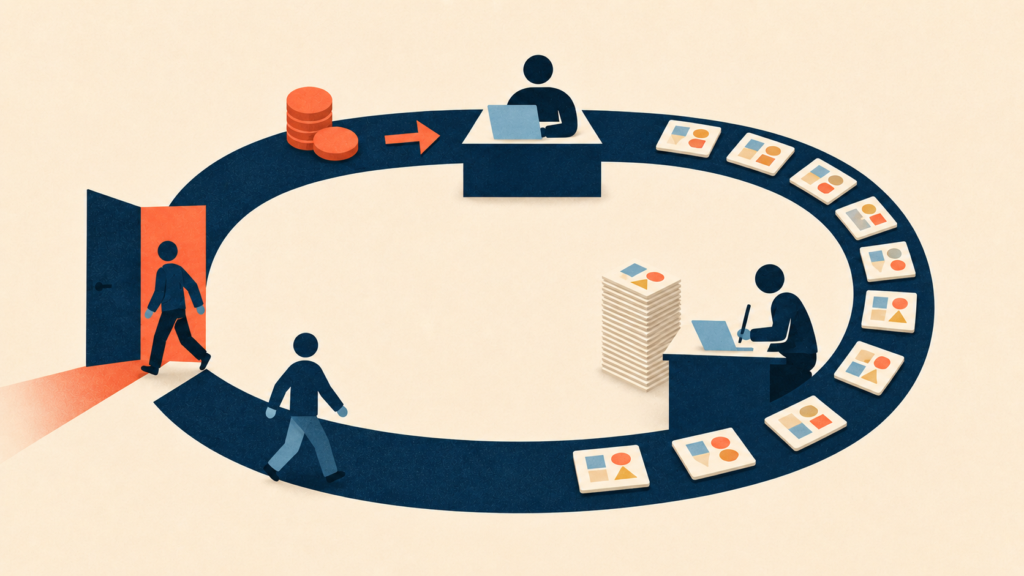
Those 2 features are a direct contradiction, and almost nobody stops to notice.
You can submit as many requests as you want.
They go into a queue.
The queue moves at one design per 24 to 48 hours.
Submit 30 requests on day one and you did not buy 30 designs.
You bought 30 spots on a waiting list.
Some of these shops even advertise “we work on a single task at a time” as a benefit. But working one task at a time isn’t a benefit when there are 29 tasks waiting behind it.
It’s a backlog.
The Queue Math
Here’s where it gets expensive, and it’s the part that doesn’t show up until month 2.
Say a graphic comes back and it’s not right.
- Wrong shade
- Off-brand
- Layout feels cheap
No problem — unlimited revisions, right?
You send it back.
Each revision round takes 24 to 48 hours.
A graphic that goes 5 rounds — and with a rotating cast of $800-a-month Designers who’ve never seen your brand, 5 rounds is normal — takes 5 to 10 business days.
For those 5 to 10 days, your one active slot is occupied. By a design you already asked for.
Everything else you need sits frozen in the queue behind it.
So your unlimited plan produced one graphic in a week and a half.
Every revision you use costs you a new design you didn’t get.
The subscription is priced on the bet that you never do this arithmetic.
Unlimited Revisions Is Not a Good Thing
I’ve been saying this for years, and it applies to freelancers and agencies just as much as the subscription shops.
Unlimited revisions sounds fantastic. But think about what the offer actually means.
The vendor is telling you, in advance, that they expect to miss.
They’ve priced the misses in.
The revision loop isn’t a safety net bolted onto the product — the revision loop IS the product.
And every round of that loop, guess who’s doing the quality control?
You.
- You’re reviewing drafts
- You’re writing feedback
- You’re explaining, for the fourth time, which blue
- You’ve become the Art Director of a design team you’ve never met, on a roster that changes monthly
The whole point of choosing to outsource graphic design was to get design OFF your plate.
Not to go back and forth 25 times over a single Instagram graphic. You don’t want unlimited revisions.
You want someone who gets it right in 1 or 2.
And someone only gets it right in 1 or 2 when they know your brand — which the queue model makes structurally impossible.
Not because the Designers are bad.
Because the model has no way to remember you.
Every request starts at zero.
What You Actually Want Is Someone Who Remembers Your Brand
Every business owner I’ve ever talked to about design wants the same thing, whether they can articulate it or not.
They want to stop rebriefing.
- They want someone who’s internalized the brand guidelines
- Who remembers what worked in the last campaign
- Who picks the right photo without being told, matches the colors on instinct, and catches the typo before it ships
- Someone who, after six months, produces on-brand work from a two-sentence Slack message
That’s not a service level.
That’s a property of a person.
A specific human who works on your brand every week gets better at your brand every week.
— Week one, they need references for everything.
— Month two, they’ve stopped asking about fonts.
— Month six, they’re anticipating what you need before you ask — and flagging things YOU missed.
A queue can’t do any of that.
Rotating Designers pulled from a pool, each one earning $800 and halfway out the door, will hand you technically competent work that starts from zero every single time.
The rebriefing cost never goes away.
You pay it on every request until you cancel.
This is why the pattern on our booking calls is so consistent.
The email marketing agencies, the ecommerce brands, the founders — they show up having already run the experiment.
They hired the unlimited shop.
It was fine for a month. Then the revisions piled up, the queue jammed, a launch slipped, and they said the same six words: “I need my own person.”
What Happens When One Designer Stays
Wesley Woods at Visibly Marketing lived the before-and-after.
He spent years on a patchwork of vendors and contractors — inconsistent output, zero accountability, nobody who felt like part of the team — before hiring Karina, a dedicated Web Designer who cut his website delivery time in half and stayed for over 3 years.
John Prince at Real Way Marketing was doing every Klaviyo email himself because the outsourced design he’d tried kept coming back with wrong links and broken details.
His dedicated Email Designer, Yulia, matched client brand styles without hand-holding and gave him 45 hours a month back.
And Brandon at GoSproost hired one Designer, Tiana, who ended up covering 3D renderings, a logo redesign, and a full website rebuild — 3 roles’ worth of work from one person who actually knew his business.
Notice what all 3 have in common.
The win wasn’t cheaper design.
The win was that the person stayed, learned, and got better every month.
When Outsourcing Design Actually IS the Right Call
Now let me argue the other side, because the subscription model isn’t a scam.
It’s a real product that’s correct for a specific type of work — and knowing where the line sits is worth more than any hot take.
Outsource to a shop, a marketplace, or a freelancer when the work is a defined project that doesn’t require anyone to remember you afterward.
1. A one-off logo.
You need it once.
Done.
2. A brand identity package.
Logos, color systems, style guide.
This is a season of work by a specialist, not an ongoing seat.
Hire it as a project.
3. Overflow during a launch.
Your dedicated Designer (or you) sets the templates and direction, and a production service cranks out the 40 size variations.
Production work with a defined spec is exactly what a queue is good at.
5. Testing whether you have enough design work at all.
If you’re not sure you can fill 10 hours a week, a month on a subscription is a cheap way to find out.
Track every request you submit.
That list becomes the job description.
The Simple Test: Project or Ongoing Relationship?
The line is simple.
If the work is recurring and depends on knowing your brand, the queue costs you on every request. If the work is a defined project with a clear spec, the queue is fine.
Most businesses reading this article have recurring work that depends on knowing the brand.
That’s why they’re reading it.
One place I’d steer you away from entirely: Fiverr and Upwork for ongoing brand work.
The good Designers have day rates that make those platforms pointless for them, so they’re not there — and lately the bottom tier has flooded with AI output that looks like a five-minute prompt session with zero thought behind it.
We broke down the whole mess in our Fiverr vs Upwork comparison.
What a Dedicated Designer Actually Costs
Here’s the part that surprises people who’ve been anchored on $500-a-month subscriptions.
A full-time dedicated Graphic Designer — 40 hours a week, your brand only, real portfolio, vetted English — runs $1,500 to $2,000 per month from Latin America and $1,700 to $2,100 from Eastern Europe.
At 20 hours a week, you’re at $900 to $1,400.
At 10 hours a week — the honest starting point for most small businesses — you’re at $400 to $700.
Read that last tier again.
10 dedicated hours of the same person every week costs about the same as the entry-level subscription.
Except this person works only on your brand, remembers everything from last week, and gets better every month.
Full pricing tables by role type and region are in our complete guide to hiring a Graphic Designer, along with the screening process, the trial task, and the brand homework you need done before you interview anyone.
The Short Version of How to Hire Your Own
The full playbook is in the big guide, but here’s what you’re walking into.
1. Define what the person will DO every day, in one sentence.
“Graphic Designer” is as specific as “athlete.” Social graphics, email templates, and ad creatives are 3 different hires at three different prices.
2. Do your brand homework first.
Hex codes, fonts, 3-5 examples you love, 3-5 you hate, and a real tone description.
If you can’t produce this, no Designer on earth can read your mind — and no, the subscription couldn’t either.
That’s half of why it failed.
3. Interview before any trial task.
15 minutes of context produces far better trial work, and the questions a Designer asks tell you everything about how they think.
4. Run a 90-minute trial on the actual work.
Not a strategy exercise.
The same type of design they’ll make on day one.
5. Then give feedback fast and let them learn.
The first 2 weeks are an investment.
Month 6 is the payoff.
Every one of those steps is expanded — with real stories of what happens when you skip them — in the full guide.
FAQ
Is it cheaper to outsource graphic design or hire a designer?
For one-off projects, outsourcing wins.
For recurring weekly work, the math flips fast.
A $500/month subscription that requires 5 hours of your time in briefs and revision management isn’t a $500 subscription — it’s $500 plus whatever your hour is worth, times five, every month.
A dedicated part-time Designer at a comparable price eliminates most of that management load within their first two months.
What’s the best country to outsource graphic design to?
For design specifically, we place most successfully from Latin America and Eastern Europe.
Latin America gives US companies real-time collaboration on US hours at $1,500–$2,000/month full-time.
Eastern Europe runs slightly higher with an exceptionally deep pool of senior visual talent.
The Philippines is the largest market by volume and works well at the production end, though for brand-level creative work we see stronger instincts from the other two regions.
The honest answer: the screening process matters more than the country.
Should I outsource graphic design to the Philippines or India?
Both are production powerhouses, and both are where most of the unlimited design shops quietly hire — which tells you the talent can execute.
The question is the model wrapped around the talent.
A Filipino Designer hired directly, paid fairly, working only on your brand will outperform the same Designer buried in a subscription queue, doing piece-rate work for eight brands at once.
If you’re choosing a country to underpay in, you’ll get the same churn the shops get.
What are the disadvantages of outsourcing graphic design?
Three structural ones.
Rotating designers start from zero on every request, “unlimited” requests move through a one-at-a-time queue, and unlimited revisions turn you into the unpaid Art Director.
None of these are quality problems.
They’re built into the model, which is why switching vendors almost never fixes them.
Why do companies outsource graphic design instead of hiring in-house?
Because a US in-house Graphic Designer costs $55,000–$75,000 plus benefits, and most small businesses don’t have 40 hours a week of design work.
The mistake is treating the subscription shop as the only alternative.
A dedicated remote Designer at 10–20 hours a week captures the cost savings AND actually learns your brand — it’s the middle option most people don’t know exists.
Are unlimited graphic design services worth it?
For defined, spec-driven production work — resizing ad sets, templated variations, overflow during a launch — yes.
For your core brand work, the 2 headline features contradict each other.
Unlimited requests move through a one-at-a-time queue, and unlimited revisions exist because the model expects to miss.
If you’re on your third vendor and still frustrated, the vendor was never the problem.
How do I outsource graphic design without losing quality?
Quality loss in outsourced design comes from 3 places.
- No brand documentation — fix it by writing down your colors, fonts, and 3-5 reference examples.
- No continuity — fix it with the same human on your brand every week, not a pool.
- Slow feedback — fix it by responding to drafts within 24 hours while context is fresh.
Get those three right and an offshore Designer at a fraction of US cost matches domestic quality.
Skip them and no vendor at any price will save you.
The Bottom Line
The unlimited design shops aren’t lying to you.
Every fact is right there on the sales page — unlimited requests, one at a time, revisions forever, cancel anytime.
They’re just betting you won’t do the math.
Now you’ve done the math.
The person making your designs earns $800 a month, carries 15 other clients, and is halfway out the door.
Your requests wait in a line that moves one design at a time.
And the thing you actually wanted — someone who knows your brand so well you stop rebriefing — is the one thing this model can’t produce at any price, because it only comes from one person staying on your brand long enough to learn it.
If you’ve got a one-off project, outsource graphic design to a shop.
Sincerely.
It’s the right tool.
But if you’ve got recurring design work and you’re tired of being the Art Director for a rotating cast of strangers — hire your own Designer.
We’ll find you one who’s been vetted with the exact process in our hiring guide, at pricing that’s not far from what the shop was charging you.
And if it doesn’t work out, we replace them.
That’s the deal.