

Earlier this year, I ran an experiment.
I sent my recruiter, and now Operations Manager (congrats!), Anja, to interview the entire Filipino talent market.
11 roles, more than 60 live interviews, every candidate scored on the same 100-point rubric.
Not a survey.
Real people, real numbers, on camera, this year.
The full salary data lives in its own guide.
For customer service outsourcing in the Philippines, her verdict came back in two parts.
Part One: The talent is some of the best on earth.
The Philippines has spent 40 years turning customer service into a national industry, and the depth of that bench is hard to overstate.
Part Two: Almost everything that goes wrong when companies outsource customer service to the Philippines has nothing to do with the talent.
It’s the setup they hire into.
We place across more than 35+ countries, so we get to watch this same failure play out everywhere.
The Philippines is just where the most people meet it, because it’s where the most people go.
Here are the nineteen things that decide whether you get the elite talent or the setup that wastes it.
Key Takeaways
- The Philippines excels in customer service outsourcing due to its extensive experience and specialized talent.
- Outsourcing and hiring differ significantly; choose between renting a seat or hiring dedicated personnel.
- Continuity in service comes from dedicated agents, not shared seats which lead to customer frustration.
- Consider the specific needs of your business; the Philippines may not be the right choice for every situation.
- Finding the right candidate requires a focus on individual skills over country-wide generalizations.
Table of Contents
- 1. The Philippines Didn’t Get Into Customer Service By Accident
- 2. “Outsourcing” and “Hiring” Are Two Different Purchases
- 3. The Shared Seat Is Why Your Customer Talks To A Stranger Every Time
- 4. This Isn’t A Philippines Problem. It’s A Seat Problem, And It’s Everywhere
- 5. The Accent Filter Tells You Everything
- 6. How The Floor Treats Its People Becomes Your Problem
- 7. A Virtual Assistant To Answer Phones Is A Different Hire Than One Who Doesn’t
- 8. Written English Is Not Spoken English
- 9. “Competent, Courteous, Comprehensible” Beats “Cheap”
- 10. The $2-of-$12 Problem
- 11. Tier 1 Is The Part AI Is Eating
- 12. The Hand-Holding Wall Is Real — And It’s A Role Problem, Not A Country Problem
- 13. Executor Work Is Where The Philippines Wins
- 14. “Just Use Latin America” Is Really “Just Use Mexico”
- 15. When Customer Service in the Philippines Is The Wrong Call
- 16. Coverage Is A Feature, Not A Fight
- 17. Domain Experience Beats Headcount
- 18. One Layer Of Industry Specificity, Not Two
- 19. Vet For The Specific Human, Not The Country
1. The Philippines Didn’t Get Into Customer Service By Accident
The country’s entire outsourcing economy was built on answering phones and tickets for Western companies.
40 years of it.
Customer service isn’t a side skill in the Philippines.
It’s the national industry, and it employs close to two million people.
You can see it in the resumes.
When Anja interviewed Operations Managers, a large share of them had come up through call center floors before they ever managed anything.
The support layer is the deepest, most trained slice of the whole Filipino labor market.
The person you’re looking for is there, in volume, available now.
What you do next is what decides everything.
2. “Outsourcing” and “Hiring” Are Two Different Purchases
When you begin researching customer service outsourcing in the Philippines, you’re actually choosing between two products that share a name and nothing else.
Door one:
- You rent a seat on a call center floor.
- They assign whoever’s free that shift.
- You are a line item on someone else’s roster.
Door two:
- You hire a dedicated person who is yours.
- Full-time.
- Learns your product, remembers your customers, stays.
Same country.
Opposite outcomes.
Nearly every Philippines horror story you’ve ever heard came from someone who thought they walked through door two and were standing in door one the whole time.
Here’s the full breakdown of that model, and why you don’t need to buy a call center.
3. The Shared Seat Is Why Your Customer Talks To A Stranger Every Time
Want to feel the problem instead of reading about it?
Call your bank right now.
Get transferred, or get disconnected, then call back 60 seconds later.
You start over…
New agent, no memory of the last one, the whole story told again from zero.
That’s the pooled model, and it’s exactly what you’re buying when you rent seats.
Monday, your tickets go to one agent.
Tuesday another…
None of them know your product past the script, none of them remember the customer who wrote in last week, and your customer feels every second of it.
Continuity is the entire job in customer service.
The shared seat is built to prevent it.
4. This Isn’t A Philippines Problem. It’s A Seat Problem, And It’s Everywhere
Here’s where most guides on customer service outsourcing in the Philippines get it wrong, usually because a call center wrote them.
The failures above aren’t Filipino failures.
We’ve placed people into support roles across more than 35 countries, and the rented-seat model produces the exact same disaster everywhere it exists.
- Mexico.
- Colombia.
- India.
- Eastern Europe.
Interchangeable agents, no continuity, a script instead of a brain.
The Philippines takes the blame because it’s the biggest, so it’s where the most buyers run face-first into the problem.
That’s not a knock on the country.
It’s a knock on a business model, and the model is on every continent.
Which means the fix isn’t “avoid the Philippines.”
The fix is “don’t rent a seat.”
5. The Accent Filter Tells You Everything
There is software running on call center floors right now that takes a Filipino agent’s voice and smooths the accent out of it.
Flatter.
More American.
It exists because customers keep asking to speak to an American.
And here’s the part that gives the whole model away: The filter works so well that customers now think they’re talking to a bot, so they get angrier, and the call goes worse than if nobody had touched it.
Ask why the filter exists at all.
It exists because in the seat-rental model, the agent is nobody.
A voice in a chair, swapped out next shift.
You slap a mask on a voice you consider interchangeable.
You would never do that to a dedicated rep who knows your business and carries your company’s name, because that person is someone you’d want your customer to actually hear.
6. How The Floor Treats Its People Becomes Your Problem
This is the part the brochures skip, and it’s not only an ethics question.
It’s a quality question.
A Rest of World investigation this year documented BPO agents being made to work through natural disasters.

When a 6.9 earthquake hit Cebu last September and killed around 80 people, agents on the 11th floor of an office tower were evacuated and then sent back to their desks about 30 minutes later.
Separately, reporting on the AI tools now running on those floors describes software scoring every call, where a stutter during the opening script earns the agent a demerit.
Now picture that person answering your customer.
Surveilled by software, penalized for a stumble, sent back into a building that was shaking an hour ago, and gone within the year because nobody survives that for long.
Your customer hears all of it in the flat, rushed, scripted tone on the other end.
A dedicated hire working from home, paid directly and treated like a human being, isn’t just the decent choice.
It’s the one where the person on the line still has something left to give your customer.
7. A Virtual Assistant To Answer Phones Is A Different Hire Than One Who Doesn’t
This is the single biggest variable in the whole decision, and almost nobody sorts it first.
If your support runs on chat, email, and tickets: The accent question disappears.
Written English in the Philippines is excellent, the bench is enormous, and you’re hiring straight into the country’s core strength.
If you need a Virtual Assistant to answer phones — live, in real time, with US customers on the line — the bar jumps and the screening changes completely.
Decide which one you’re staffing before anything else.
A huge share of bad customer service outsourcing in the Philippines experiences come from companies that hired a chat-grade candidate and then handed them a phone.
8. Written English Is Not Spoken English
Across the whole market, Anja hit the same pattern again and again.
Candidates who read as perfectly fluent over text can drop a full step the moment you get them on a live call.
For chat and email support, that gap never surfaces.
For phone support, that gap is the job.
So screen the channel you’ll actually use.
If they’ll be typing to your customers…test their typing.
If they’ll be talking…get them on video, off-script, before you decide a thing.
Not sure what to assign as a trial task? We’ll help you create one that accurately evaluates real-world skills.
9. “Competent, Courteous, Comprehensible” Beats “Cheap”
The real spec for a support hire is three words, and not one of them is “cheap.”
- Can they solve the problem?
- Are they pleasant doing it?
- Can your customer understand them?
Hit all three and your customer never once wonders where the rep is sitting.
Miss any one and no hourly rate can save you.
A $5-an-hour agent who can’t close the ticket isn’t cheap.
They’re the most expensive person on your payroll, billed to you one refund at a time.
10. The $2-of-$12 Problem
Here’s the math the outsourcing industry would rather you never run.
When you pay a call center $12 an hour for a seat, the person actually sitting in it often takes home around $2.
The other $10 buys the floor, the layers of supervisors, and the agency’s cut.
The agents know this math cold.
It’s exactly why the best of them walked off the floor to work with clients directly.
Hire direct and dedicated and the equation flips.
They earn more than the call center ever paid them, you pay less than the call center ever charged you, and the only loser is the middleman.
Here’s what the real numbers look like.
11. Tier 1 Is The Part AI Is Eating
If you’re considering customer service outsourcing in the Philippines for nothing more than password resets and “where’s my order,” be honest about the purchase.
You’re buying a service that software is automating in real time.
The durable value in customer service is the judgment layer.
The escalation.
The furious customer.
The weird edge case no bot has an answer for.
Staff for that, not for warm bodies reading a decision tree.
A great support hire is not a button-pusher, and the ones who only push buttons are now competing with a robot that works for free.
12. The Hand-Holding Wall Is Real — And It’s A Role Problem, Not A Country Problem
Every founder who got burned tells the same story.
“I tried the Philippines. I explained everything three times. It caused mistakes, it made me look bad, and it cost more time than it saved.”
I believe every word…
Clients have walked in our door saying exactly that.
But look at what they were actually asking for: They didn’t want a support rep…
They wanted someone to make:
- Independent calls
- Own outcomes
- Find the path with no map
Then they hired off a freelance platform and pulled one random profile out of an ocean of identical ones.
That’s two mistakes stacked on top of each other.
Neither of them is named “the Philippines.”
13. Executor Work Is Where The Philippines Wins
There are two kinds of hires:
- Initiators, who you point at a fuzzy goal and trust to invent the path.
- Executors, who you hand a defined system and trust to run it flawlessly, at volume, every day.
Customer support, done right, is what customer service outsourcing in the Philippines does best.
SOPs, known scenarios, relentless consistency.
And that is exactly where the Filipino market runs deepest.
I’ve written the long version of this, but the short version fits in a sentence: The hand-holding complaints come from asking a market of world-class Executors to be Initiators.
Match the role to the market and the wall never shows up.
14. “Just Use Latin America” Is Really “Just Use Mexico”
You’ll hear this advice constantly.
For anything customer-facing, skip the Philippines and hire Latin America.
Closer, more cultural overlap, better on the phone.
There’s truth in it.
But “closer” is doing a lot of quiet lying.
- Mexico City to Los Angeles: about 4 hours in the air.
- Buenos Aires to Los Angeles: about 13 hours, and no direct flight, so call it 15-plus door to door.
- Manila to Los Angeles: about 13.5.
A support rep in Argentina is as far from your customer as one in the Philippines.
The real Latin America edge is mostly a Mexico edge, built on people who lived in the States for years and came home carrying the accent and the cultural fluency.
Someone in Mexico City, sure.
Someone in Florianópolis is a different planet wearing the same label.
Here’s the honest Philippines-vs-Latin-America comparison.
15. When Customer Service in the Philippines Is The Wrong Call
I’ll tell you flat out when to look elsewhere, because pretending it’s always the answer helps nobody.
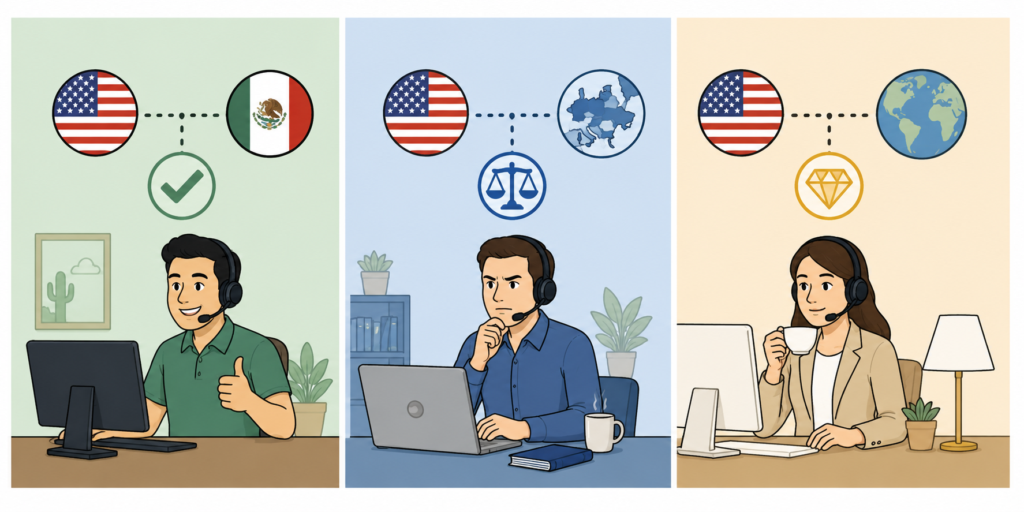
- If you need native-level phone English for US consumers who hang up the second they hear an accent — look at Mexico.
- If your “support” role is secretly a judgment role wearing a support title — look at Eastern Europe.
- If you’re running white-glove VIP support where every interaction is brand-critical — you may want someone in your own time zone and culture.
This is actually one of the things we do differently.
When a client isn’t sure what they need, we don’t push one country.
We put candidates from several regions in front of them, side by side, and let them make the call based on the role, the budget, and the time zone.
A Filipino agency can’t do that.
Their answer is always the Philippines, because the Philippines is the only thing they sell.
16. Coverage Is A Feature, Not A Fight
Years ago at Hitachi, I pulled a two-month stretch of 6 p.m. to 6 a.m., Friday through Sunday.
I still do not understand how I did it, and I understand even less how anyone does it for a career.
In the Philippines, plenty of people do, and they do it well.
Almost everywhere else on earth, staffing your overnight US hours is a war and people quit over it.
There it’s the baseline.
The whole outsourcing economy runs on Western clocks and has for decades, so night work isn’t a hardship post; it’s a normal job.
Depending on which US window you need covered, you’re either buying their daytime or a night shift the culture absorbed a generation ago.
Here’s a total hunch, worth exactly what you paid for it:
It’s so hot across much of Southeast Asia that being awake and outside during the day isn’t much of a prize anyway.
Sleeping through the heat and working the cool night might even be the better trade.
I have no idea how many homes there run air conditioning, so file that one under speculation.
Either way, 24/7 coverage stops being a fight and becomes a line on the order form.
17. Domain Experience Beats Headcount
A support rep who already worked your kind of business ramps faster than a general hire holding a perfect SOP binder.
- SaaS support.
- Healthcare support.
- E-commerce support.
The person who lived in your world already knows the question before the customer finishes asking it.
So when you screen, weight the industry over the years.
One rep who understands your product will out-resolve three who are still learning what you sell, and cost you a fraction as much in escalations doing it.
18. One Layer Of Industry Specificity, Not Two
Wanting industry experience is smart!
Go one layer too deep and the math turns on you.
“Ecommerce support” is a deep pool…
Name it and we’ll find people who’ve lived in it.
“Ecommerce support with direct-response and supplement experience specifically” is maybe 11 people on the planet, and 9 of them are happy where they are.
Same trap with SaaS, same trap with healthcare — one layer of specificity is a smart filter, two layers is a unicorn hunt that leaves the role open for four months.
Ask for the industry.
Don’t ask for the industry, the sub-niche, and the exact business model all at once.
19. Vet For The Specific Human, Not The Country
Here’s the thread running through the other 18.
“Should I outsource customer service to the Philippines” is the wrong question.
The market is enormous, and on paper everyone looks identical:
- Same tool lists
- Same skill sections
- Same years
The few who are competent, courteous, comprehensible, and right for your exact role are buried under thousands who match them line for line on a resume.
The whole game is finding that one specific human.
Then hiring them dedicated instead of renting their chair.
That part is hard.
It’s also what we do all day.
We place across more than 35 countries, and customer service outsourcing in the Philippines remains one of the strongest hiring markets we work in.
Every candidate we send is interviewed live, scored against our 100-point rubric, and backed by a replacement guarantee.
Dedicated.
Yours.
Not a seat on someone else’s floor.
If you want a support hire your customers actually stay loyal to — and an honest answer about whether the Philippines is even the right country for your role — book a call and we’ll find the specific human for your specific business.