

Last year you hired a JavaScript Developer through a freelance platform.
Good rate + Solid portfolio
The demo looked clean — the buttons clicked, the pages loaded, everything moved.
- You were happy
- You paid
- You launched
And 2 months later the whole thing started falling apart…
- Checkout errors your developer couldn’t explain
- Pages that loaded fine on your laptop and choked on everyone else’s
- Every fix broke 2 other things..
Maybe that’s not your exact story.
But some version of it is the most common story we hear from people who come to us after trying to hire a developer on their own.
Here’s the part that stings: the developer usually isn’t a fraud.
He’s a real developer.
He’s just not the kind of developer your project needed — and neither of you knew it.
You hired a JavaScript Developer.
What you needed was a specific person hiding inside that job title… And by the time you find out the difference, you’re paying a second developer to dig out the first one’s work.
This article is about that difference.
Because “JavaScript Developer” is one of the emptiest job titles in hiring — and if you don’t know what’s hiding inside it, that story up top is where you’re headed.
That’s the trap waiting for anyone who tries to hire JavaScript developers without knowing which one they actually need.
TLDR
- Hiring a JavaScript Developer can lead to issues if you don’t specify the type you need, as the title encompasses various roles like front-end, back-end, and full-stack.
- The title ‘JavaScript Developer’ is ambiguous and doesn’t indicate skill level; hiring without clarity can end up being costly.
- Real expertise in JavaScript evolves quickly, and what was senior-level expertise can become obsolete; focus on fundamentals that transcend specific frameworks.
- Use a paid Trial Week to vet candidates; real work reveals capabilities that interviews and resumes often mask.
- For effective hiring, diagnose your specific needs and source from regions with strong engineering cultures, like Eastern Europe.
Table of contents
- “JavaScript Developer” Is Like “Assistant”
- Why Nobody Can Tell You What This Costs
- It Runs. It Demos. Then It Dies.
- “Senior” Javscript Dev Comes With an Expiration Date
- Throw Away the Resume With 40 Technologies on It
- Where to Actually Hire JavaScript Developers
- The Trial Week
- What to Do Next
- Frequently Asked Questions
- The Bottom Line
“JavaScript Developer” Is Like “Assistant”
Let me explain this the way I explain it on sales calls…
Imagine someone tells you, “I’m an Assistant.”
What did they just tell you?
Almost nothing.
Because “Assistant” could mean 3 wildly different people.
1. It could mean a receptionist — Someone who sat at a front desk, answered the phone, and reminded patients about their Tuesday appointments.
A real job.
An important job.
But a narrow one.
2. It could mean a basic admin — a Virtual Assistant who did data entry in Excel, uploaded files, and followed a checklist someone else wrote.
3. Or it could mean a right-hand making $250,000 a year to a multi-millionaire businessman in New York City.
Someone who runs his calendar, his travel, his family’s life.
Someone who knows the boss cold, sees around corners, and is borderline running the company.
All 3 call themselves the same thing.
Their salaries are 5 times apart.
And if you post a job for “an Assistant” without knowing which one you need, you’ll get all 3 in your inbox — and no way to tell them apart.
Now, pay attention: “JavaScript Developer” works exactly the same way.
JavaScript is not one job.
It’s a language that dozens of very different jobs happen to share.
Under that one title you’ll find:
Front-End JavaScript Developers.
They build what you can see.
- The buttons
- The pages
- The animations
- The layout on your phone
Most of them work in a framework called React — think of frameworks as dialects of the same language.
A React person, a Vue person, and an Angular person all “speak JavaScript,” but they’ve spent years in different dialects, and fluency in one doesn’t transfer overnight.
Back-End JavaScript Developers.
They build what you can’t see.
The engine room:
- Databases
- Payment processing
- Logins
- The machinery that makes the pretty buttons actually do something
In JavaScript, that world is called Node — and it has almost nothing in common, day to day, with front-end work.
Full-Stack JavaScript Developers.
Supposedly both.
In reality, almost always strong on one side and passable on the other.
We covered this in our guide on how to hire remote developers — “full-stack” is the most inflated title in software, and the honest ones will tell you which side they’re actually good at.
The client from the opening hired a front-end person for a project whose real problems lived in the back end.
Same language on the resume.
Completely different job.
He didn’t hire the wrong person…
He hired the wrong kind of person — because the title gave him no way to know there were kinds.
Why Nobody Can Tell You What This Costs
Here’s where the empty title reaches into your pocket.
Most JavaScript salary guides show you a range — roughly $1,000 to $4,000 a month for overseas talent — and call it pricing.
Look at that range for a second.
The same 2 words sit at both ends of it.
1. Down at the floor, someone who finished a twelve-week bootcamp in the spring.
2. Up at the ceiling, someone who can architect a complex app and walk into a production fire at 2am without flinching.
Same title.
4 times the money.
Here are some examples from Eastern Europe’s largest developer job board, where every candidate lists their actual salary expectations.
The data is public — pull it up yourself and you’ll see it plain.
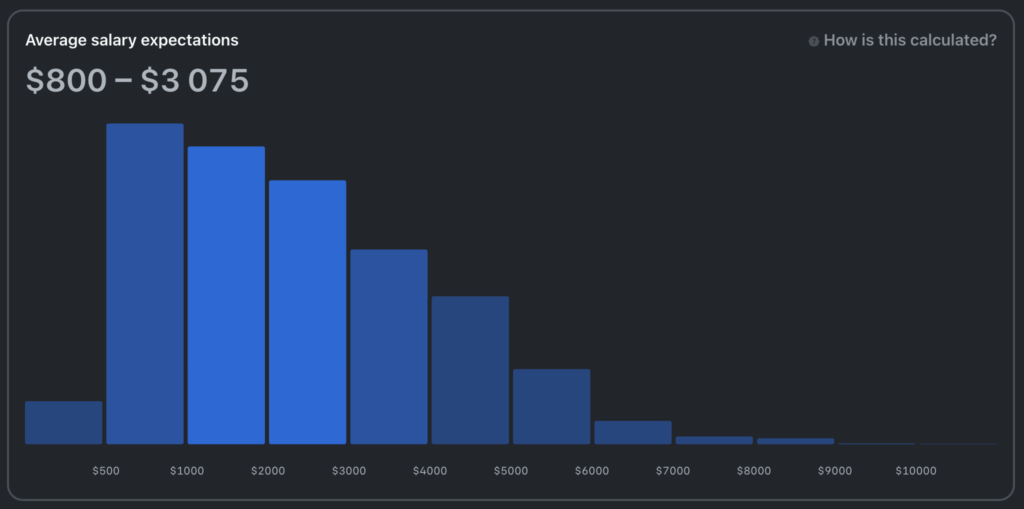
1. (Djinni React.js salary distribution)
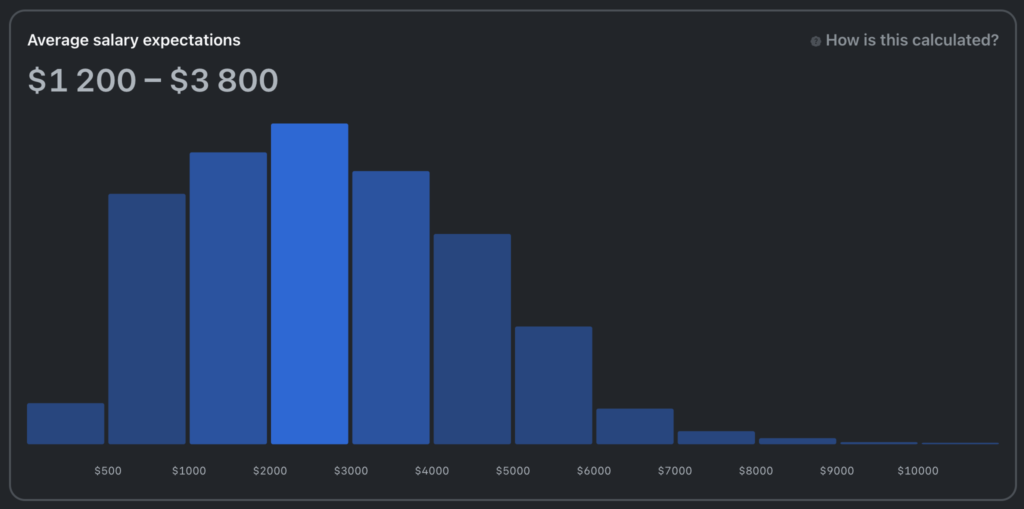
2. (Djinni JavaScript/Front-End salary distribution)
That spread isn’t a market being indecisive…
That’s beginners and experts wearing the same name tag.
The floor sits low because JavaScript is the front door of the entire programming world.
It’s the language every bootcamp teaches first.
It runs in every browser on earth with zero setup.
So the bottom of the pool is enormous — and it’s exactly where you’ll find the twelve-week grads, the career-changers, and the people whose resumes were written by ChatGPT 20 minutes before they applied.
The ceiling is where the actual engineers live.
Here’s how the wide range costs you real money:
- You scan it
- Settle on the number your budget allows
- Hire whoever that buys
Land near the floor, and you’ve hired the bootcamp grad.
Nothing on the resume told you that.
You find out around month 3, when the thing they built starts breaking in ways they can’t fix — and now you’re paying someone else to untangle it.
The range only tightens when someone asks what you actually need.
Front end or back end?
Mid-level or senior?
A marketing site, or a checkout flow that moves real money.
Answer those, and the picture changes fast.
For reference, the seniority ladder on that same job board runs about $700 a month for a junior, $2,200 for mid-level, $3,500 for senior, and $4,500 for a lead — with Western remote roles paying a premium on top of that.
A mid-level developer in a mainstream stack like React or Node lands around $2,800 to $3,500 a month.
Suddenly you’re planning around a number instead of a canyon.
That’s the work most people skip.
It’s the exact work we do before you pay anyone a dollar.
One more thing about that pricing data, because it matters: if someone answers your job post offering senior-level work at the very bottom of the range, that’s not a bargain.
The market just told you what senior work costs.
Someone offering it at a third of the price is either:
- Not senior
- Juggling four other clients
- Not who they say they are
That’s the bait.
It Runs. It Demos. Then It Dies.
Now let me tell you why JavaScript, specifically, is the easiest place in software to get burned — even by developers who aren’t lying to you.
Most programming languages are strict.
Make one mistake and the program refuses to run.
It’s like that teacher everyone had in school — the grammar psycho who hands your essay back the second she spots a single error, circled in red, do it again.
Everybody hated that teacher…
But get this: That teacher is exactly what you want and need from a programming language.
Someone who refuses to accept broken work, no matter how annoying it is in the moment.
JavaScript is not that teacher…JavaScript is the substitute who:
- Accepts every essay
- Marks nothing
- Lets the whole class out early
Broken JavaScript still runs…
Sloppy JavaScript still runs…
Code held together with duct tape and copy-paste still runs — right up until it doesn’t.
The language was designed in 10 days in 1995 to make web pages a little more lively, and it grew into running half the internet without ever losing its forgiving streak.
Here’s why that matters to you:
In JavaScript, “it works in the demo” and “it’s built properly” can be 2 completely different things — and they look identical on a screen share.
Think about a bridge.
A bridge can “work” the day it opens.
One car drives across, nothing wobbles, everyone claps.
But you don’t want a bridge that passed the one-car test.
You want a bridge built properly — sound design, sound materials — because the difference doesn’t show up until it’s carrying real weight, every day, for years.

A weak developer can show you a polished demo.
Buttons click.
Pages load.
You approve it, you pay, you launch.
The cracks show up later, under real traffic, with real customers, in ways that take a stronger developer weeks to diagnose.
That’s what happened to the client in the opening.
His demo was real.
The engineering underneath it wasn’t.
And here’s the kicker: AI made this dramatically worse…
Anyone with a $20 subscription can now generate JavaScript that looks professional, runs fine, and demos beautifully.
The industry even has a name for it — Vibe coding.
Companies report interviewing candidates who submit polished projects and then can’t explain a single line of their own code.
The gap between “looks done” and “is done” exists in every language.
In JavaScript, it’s a canyon — because the language itself will never tattle on the person who built it badly.
An interview won’t catch this…
A portfolio won’t catch this…
I’ll tell you what does catch it in a minute.
“Senior” Javscript Dev Comes With an Expiration Date
There’s one more thing about the JavaScript world you need to understand before you hire in it.
It reinvents itself constantly.
In most professions, experience compounds.
A bookkeeper with 15 years of experience is usually better than one with 5.
The rules of accounting didn’t rewrite themselves in 2021…
JavaScript rewrites itself roughly every 18 months.
- The dominant framework changes
- The “right way” to build things changes
- Tools that every job posting demanded three years ago are legacy today
- The stack that’s cutting-edge this year will be the thing candidates apologize for next year
Which does something strange to the word “senior.”
A developer who was legitimately senior in the 2019 version of this world can be functionally junior in the 2026 version — same person, same work ethic, same 10 years on the resume.
The years didn’t expire.
The tools they were spent on did.
So when you hire a JavaScript Developer, you’re not really buying what they know today.
You’re buying whether they can survive the next reinvention.
The developers worth paying for are the ones who went deep on the fundamentals underneath the frameworks — because those transfer.
The ones who only ever learned this season’s tools are renting their expertise, and the lease runs out fast.
You can’t read that off a resume.
Which brings me to resumes…
Throw Away the Resume With 40 Technologies on It
We screen thousands of developer resumes, and JavaScript resumes have a tell all their own.
The skills section that lists everything.
React, Angular, Vue, Svelte, Next, Nest, Node, Express, jQuery, TypeScript — plus Python, Java, PHP, and .NET for good measure.
14 frameworks…
I’ve seen resumes claiming competence in over 40 technologies from someone with 7 years of total experience.
Do the math on that.
— Nobody gets deep in 40 technologies in 7 years.
— Nobody gets deep in 40 technologies in a career.
Here’s the deal:
That list isn’t a display of range.
It’s a confession of shallowness — a developer casting the widest possible net because they can’t win on depth in any single water.
The strongest developers we place tend to have the shortest skills lists.
One core dialect, listed with specifics.
Real things they built with it…
The confidence to leave everything else off.
The long list also tells you something about judgment.
A developer who thinks 40 buzzwords looks impressive doesn’t understand what hiring managers actually value — and that same judgment is what they’ll bring to your codebase.
And AI has made all of this worse.
A huge share of the resumes we see now were written by ChatGPT — same polished phrasing, same keyword-stuffed skills lists, same interchangeable bullet points.
The resume used to be a weak signal… Now it’s barely a signal at all.
This is one signal among many.
We published a whole piece on [how to screen a resume in 10 seconds] — the page count, the formatting, the stock phrases, all of it applies to developers too.
But the buzzword salad is the JavaScript-specific tell, and once you see it, you can’t unsee it.
Where to Actually Hire JavaScript Developers
So where do you actually find the person hiding inside the job title?
First, understand what you’re up against if you post the job yourself.
JavaScript has the largest candidate pool in software — roughly 10 developers for every open seat.
Post a JavaScript role publicly and you won’t get a trickle of applicants… You’ll get a flood, and the flood is exactly the problem.
Hundreds of applications, most of them written by AI, stacked on top of each other, every one wearing the same empty title.
The volume doesn’t help you.
The volume buries you.
When clients come to us for JavaScript roles, we route to Eastern Europe.
We’ve placed talent across 35 countries, so this isn’t loyalty talking — for LATAM we love Sales hires, the Philippines is a machine for customer service and admin.
But for developers, Eastern Europe has the highest technical floor we’ve found anywhere, and the engineering culture runs deep.
These are people who learned fundamentals in rigorous university programs, not twelve-week sprints.
The dialects change every 18 months.
Their fundamentals don’t.
And the first thing we do with every JavaScript request has nothing to do with sourcing: we figure out which developer you actually need.
Front end or back end.
Which dialect.
What level.
Whether your project needs the $250,000 right hand or whether a solid receptionist-level hire covers it just fine at half the price — because sometimes it does, and paying senior rates for junior work is its own kind of expensive.
That diagnosis is the step every salary table skips.
It’s why their ranges are canyons and our quotes are numbers.
The Trial Week
Now — the thing I promised.
The thing that actually catches the “runs fine, built badly” problem.
You can’t interview your way to it…
You can’t portfolio your way to it…
The demo lies, the resume lies, and in the AI era, even the take-home test lies.
The only thing that doesn’t lie is a week of real work.
Every developer we place goes through a paid Trial Week — 5 days inside your actual project, on your actual codebase, solving your actual problems.
Not a toy exercise.
Not a whiteboard puzzle.
Real work, reviewed, before you commit to anything.
A weak developer can survive an hour-long interview.
Nobody survives 5 days of real work pretending to be someone they’re not.
The person who vibe-coded their portfolio falls apart by Wednesday.
The person with real depth shows it by Tuesday afternoon.
And if it’s not a fit, you’ve lost one week and one week’s pay — instead of finding out at month 3, after launch, with customers in the checkout flow.
That’s the whole system.
Diagnose which developer you need before sourcing.
Route to the deepest talent pool.
Verify with real work instead of promises.
What to Do Next
If you’re about to hire a JavaScript Developer, do this much even if you never talk to us.
Figure out whether your project is front end, back end, or truly both — before you write the job post.
Be suspicious of demos, because in this language a demo proves almost nothing.
Throw out the resumes with 40 technologies on them.
And never, ever skip a paid trial period, whatever else you skip.
But if you’d rather have someone who’s done this a thousand times handle it: we’ve made 1,100+ placements across 35 countries.
We know which developer is hiding inside the job title, we know what they actually cost, and we put every single one through a Trial Week before you’re locked into anything.
Book a call.
Tell us what you’re building.
We’ll tell you which developer you actually need — and that conversation alone will save you from the mistake that opened this article.
Frequently Asked Questions
How much does it cost to hire a JavaScript Developer?
Depends entirely on which JavaScript Developer.
Overseas, junior talent starts around $700 to $1,000 a month, mid-level developers in mainstream frameworks like React or Node run $2,800 to $3,500, and senior talent runs $3,500 to $5,000+.
The wide ranges you see in salary guides exist because “JavaScript Developer” covers everyone from bootcamp graduates to systems architects.
Narrow the role and the price narrows with it.
What’s the difference between a JavaScript Developer and a React Developer?
React is a framework — a dialect of JavaScript used mostly for building user interfaces.
A React Developer is a JavaScript Developer who specializes in that dialect.
Most working front-end developers today are React people, but React skills don’t automatically transfer to back-end work in Node, and vice versa.
Always ask which specific tools a developer works in daily, not just which language.
Do I need a front-end or back-end JavaScript Developer?
- If your project is about what users see — pages, buttons, layouts, mobile responsiveness — you need front end.
- If it’s about data, logins, payments, or connecting systems together, you need back end.
- If it’s truly both, you either need two people or an honest full-stack developer — and you should ask any full-stack candidate which side they’re stronger on.
The ones worth hiring will tell you.
Can I hire a JavaScript Developer if I’m not technical?
Yes, but not alone.
If you can’t read code, you can’t evaluate code — and no interview changes that.
Either bring in a technical advisor to review real work, or hire through a channel that verifies developers with actual work instead of interviews.
This is exactly what a paid Trial Week exists for.
Why is there such a huge salary range for JavaScript Developers?
Because the title doesn’t describe a skill level.
JavaScript is the most common entry point into programming. The candidate pool contains a massive bottom layer of beginners alongside a much smaller top layer of experts — all using the same job title.
A range like $1,000 to $4,000 a month isn’t describing one job at different prices.
It’s describing different jobs wearing the same name.
Should I hire a freelance JavaScript Developer or a full-time one?
Freelancers work on your project between their other clients.
That’s fine for small, clearly scoped, one-off work…
For anything ongoing — a product, a platform, a codebase that needs an owner — you want a dedicated full-time person.
The failure stories almost always start with ongoing work handed to someone treating it as a side project.
Where’s the best place to hire JavaScript Developers overseas?
For developers specifically, we route to Eastern Europe.
The technical floor is the highest of any region we’ve hired from across 1,100+ placements, and the university-driven engineering culture produces developers with deep fundamentals rather than framework-of-the-month training.
Latin America works well when live timezone overlap matters more than technical depth.
How do I screen a JavaScript Developer’s resume?
Watch for the buzzword salad — a skills section listing 15, 20, or 40 technologies is a red flag, not a green one.
Deep developers list a short stack with specifics. Then apply the universal checks: clean formatting, specific numbers, no stock phrases.
And remember the resume only gets a candidate to the conversation.
Only real work proves real skill.
What is a paid Trial Week and why does it matter for JavaScript hires?
5 days of paid, real work inside your actual project before either side commits.
It matters more in JavaScript than almost anywhere else because the language runs broken code without complaint — meaning demos and take-home tests can look perfect while the engineering underneath is rotten.
A week of real work is the only screen that can’t be faked, vibe-coded, or rehearsed.
How long does it take to hire a JavaScript Developer?
For mainstream roles — a mid-level React or Node developer — expect 2 to 4 weeks from kickoff to start date through a proper process.
Highly specific requirements stretch that timeline.
The bigger time cost isn’t the search.
It’s the three months you lose discovering you hired the wrong kind of developer because the job title hid the difference.
The Bottom Line
“JavaScript Developer” tells you a language.
It doesn’t tell you a job.
Inside that title is a receptionist, a basic admin, and a $250,000 right hand — front end, back end, junior, senior, real depth and rented buzzwords — all wearing the same name tag, priced across a range so wide it’s useless.
The people who get burned are the ones who hire the title.
The people who win are the ones who find the specific person inside it.
We do that part for a living.
Book a call and let’s figure out which developer you actually need.