

Four of the most successful people alive were each asked, in one form or another, how they delegate.
At their level, “I don’t delegate” is not on the menu. You cannot run companies that size while touching every task yourself.
So the only interesting question is how. And here’s what happens when you ask:
They give 4 completely different answers.
1. Elon Musk — north of $1 trillion as of 2026, the richest human in history — calls himself a “nano-manager.” Not a micromanager. A nano-manager.
During Model 3 production hell, he slept on the Tesla factory floor.
When the product is on the line, no detail is too small for him to grab.
2. Jeff Bezos — around $240 billion — does the opposite.
He sorts every decision into two buckets: reversible and irreversible.
Reversible ones get handed to a single high-judgment person, and he never thinks about them again.
Only the irreversible ones get his full attention.
3. Jensen Huang — around $154 billion — runs Nvidia with roughly 60 direct reports and zero one-on-one meetings.
Everything happens in the open, in groups, so nobody gets private information and nobody can hide.
4. Mark Cuban — around $6 billion, which, let’s be honest, doesn’t put him in the same room as these three, but Shark Tank made him famous enough to sneak onto this list — reads 700 to 1,000 emails a day across three phones.
He has never once hired an assistant to touch his inbox.
His reasoning: “Delegating slows things down.”
Look at that spread.
- One buries himself in the smallest details
- One hands nearly everything off
- One flattens the whole company
- One refuses to delegate his own email while worth six billion dollars
If “how to delegate tasks” had a correct answer, these four would have found it.
They have unlimited money, unlimited access to the best operators alive, and 30-plus years each running companies.
And they can’t agree on the basics. Because “how” was never the question.
TLDR
- Four billionaires have vastly different approaches to delegation, showing that there’s no universally correct way to delegate tasks.
- The root cause of delegation failure often lies in hiring the wrong person, not in the delegation technique itself.
- Successful delegation hinges on clarity of expectations and outcomes while ensuring the right person handles the task.
- A suitable hire can turn tedious tasks into effortless outcomes, while a poor one leads to constant back-and-forth, termed the ‘Boomerang.’
- Ultimately, effective delegation is about hiring high-quality individuals who can manage tasks independently, allowing you to focus on what matters.
Table of Contents
- You Don’t Have a Delegation Problem
- The Boomerang
- The Lemon
- What the Four Billionaires Actually Agree On
- You Don’t Pick Your Management Style. Your People Pick It For You.
- The Vanishing Act (and the 10/80/10)
- The Label Trap
- The Short List You Should Actually Keep
- How to Delegate Tasks: The Actual Answer
- Frequently Asked Questions
- The Bottom Line
You Don’t Have a Delegation Problem
I run a staffing agency. We’ve made over 1,100 placements in 35 countries.
Which means I’ve had a front-row seat to hundreds of Owners and Executives trying to hand work off to other humans, plus my own scars doing it inside my own company.
Here’s the pattern I see every single time.
- The Owner reads the books
- Sets clear expectations
- Defines the outcome
- Writes it all down
- Delegates the task
- The task comes back wrong. Or half-done… Or it comes back as 14 questions
So he takes it back and does it himself. And then he tells himself the lie: “I’m just bad at delegating.”
You’re not bad at delegating.
You’re delegating to the wrong person.
You already know the technique.
You’ve read the same 8 tips a dozen times: Pick the right person, define done, set checkpoints, trust but verify.
None of it is complicated. A clear instruction is not hard to write.
The technique fails anyway. And when a technique fails in the hands of someone who executed it correctly, the technique was never the variable.
The person was.
There’s a name for what happens next.
I call it “the Boomerang” — you throw the task, and it keeps flying back to your desk.
Let me show you a real one, with my own money and my own time.

The Boomerang
A while back I hired an Executive Assistant. — I’ll get to how I hired her in a minute, because that turns out to be the whole point of this article.
First, the Results
I needed a hotel booked in Warsaw for a work trip. This wasn’t a vague ask.
Here is the actual task I assigned her: Reserve the Westin Warsaw.
Use my free-night certificate on the night before my meeting — it’s expiring, so it needs to get used. Book two additional nights with cash, and make sure they’re refundable. Put all three on separate reservations.
Definition of done: three reservations complete.
I had already logged into my own account, confirmed the Westin qualified for the certificate, and checked that rooms were available.
That is 90% more preparation than most Executives would ever give.
The task was: click the buttons.
Here’s what happened instead.
Her (3:31 PM): I can’t use the free night at the Sheraton downtown — it’s sold out. The only available Sheraton is a bit far from the center. Can I choose another hotel from their list instead? If so, what are your criteria? And should I book the two cash nights there too?
Me (3:33 PM): Westin or Sheraton?
Her (4:14 PM): I think the Westin is available, and the Sheraton is sold out. Are you okay with the Westin?
Me (4:33 PM): Yes. That’s what I requested on the task.
Her (5:12 PM): All three separate reservations have been added to the calendar. Both cash nights are paid at the hotel by card, with free cancellation up to 24 hours in advance.
Me (6:06 PM): Please let me know if the original task notes were unclear about the Westin. I’m unclear on where you got Sheraton from.
Her (6:30 PM): The entire time I’ve worked for you, I’ve always booked the Sheraton. To be honest, today was the first time I found out Marriott has a hotel called “Westin” — I’d never heard of it. So when you wrote “reserve the Westin,” at first I thought you meant “west in,” as in the west side of the hotel. Then I checked the Marriott website and realized it’s actually the name of a hotel. So all clear 🙂
3 hours of back-and-forth. On a task where I named the exact hotel.
My message to her 3 days later, condensed: Do you understand the problem here?
This is a very simple task that resulted in 3 hours of back-and-forth…
The instruction was completely clear:
- Exact hotel
- Exact dates
- Exactly which night to use the certificate and which nights to pay cash
I had even logged in myself and confirmed availability.
“Westin Warsaw” is one Google search away — my job is not to explain hotel brands to you.
If something is unclear: Ask a precise clarifying question.
Don’t guess.
Do your own research.
I don’t care that it’s now done and correct. I care that I had to waste my time and energy dragging it there.
That’s the Boomerang in the wild.
The Second One, Same Format
I asked for flights booked for my Dad. Economy, one stop allowed.
The seat instruction was two lines:
Seat preference: 1. Aisle 2. Window
A week after “done,” my Dad happened to check his own ticket. No seats secured at all.
She had bought the tickets and left the seats to luck at check-in.
I raised it, and here’s the conversation.
Her (3:47 PM): I’m honestly a bit confused right now, because I’ve updated everything. I purchased all the seats this morning and shared which ones I selected — they’re all aisle seats. On the ticket document, the exact seat numbers only appear after check-in is completed, which happens 24 hours before departure. If I’m missing something or doing anything wrong, please let me know — I’m open to correcting it. But I truly don’t understand why you’re upset with me right now.
Me (3:48 PM): I mean the original tickets from last week.
Her (3:57 PM): Usually when I book tickets, I just buy them first, and then during the 24-hour check-in window you get shown seats you got for free. Very often a person receives either an aisle or window seat without paying extra. In most cases, about 90%, you don’t need to pay the extra $150 for seats. But yesterday you emphasized it’s important to have confirmation that the seat is actually an aisle or window. So today I bought the seats in advance.
Me (4:22 PM): It’s not about how it works 90% of the time. My Dad asked me about it on Sunday, and I had to come back to a task I assumed was done. Imagine he got to the airport and was in the middle? I would’ve never thought to check his ticket. We’re lucky he did. The instructions were clear: aisle or window. If they weren’t clear, the right move would’ve been to ask. “Hey, to confirm — you want me to BUY the aisle seats, right?” Totally perfect, I would’ve said approved, that is that. Instead we’ve spent 30 minutes swapping messages arguing about nothing. I’m not upset. Let’s just get it right from the start next time.
Her (4:32 PM): I wasn’t planning to rely on fate and just leave it like that. I was going to make sure he got aisle seats when I checked in for him. That’s what I’ve always done. But I realized I misunderstood you. I’m sorry.
Me (4:34 PM): Thank you, it’s all good.
Here’s the thing about both stories.
The task technically got done. The hotel got booked. The flights got seats.
But the whole reason you delegate is to get the mental work off your plate.
When every task comes back to you for decisions, clarifications, and rescues, you did the mental work anyway. Plus you managed a person on top of it.
And in the flight case, the task only got rescued because my Dad happened to double-check a ticket I would never have thought to look at.
That’s worse than doing it yourself…
I could have booked the damn Westin in 5 minutes.
This is the failure mode nobody names when they teach you how to delegate tasks effectively.
It isn’t “the task didn’t get done.”
It’s the Boomerang: the task got done after landing on your desk 5 times, so you saved nothing and paid extra.
If you have to tell someone every step, and re-tell them, and catch their guesses, you are not delegating. You are doing the task with a translator in the middle and a worse result at the end.
The Lemon
So was she just not capable? Maybe…
But the more useful question is: How did she end up in the chair?
Here’s how.
I was living in Poland at the time, and I decided my Executive Assistant had to be local. I wanted someone who could run errands, speak Polish, and come with me to government document appointments.
That one requirement — must be local — shrank my candidate pool to 3 people.
Two were clearly bad. One seemed good.
I hired the one who seemed good.
I didn’t hire the best Executive Assistant I could find. But I hired the best of three. Those are very different things.
Think about what I actually did.
The Executive Assistant is the highest-leverage seat in my work life.
This person touches everything:
- My inbox
- My calendar
- My travel
- My family logistics
- My open loops
And I capped the search for that seat at 3 candidates to solve a problem — errands and translation — worth about $20 an hour, a few hours a month.
I know that now, because a good Executive Assistant would have solved “local” as a sub-task.
I need to register a car? A good EA finds a local fixer, pays them $20 to show up for an hour, done.
I handcuffed a $20-an-hour requirement to the most important hire on my team, and I got neither the A-player nor the errands.
How a Bad Hire Destroys Your Ability to Delegate
And here’s what a bad hire does to you afterward.
Once you’ve owned a car that breaks down every week, you never trust that car again. Even on the mornings it starts fine, some part of you is waiting for it to die on the highway.
A bad hire is a lemon.
After you’ve been burned, you hover over the next person. You re-check everything. You keep the important stuff to yourself.
Everyone around you calls that being bad at delegating.
It’s not. It’s a rational response to owning a lemon.
You bought a car you can’t trust, and now you can’t hand anyone the keys.
The fix isn’t a delegation framework.
The fix is the car.
What the Four Billionaires Actually Agree On
Go back to Musk, Bezos, Huang, and Cuban. Their methods contradict each other completely.
But look underneath the methods, and there’s exactly one thing all 4 share.
Bezos hands reversible decisions to “high judgment individuals.” Not to whoever is nearby.
The system only works because of who catches the handoff.
Musk gets to bury himself in one product at one company during a crisis precisely because he has trusted operators running everything else.
You cannot run 6 companies by inspecting tasks.
The most famous micromanager alive is, by pure necessity, one of the heaviest delegators alive. He nano-manages the thing that matters and hands off the rest, because there is physically no other option.
Huang can run 60 direct reports with no one-on-ones only because all 60 can operate on open information without being spoon-fed.
Try that structure with 60 average performers, and the company burns down in a quarter.
And Cuban?
Cuban says the employees who last with him share one trait: they reduce his stress instead of creating it. They size up a situation, solve it, and don’t make a big deal of it.
The one thing he keeps — his inbox — he keeps because for him, specifically, a middleman adds drag.
Notice what none of them credit: A delegation technique.
- No checkpoint system
- No RACI chart
- No seven-step handoff framework
What they all built is a bench of people worth handing things to.
The method each one runs on top of that bench is almost a personality quirk. Which leads to the thing I most want you to take from this article.

You Don’t Pick Your Management Style. Your People Pick It For You.
Not long ago, a client negotiation escalated to me. A discount question, mid-deal — the kind of small, reversible call that lands on a Founder’s desk a hundred times a year.
My team handled 90% of it.
I stepped in, made the call, caught a contract error while I was in there, approved the final number. Same afternoon, I sent one of my team leads an email.
Paraphrasing: Moving forward, you’re authorized to make exceptions up to $1,000 with clients if it gets the deal across the line or solves a problem.
Use your best judgment. You do not need to run it by me.
One rule: If you use it, tell me afterward and explain your reasoning.
That decision will never reach my desk again. That’s the Bezos two-way door, live and in production.
Now the honest part.
I could only write that email because of who was receiving it. Send that exact authorization to my old Executive Assistant, and it’s a grenade with the pin pulled.
With her, I was forced to re-check hotel bookings and inspect plane tickets — not because I’m a control freak, but because the person left me no other option.
The lemon turned me into a micromanager against my will.
The A-player earned a standing authorization the same afternoon.
Same me.
Same company.
The same “delegation skills.”
The only thing that changed was the person, and the person dictated the style…
So when you ask whether you should manage like Bezos or like Musk, understand:
You don’t actually get to choose.
Hire lemons, and you will be a micromanager, whatever the books say. Hire A-players, and the handoff style takes care of itself.
The Vanishing Act (and the 10/80/10)
I replaced that Executive Assistant.
This time I ran the search the way we run searches for clients:
- Global pool
- Scored rubric
- Paid trial before the real start
She’s in her second week. Watch the difference.
I’d been procrastinating on finding a nanny for weeks.
It’s a swamp of a task:
- Post in local groups
- Respond to every reply
- Collect details
- Verify
- Schedule
- Background-check
- Call references
Left to me, that’s realistically 10 more weeks of not doing it.
I gave her one line and the criteria. 5 days later, five interviews appeared on my calendar. 15 minutes each.
I interviewed all five back-to-back in 75 minutes, liked 3, and I’m running paid trials with 2.
And she built this on her own, unprompted:
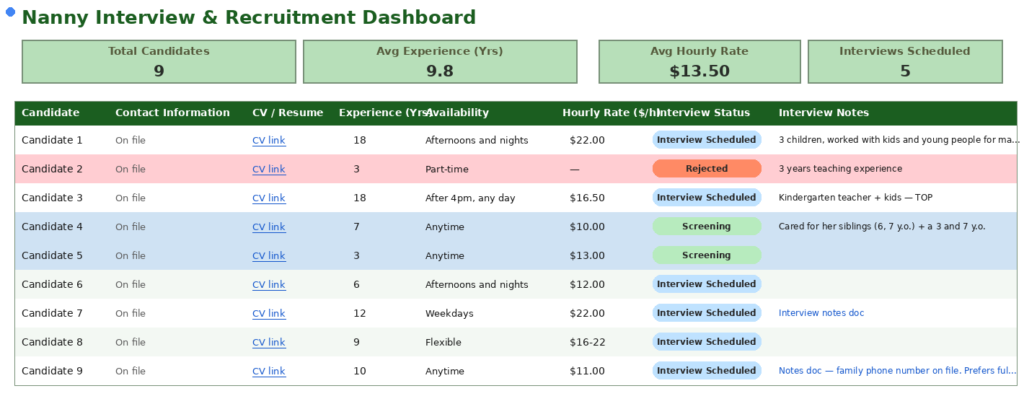
9 candidates sourced, CVs collected, rates compared, availability mapped, notes on every one.
It made the whole decision simple — everything I needed to compare 5 humans, in one view, ready before I ever asked for it.
That’s the difference between someone who completes tasks and someone who owns outcomes.
Now, notice how this actually worked, because it wasn’t a full hands-off dump.
The 10/80/10 Rule
Steve Jobs had a version of this with Jony Ive, his lead designer — the whole partnership is laid out in Walter Isaacson’s biography.
Jobs didn’t design the iPhone. But he didn’t hand Ive a blank page either.
He set the vision at the start — the first 10%. Ive and his team did the actual design — the 80% in the middle. Then Jobs came back at the end and tore it apart until it was perfect — the last 10%.
He was ruthless about that final cut, obsessing over details no customer would ever see.
Call it the 10/80/10.
You own the vision and the final judgment. The right person owns everything in between.
That’s exactly what the nanny hire was.
I sketched the criteria — the first 10. She ran the entire middle — sourcing, vetting, scheduling, the dashboard — the 80. And I kept the last 10: the final interviews and the decision.
Because she’s remote, and she is not going to be the one who decides who watches my child. That part is mine, and it should be.
The point isn’t that a great hire does everything alone.
It’s that a great hire collapses a 10-week swamp down to the 2 pieces that actually require you, and disappears the rest.
What Ownership Looks Like in Practice
Two more from the same week:
- She ran full research on a legal question I needed handled.
- She found a couch for my office — a task so low-priority I would have literally never gotten to it — sent me 5 options, I picked one, and she’s tracking the delivery.
And my favorite.
After a recent move, I assumed I needed to buy a toll responder to legally use the highways.
She did the research and came back with: “You don’t need it unless you’re regularly driving to one particular region. How often are you planning to make that drive?”
Not often.
“Then it’s not worth buying.”
She didn’t hand me research. She handed me the answer, then took the decision off my plate.
That’s Cuban’s stress-reducer in the flesh.
The lemon created stress with every task. This one deletes it.
So here is the real definition, the one no framework will give you.
Delegating to the wrong person feels like a Boomerang. Everything comes back.
Delegating to the right person feels like forgetting. The task leaves your head and either never returns, or returns once as a 90-second decision.
The Label Trap
There’s a popular system for this in Dan Martell’s Buy Back Your Time, probably the biggest book in entrepreneurship and time management right now.
His “Email GPS” has your assistant sort your inbox into a stack of folders:
- Respond
- Review
- Responded
- Waiting On
- Financials / Receipts
- Newsletters
- A folder with your name on it — the only one you actually open
You can follow a system like that if you’ve never delegated email before.
But here’s how I like to think about it:
How would you want your own inbox managed? It shouldn’t be that different from how you would run it yourself.
Back when you ran your own inbox, did you drag every newsletter into a Newsletters folder? Label every receipt?
Of course not. Nobody who actually processes email labels everything.
It probably can’t be exactly the same as when it was just you, but the person should be adapting to you as much as possible — not the other way around.
A Four-Bucket System Built on Trust
Here’s my actual system, refined through one bad Executive Assistant and one great one.
Four buckets: Inbox. Kyle. Complete. And a folder with her name on it.
The inbox is hers. All of it, her responsibility.
Anything that needs me goes into my folder.
When I finish something, it moves to Complete. When I want to pass something back, I drag it into her folder, and it’s gone from my life.
That’s the whole system.
4 buckets instead of seven-plus labels, and it works better, because the work isn’t being done by the folders.
It’s being done by a person I trust with the entire inbox.
Complex systems are what you build when you can’t trust the person.
The stronger the hire, the simpler the system gets.
If your delegation setup keeps sprouting more labels, more checkpoints, more tracking layers, that isn’t process maturity.
That’s scar tissue.
The Short List You Should Actually Keep
Now, some things you should never fully hand off, and pretending otherwise would be lying to you.
Knowing what to keep is half of how to delegate tasks.
Bezos keeps the one-way doors: irreversible, high-consequence decisions.
Musk keeps the core product at the make-or-break moment.
In my world, it’s things like visa and immigration paperwork. A great Executive Assistant can prepare 90% of it, chase the appointments, and tee everything up.
But the signature, and the final review of documents that could wreck my family’s residency if they’re wrong?
That’s mine.
It should be.
This is where the 10/80/10 matters most.
Some tasks aren’t a clean keep-or-delegate. The right move is to keep the bookends — the vision at the front, the final judgment at the back — and give away the middle.
A good hire still needs your taste and your concluding call on the things that matter.
That’s not a failure of delegation. That’s the correct shape of it.
So yes, keep a short list.
- High-stakes
- Irreversible
- Legally-must-be-you
For most Owners, that list is maybe 5 items long.
Now be brutal about everything else you’re holding.
- The client emails only you can answer
- The proposals only you can write
- The follow-ups only you can send
Are those on your list because they’re irreversible? Or are they on your list because you don’t trust anyone on your team to catch them?
Here’s the test.
For each task you “can’t delegate,” ask: If I had someone I trusted completely — the way I trust my own hands — would I still keep this?
If the answer is no, it was never a keep.
It’s a trust problem wearing a “this is important” costume. And a trust problem has exactly one fix, and it isn’t a framework.
How to Delegate Tasks: The Actual Answer
Here’s the answer every listicle is dancing around:
You hire someone worth delegating to. That’s the whole technique for how to delegate tasks.
Get that part right, and delegation stops being a skill you perform. — You hand things off in one sentence, they vanish, and you forget you ever owned them.
Get it wrong, and no framework on Earth will save you. — You’ll Boomerang tasks with a lemon until you give up and take everything back.
Which moves the real question from “how do I delegate” to “how do I find that person” — and that’s a completely different problem.
- It’s sourcing beyond your local pool of three
- It’s screening for the judgment that lets you write someone a $1,000 authorization in week two instead of babysitting them in year two
- It’s testing them on real work before you ever hand over your inbox
That part is what I do all day.
At HireUA, we’ve placed 1,100+ people across 35 countries — Executive Assistants, Operations Managers, Sales roles, developers, the exact seats you keep Boomeranging tasks around because you don’t trust anyone to catch them.
Every candidate is scored against a 100-point rubric before you ever see them, works a paid trial with real deliverables before you commit, and comes with a one-year replacement guarantee.
If we got it wrong, we replace them.
You don’t re-live the lemon.
If you’re tired of being a micromanager against your will, book a call.
Tell us which tasks keep Boomeranging back to your desk, and we’ll find you the person who makes them disappear.
Frequently Asked Questions
What is the Boomerang?
The Boomerang is what a bad delegate does to a task.
You hand it off, and it keeps flying back: questions, guesses you have to catch, decisions that should have been made without you.
The task technically gets finished, but it lands on your desk 5 times on the way, so you did the mental work anyway and managed a person on top of it.
If your tasks Boomerang, you don’t have a process problem.
You have a people problem.
What is a Definition of Done?
A Definition of Done is one pre-agreed sentence that says exactly what “finished” looks like before anyone starts.
Not “book the hotel,” but: “Three separate refundable reservations, certificate used on night one, confirmations on my calendar.”
Most delegation fails because “done” lives only in the Owner’s head. The delegate hits their version of done, the Owner hits the ceiling, and the Boomerang starts.
Write the Definition of Done up front and you kill half the back-and-forth.
The other half is the person.
What is the 10/80/10?
The 10/80/10 is how you delegate the tasks you can’t fully hand off.
You own the first 10% (the vision and the criteria) and the last 10% (the final judgment and the ruthless edit).
The right person owns the 80% in the middle.
Steve Jobs worked this way with Jony Ive: vision at the start, design in the middle, a brutal polish at the end.
Use it whenever a task needs your taste but not your hours.
What is 1-2-1?
1-2-1 is how someone should bring you a problem: one clearly defined problem, 2 viable solutions, and 1 recommendation with the reasoning.
You’ll see 1-3-1 floating around out there (it’s in Dan Martell’s book, though he didn’t invent it).
I prefer 2 options to 3.
In practice, when you force a third option, people pad it — they invent a weak choice to fill the slot, and it clutters the decision.
2 real options plus a confident recommendation is sharper.
But here’s the catch: 1-2-1 only works if the person is good enough to bring you two real options and back the right one.
Same as everything else on this page. It comes back to the person.
How do I decide which tasks to delegate?
It’s the question people actually mean when they ask how to delegate tasks.
Flip it.
Instead of picking tasks to hand off, list the tasks you must keep: irreversible decisions, legally-must-be-you items, and the final 10% on anything that needs your judgment.
For most Owners, that list is about 5 items.
Everything else is delegatable by default, and every task you’re still holding beyond that list is there for one reason — you don’t trust anyone to catch it.
That’s not a sorting problem. That’s a hiring problem.
How do I follow up on delegated tasks without micromanaging?
Set the Definition of Done and a deadline up front, then make status their job, not yours.
The rule I give my team: I should never have to chase you. If something threatens the deadline, you tell me the moment you realize it, not after it’s late.
With the right person, follow-up shrinks to reading a short daily report. If you find yourself building trackers, scheduling check-ins, and chasing updates, you’re not following up.
You’re compensating.
How do I keep track of delegated tasks?
A simple task board, 1 row per task, 5 fields: the task, the deadline, a priority level, the Definition of Done, and notes.
The tool doesn’t matter — a spreadsheet works as well as any project management app, and there are a million of them.
What matters is that every task has an owner and a Definition of Done before it leaves your head, and that updating the board is their job, not yours.
If you’re the one maintaining the tracker, you’ve just invented a new task for yourself and called it delegation.
What if I’m faster at the task than anyone I could delegate to?
At the things you’ve been doing for years? Sure, you probably are.
That’s the wrong comparison, for 3 reasons.
First: the goal isn’t for them to match you.
The goal is for a good hire to be about 80% of your speed within a month — and 80% of your speed while your hour goes to work only you can do is a massive win.
Second: speed math ignores procrastination.
There are tasks I’d theoretically do faster that in practice I’d avoid for 10 weeks.
My Executive Assistant just does them. Her real speed on those is infinite, because mine was zero.
Third: there are things a good hire is flat-out better at.
Organization, for one.
Every assistant should be better than their Founder at staying organized and keeping things intact.
If yours isn’t, that’s a different problem.
What is a lemon hire?
A lemon is a hire you can no longer trust, no matter what they’re working on — named after the used car that breaks down so often you flinch every time you start the engine.
The damage isn’t just their bad output.
It’s what they do to you: you start re-checking everything, keeping the important work, and hovering over the next person too.
One lemon can turn a hands-off Owner into a micromanager for years. The fix is never a better framework for managing the lemon.
It’s replacing the car.
What tasks should you never delegate?
The genuinely short list: irreversible, high-consequence decisions (Bezos’s one-way doors), anything where the law requires you personally (signatures, sworn documents, certain filings), the final call on people — who gets hired, fired, or trusted with your kids — and the last 10% of judgment on work that defines your standards.
Everything else on your “can’t delegate” list is a trust problem wearing a costume.
Be brutal about telling the two apart.
The Bottom Line
Every article about how to delegate tasks is selling you a better throw.
- Grip the task differently
- Release it with clearer instructions
- Follow through with checkpoints
And none of it matters, because the throw was never the problem. A Boomerang comes back no matter how well you throw it.
That’s what it’s built to do.
The billionaires never agreed on a throwing technique. They agreed on something quieter: Build a bench of people worth throwing to, and the technique stops mattering.
- Bezos hands off entire categories of decisions.
- Musk buries himself in one product while trusted operators run five companies.
- Huang runs 60 reports with no one-on-ones.
- Cuban keeps his inbox and delegates his companies.
4 styles, 1 foundation.
I’ve lived both sides of it inside one calendar year.
Same company, same tasks, same me.
One Executive Assistant turned a 5-minute hotel booking into a 3-hour saga. The next one turned a task I’d avoided for weeks into 5 interviews on my calendar and a dashboard I never had to ask for.
Nothing about my delegation skills changed in between.
The person did.
That’s the honest answer to how to delegate tasks, and it has nothing to do with your grip.
So stop practicing your throw.
Fix who’s catching.