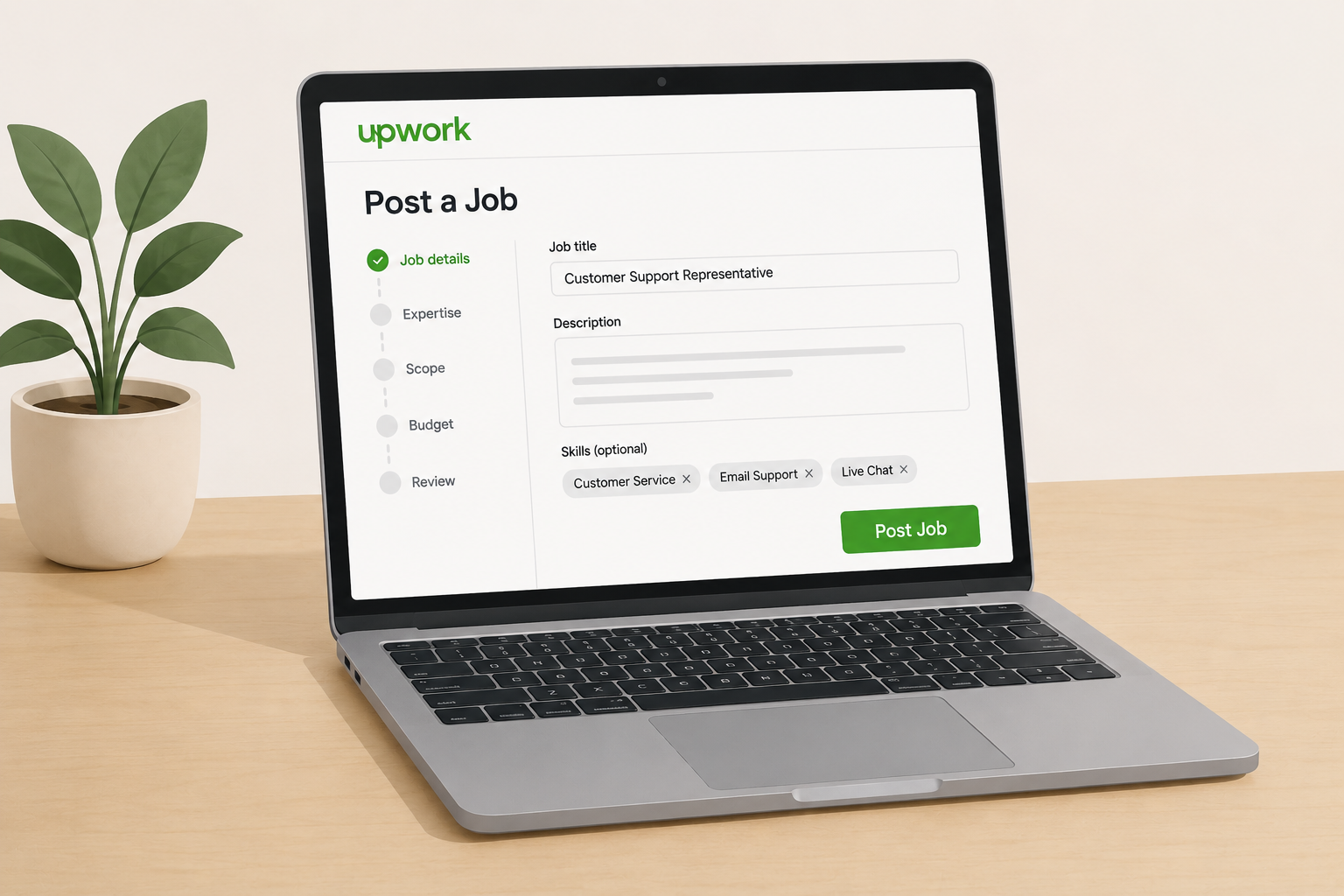

A few weeks ago, I posted an Executive Assistant job on Upwork.
I didn’t need to.
The agency I run has made 1,100+ placements across 35 countries. I have a full recruiting team that does nothing but find people all day.
But I was hiring an assistant for myself, and I got curious.
Upwork is the biggest freelance marketplace on the planet.
It’s the first answer in every “how to find a virtual assistant” article ever written.
Millions of freelancers…
Surely the machine works.
So I ran the experiment.
Generic remote role.
Good pay.
The kind of job post that should get buried in applicants.
20 people applied.
Twenty.
On the largest freelance platform on earth. For a well-paid remote job with no weird requirements.
I interviewed a quarter of them. And I can describe every single call the same way:
I wanted to get off the phone.
- No enthusiasm
- No energy
- No curiosity about the role
They all had other clients they weren’t willing to leave — not even for a few hours a month.
I wasn’t talking to candidates…
I was talking to vendors deciding whether my account was worth adding to their portfolio.
Not one of them made it to a second conversation.
I do this for a living.
I know how to write a job post, I know what good pay looks like, and I still ended up with twenty people I didn’t want.
That should tell you something about the water everyone keeps telling you to fish in.
So let’s talk about how to actually find one.
Not a directory of websites to go post on — you’ve seen those, and the posting was never the hard part.
The actual search: Where the good ones are, how to get them to move, and how to tell them apart from the twenty people who’ll waste your time.
TLDR
- Finding a good Virtual Assistant requires understanding the differences between freelancers and employees; focus on candidates actively seeking full-time roles.
- Choose the right geographical market for hiring: Philippines for admin support, Eastern Europe for communication, Latin America for time zone compatibility.
- Offer competitive pay to attract strong candidates; the difference between mediocre and exceptional candidates often hinges on a few hundred dollars a month.
- Screen candidates effectively to discern genuine talent amidst a sea of AI-generated resumes; focus on their energy and enthusiasm during interviews.
- Consider professional help for hiring; running a solid search takes significant time and expertise, which may be better outsourced.
Table of Contents
- Onboarding Isn’t Your Problem
- Step 1: Pick Your Geography Once, and Pick It Right
- Step 2: Understand Who You’re Actually Looking For
- Step 3: Make an Offer Someone Would Actually Move For
- Step 4: Screen Like You’ve Done This 10,000 Times
- Step 5: Interview for the Thing the Resume Can’t Fake
- The Math Nobody Wants to Say Out Loud
- FAQ
Onboarding Isn’t Your Problem
Before we get anywhere near sourcing, we need to clear something out of the way.
Somewhere along the line, business owners collectively agreed on an explanation for why their Virtual Assistant hires keep failing:
“My onboarding wasn’t good enough.”
You’ll hear it everywhere.
Mention a failed VA hire in any business forum and a chorus shows up to tell you your systems were the problem.
- No SOPs.
- No documentation.
- No structure.
I understand why that lands.
It sounds responsible.
It’s the answer that makes you feel like you have a lever to pull.
But here’s the thing:
Onboarding a Virtual Assistant is a solved problem, and it takes one afternoon.
- Turn on Loom.
- Do the task while you talk through it.
- Do that for your 5 or 6 recurring tasks.
- Feed the transcripts to AI and have it write your SOPs.
Done.
You now have better documentation than most 50-person companies.
That’s the whole mountain people spend months describing as unclimbable.
Which leads somewhere interesting…
If Onboarding Isn’t the Problem, What Is?
If the job can be fully explained in a few Looms and a VA role can, that’s the definition of the role, then what’s actually going wrong?
Two possibilities.
- The tasks aren’t as simple as we just described.
You’re expecting a rocket scientist.
Inbox and calendar on the job post, but what you actually needed was someone who could restructure your operations, make judgment calls on your behalf, and read your mind about priorities you’ve never written down.
That’s not a VA role.
That’s an Operations Manager or an Executive Assistant, and hiring at VA rates for it will fail every time no matter who you hire.
2. The role really is what it says, and you hired the bottom of the barrel.
Three times…
Most of the time it’s the second one.
And you couldn’t have known, because on paper, the bottom of the barrel looks exactly like everyone else.
Either way, the fix isn’t better documentation.
It’s a better search.
Step 1: Pick Your Geography Once, and Pick It Right
I’ve watched business owners burn through 3 countries trying to outrun a problem that wasn’t geographic.
They hire in one region — communication issues.
Switch regions — inconsistency.
Switch again, pay more, and things finally settle.
They credit the third country.
What actually happened is they got lucky on the third random pull after two random failures.
Country selection is a real decision.
It’s just not the decision that keeps killing your hires, and changing countries won’t fix a broken screening process.
It follows you across every border.
So make the geo call once, correctly, and move on:
Philippines: The machine for admin, customer service, and support roles. Deep talent pool, decades of experience serving US businesses, and rates that make full-time support accessible for almost any business.
Eastern Europe and the Balkans: Consistently excellent written English and a work ethic built on rigorous education. When 90% of the job is written communication, this region punches way above what most companies expect.
Latin America: Your time zone. Real-time collaboration, same-day availability, and strong English. If you need someone working while you’re working, start here.
South Africa: Neutral accents, excellent English, and a business culture that reads Western without any translation required. Overlaps European hours and reaches into the US morning. Costs more than the Philippines and earns it for client-facing work.
That’s the short version because I already wrote the long one.
We published a full breakdown of the 13 best countries to hire a Virtual Assistant, with real pricing for every region.
Read it, make your call, come back.
The rest of this article is about what happens after the map is settled. Because the map was never your problem either.
Step 2: Understand Who You’re Actually Looking For
Here’s where every article on this subject sends you off a cliff.
They hand you the list: Upwork, Fiverr, OnlineJobs, Freelancer, and eleven more.
- Pick a platform
- Post a job
- Review applicants
As if the platforms are interchangeable vending machines and talent comes out when you put money in.
Nobody stops to ask the only question that matters:
Who is on the other side of that platform?
On Upwork and Fiverr, the answer is freelancers. And a freelancer is a specific kind of professional running a specific kind of business.
The business model is collecting clients.
5 clients at a few hours each beats one client at 40 hours, because 5 clients means no single point of failure.
If you disappear tomorrow, they lose 20% of their revenue instead of all of it.
That’s not a character flaw.
It’s smart business!
I’d run it the same way.
But understand what it means for you:
You are a line item in their portfolio.
That’s why my twenty Upwork calls felt dead.
Nothing was at stake for anyone on the other end. Nobody was excited, because winning me changed nothing about their life.
Add a client, lose a client.
Employees Think Differently Than Freelancers
Now flip it.
They’re looking.
Not for another client to stack onto 4 others.
For a job.
One job… And when they get it, it changes their month, their year, maybe their family’s situation.
- They show up enthusiastic because it matters
- They respond fast because it matters
- They stay for years, because leaving would mean giving up the thing they went looking for in the first place
And here’s what surprises people:
You want someone who is actively looking.
Everyone’s absorbed this idea from executive recruiting that the best people are never on the market — that real talent is employed, passive, and has to be pried away.
For a $250K Creative Director, sure. You’re fishing in a puddle and every fish in it has three offers.
A Virtual Assistant role is the opposite market…
The pool is enormous, and the strongest candidates in it are actively hunting for a great full-time seat.
- Active means enthusiastic
- Active means responsive
- Active means grateful for a good offer and loyal to the person who made it
The problem was never that good people are looking for work.
The problem is that the platforms you were told to search are full of people who are looking for clients — and you need someone looking for a job.
Same word on the profile.
Opposite species.
Fish where the employees are, not where the vendors are.

Step 3: Make an Offer Someone Would Actually Move For
Now for the part of the search nobody warns you about.
Say you find them — The strong candidate, the one with the great written English and the sharp portfolio and the work history that actually holds together.
There’s a decent chance they’re currently working.
Maybe employed, maybe finishing a contract, maybe fielding 2 other offers, because good candidates in any market are never fielding zero.
If you want someone to move, your offer has to beat what they already have.
Obvious, right?
Except watch what business owners actually do.
They Google “average virtual assistant rate,” find some number, subtract a little because they read that overseas talent is cheap, and lead with that.
Then they’re confused when the only people who say yes are the people nobody else wanted.
Pay is a filter — it filters in both directions.
A bottom-scraping offer doesn’t just fail to attract the top of the pool…
It actively selects for the bottom, because the bottom is the only segment with no better options.
You didn’t get unlucky 3 times.
You built a funnel that only the desperate could pass through.
The Salary Sweet Spot
Here’s the part almost nobody knows:
There’s a number in every market that changes everything.
Average local salaries across much of Eastern Europe and the Balkans run $400–$800 a month.
Pay meaningfully above that line, and you’re no longer posting a job.
You’re one of the most attractive employers that candidate will encounter this year.
Same math exists for the Philippines, for Mexico, for every market we place in. The line just sits in a different place, and the structure of the comp matters as much as the total.
We know where that line is in every country we work in, for every role, because we’ve made 1,100+ placements against it.
It’s one of the main reasons our candidates say yes fast and stay for years.
What I’ll tell you is this:
The difference between a mediocre offer and a magnetic one is usually a few hundred dollars a month.
Most business owners lose extraordinary candidates over less than the cost of their software subscriptions.
Step 4: Screen Like You’ve Done This 10,000 Times
Let’s say you get the sourcing right and the offer right.
Congratulations — now you have a different problem.
Volume.
A well-positioned VA job post doesn’t get 20 applicants.
It gets 500. Or more.
I recently screened 224 applicants for one Operations role in 29 minutes, on a recorded training call, in front of my team.
That pace isn’t showing off.
That pace is the job now.
Because here’s what’s waiting in your pile:
Four hundred resumes that all sound like the same person.
“Results-oriented leader with a proven track record.”
“Self-starter who thrives in fast-paced environments.”
AI writes nearly every resume and cover letter you’ll receive now.
The candidate types a prompt, hits apply on 200 jobs before lunch, and one of those 200 was yours.
Which means the resume tells you almost nothing, and the way most people read resumes tells you less.
I published the full system we use for this:
11 things I check on every resume, most of them in under a second.
- Page count
- Formatting
- What the candidate chose to put in the top third of the page
- The stock phrases that are a small confession every time they appear
If you’re going to run this search yourself, go read it, because screening a 400-resume pile without a system isn’t screening.
It’s scrolling.
The One Test That Actually Matters
But I’ll give you the one check that matters most for a Virtual Assistant, because it’s the one the resume can never show you:
The gap between written English and spoken English.
The application will be flawless.
AI wrote it.
The candidate behind it might be extraordinary… or might not be able to hold a three-minute conversation.
The text physically cannot tell you which one you’re holding.
The only test is a live video call, fast, unscripted — 15 minutes, no script, just a conversation.
The fakers collapse in under 3 minutes.
The real ones sound exactly like their application because they actually wrote it.
Every candidate we send a client has already been through that call.
The mirage never makes it to your inbox.
Step 5: Interview for the Thing the Resume Can’t Fake
I’ve overseen more than 10,000 interviews.
Every role you can imagine… Virtual Assistants, Executive Assistants, Developers, Operations Managers, Bookkeepers. I wrote an entire book on what happens in that room.
And I can tell you the moment I know.
It’s not an answer.
It isn’t the credential, either.
It’s the first 30 seconds, and it’s the energy.
The candidate who wants THIS job — not a client, not a gig, this job — shows up different.
- They’ve researched you.
- They ask about the role before you’ve finished describing it.
- They have questions that could only come from someone who already pictured themselves in the seat.
The conversation has a pulse.
Then there’s the other call.
The one I had twenty of…
- Polite
- Professional
- Flat
You’re being processed, not talked to. They’ll take the work if you offer it, the way they’d take any work, and they’ll leave the same way.
Thirty seconds.
That’s the tell…
A Great Interview Doesn’t Guarantee a Great Hire
Now — one warning, because the failure runs in both directions:
Confidence on a call is also how you get burned.
Some candidates interview like a dream and deliver nothing — Smooth talkers who’ve done a hundred of these calls and know every answer you want to hear.
Interview performance and job performance are cousins, not twins.
So the interview screens for one thing:
Does this person want this job, specifically, with real energy behind it?
Everything else:
- Whether they can actually do the work
- Whether the follow-through matches the talk
- Whether the person you hired is the person who showed up on the call
No interview on earth can tell you that!
Only real work can.
Which is why every placement we make goes through a paid trial with real deliverables before anyone commits to anything.
What goes into that trial, how long it runs, and the kill criteria we set before day one — that system took 1,100 placements to build, and it’s the piece of this I don’t publish.
The Math Nobody Wants to Say Out Loud
So there’s the search:
- Pick the geography once.
- Fish where the employees are.
- Make an offer worth moving for.
- Screen the pile with a system.
- Interview for energy, verify with a trial.
Every step is real.
Every step works.
You could run this yourself.
Now let me tell you what it costs…
- The 400-resume pile takes hours to screen even at professional speed — and you won’t be at professional speed
- The live calls, 15 minutes each across a shortlist of 20
- The scheduling across time zones
- The interviews
- The trial design, the trial review, the offer negotiation
Run honestly, a proper search is 40–60 hours of work.
And here’s the part that stings:
My recruiters do this full-time and place up to 10 people a month.
Each.
You’ll run this process once, maybe twice a year, squeezed between the actual job you were hired to do.
You will be a beginner every single time.
The pile doesn’t care how busy you are…
That’s the real reason 3 VAs failed in three years.
Not the platform.
Not the onboarding.
A beginner ran a professional’s search, 3 times, against 400 AI-written resumes, and picked from the bottom of the barrel without knowing it — because from where a beginner stands, the whole barrel looks the same.
You now know how to run the search properly.
Go do it!
The steps above will put you ahead of 95% of the people hiring right now.
Let Someone Who Does This Every Day Handle It
Or skip the pile.
We find, place, and integrate your Virtual Assistant in 5 days.
You interview a handful of people worth your time instead of 400 who aren’t.
Every candidate is
- Pre-screened through the live call
- Scored through the system
- Backed by a one-year replacement guarantee
If it doesn’t work out, we replace them.
That’s how confident we are in the search.
FAQ
How do I find a good Virtual Assistant?
Stop looking where freelancers collect clients and start looking where employees look for jobs.
A good Virtual Assistant is actively searching for one great full-time role.
Your job is to be findable, make an offer that beats what they have, and screen fast enough to get to them before someone else does.
The search process above covers each step.
How do I find a Virtual Assistant in the Philippines?
The Philippines has the deepest Virtual Assistant talent pool in the world, which is both the good news and the problem:
A single job post can pull 400+ applicants, most with AI-written applications. The screening matters more there than anywhere.
Start with our full breakdown of hiring Filipino Virtual Assistants — it covers the 13th month pay, the cultural context, and the vetting traps specific to that market.
Where can I find a Virtual Assistant for my business?
Depends on what you’re optimizing for.
Philippines for admin and support depth, Eastern Europe for written communication quality, Latin America for time zone overlap.
We broke down all 13 countries with real pricing in our best countries guide. If you’d rather skip the search entirely, that’s what we do — in 5 days.
How much should I pay a Virtual Assistant?
Enough to be the best offer that candidate sees this year.
The exact number depends on country and role, and in every market there’s a line above which you stop being a job post and start being the opportunity.
We help every client build that comp structure as part of the placement — it’s one of the biggest reasons our placements stay for years.